
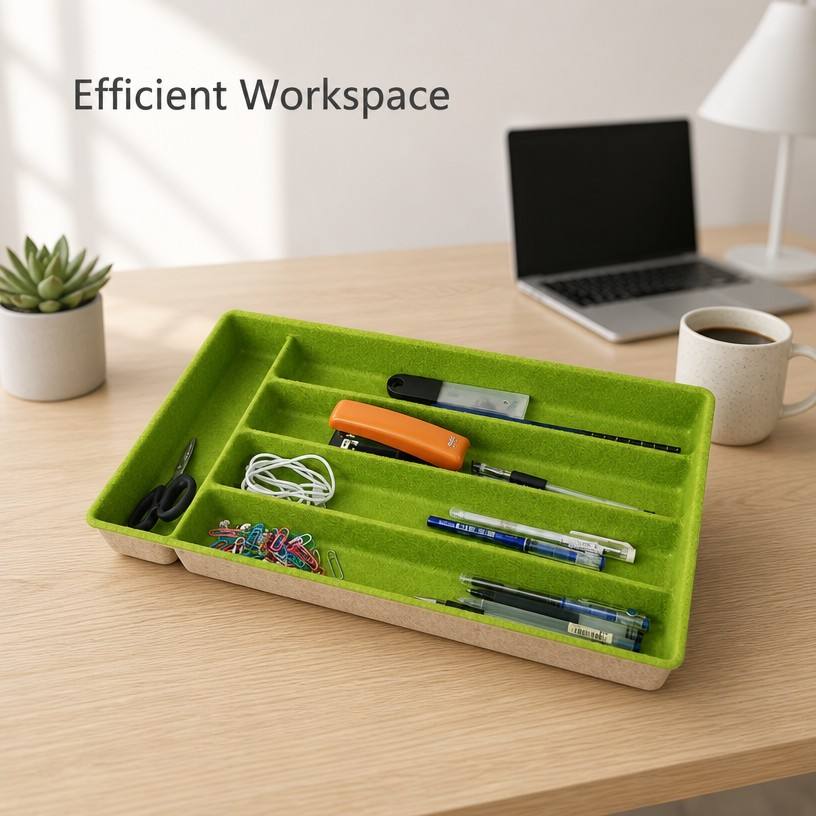


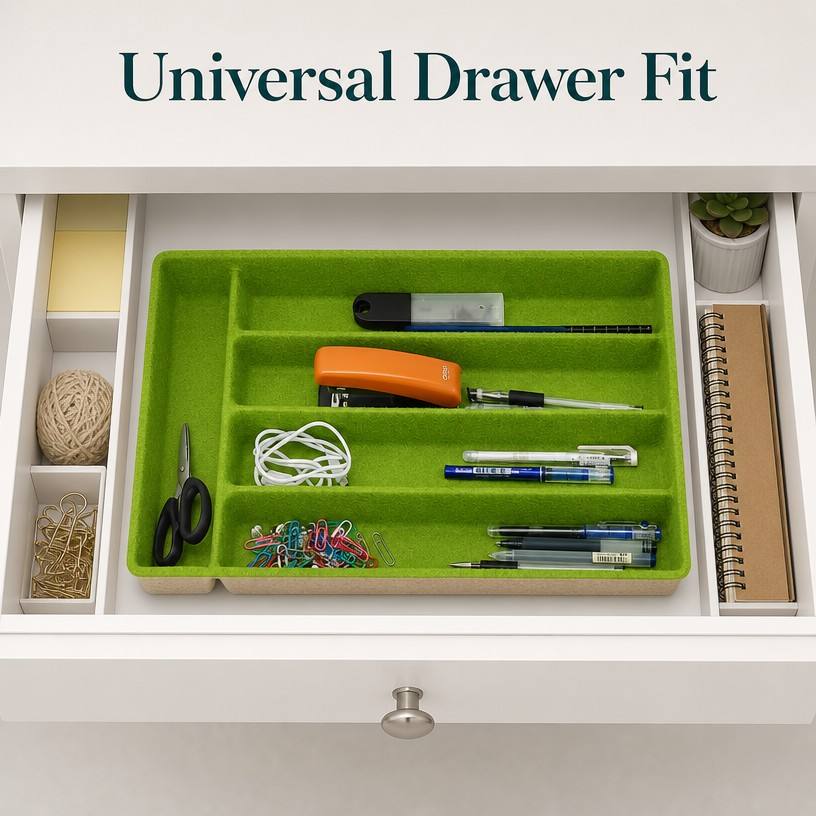
Organizer Tray with Multi Compartments, 45.5 x 24.5 cm Double-Color Drawer Divider for Pens, Stationery and Office Supplies
OEM & Private Label · Drawer Organisation · Tianjin, China
Double-Colour Felt Desk Organizer — 6-Compartment Tray for Cutlery, Stationery & Jewellery
Lime felt on a tan base, soft corners and six divided bays — one tray that moves from kitchen drawer to nightstand to wardrobe shelf.
The two-tone build is the point: the colour face reads as a design decision on an open shelf, while the tan base hides the marks a drawer makes over a year of use.
- 6 compartments
- Double-colour felt
- Soft corners
- No rigid frame
- Custom layout
01 — WHY IT SELLS
Four reasons this tray photographs better than a plastic insert
Drawer organisers are a commodity until someone photographs one properly. These four properties are what make the difference between a listing that scrolls past and one that gets clicked.
The two-tone carries the photo
A saturated colour face against a tan base gives the tray a visible edge line in any lighting — the product reads clearly even as a thumbnail.
Six bays, not one
Cutlery, stationery and accessories each need a different channel depth. Six compartments do the sorting that a single open tray cannot.
Soft corners, no scratches
Bound and rounded at every corner, so it can be dropped into a lacquered drawer or a glass-topped nightstand without leaving a mark.
Silent in use
Felt absorbs the knock of metal cutlery and keys. In a hotel drawer or a bedside table, that is the difference between premium and cheap.
02 — MATERIAL & CONSTRUCTION
Felt face, tan base, partitions stitched through
The colour face is needled felt, dense enough to hold a straight partition wall without a card insert behind it. The tan base is a separate panel, joined at the seam so the tray keeps a flat footprint under load.
Partitions are stitched through both layers rather than glued, which is why the bay walls stay upright after a year of cutlery being dropped between them. There is no adhesive line to soften in a warm container.
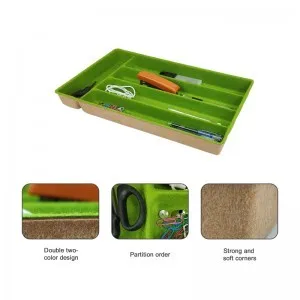
Corners are bound and rounded — the detail the third callout on this page is pointing at, and the one that decides whether the tray scratches what it sits on.
03 — THE PRODUCT
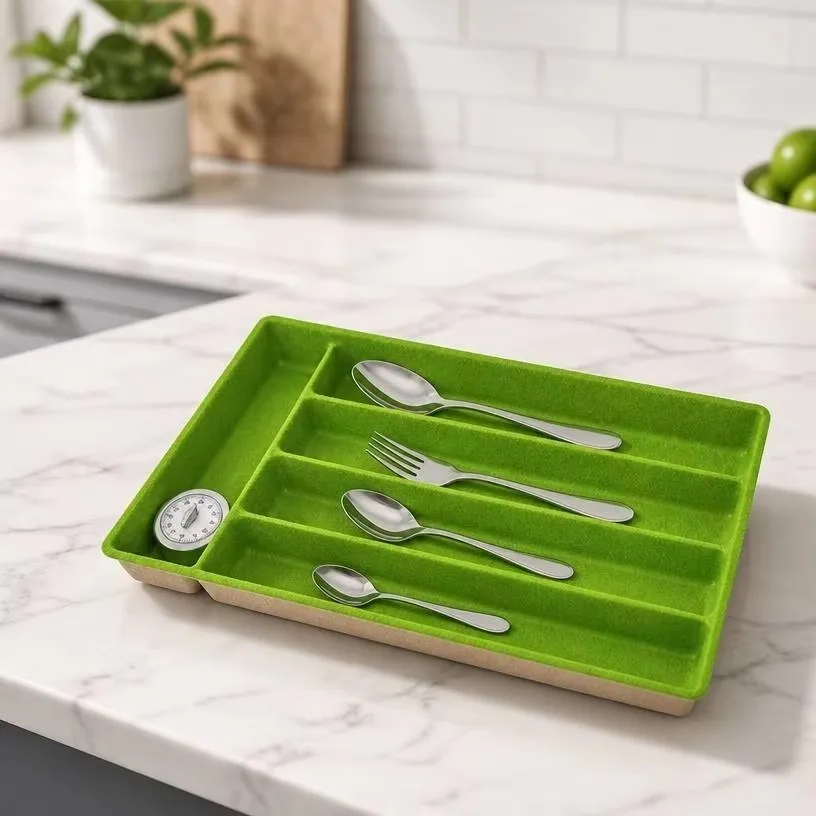
Three rooms, one tray
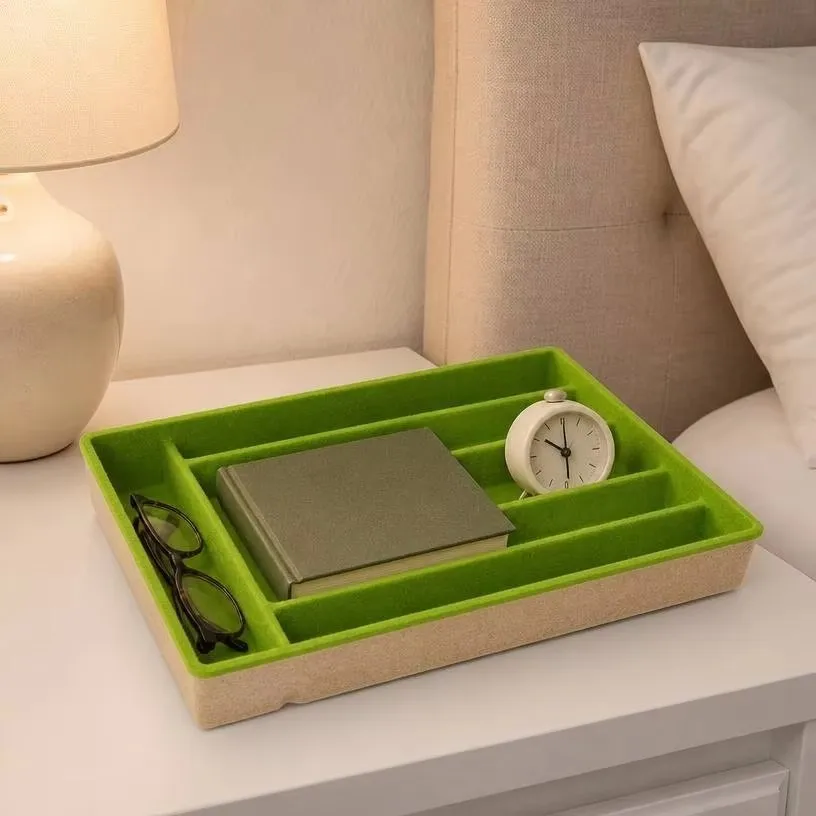
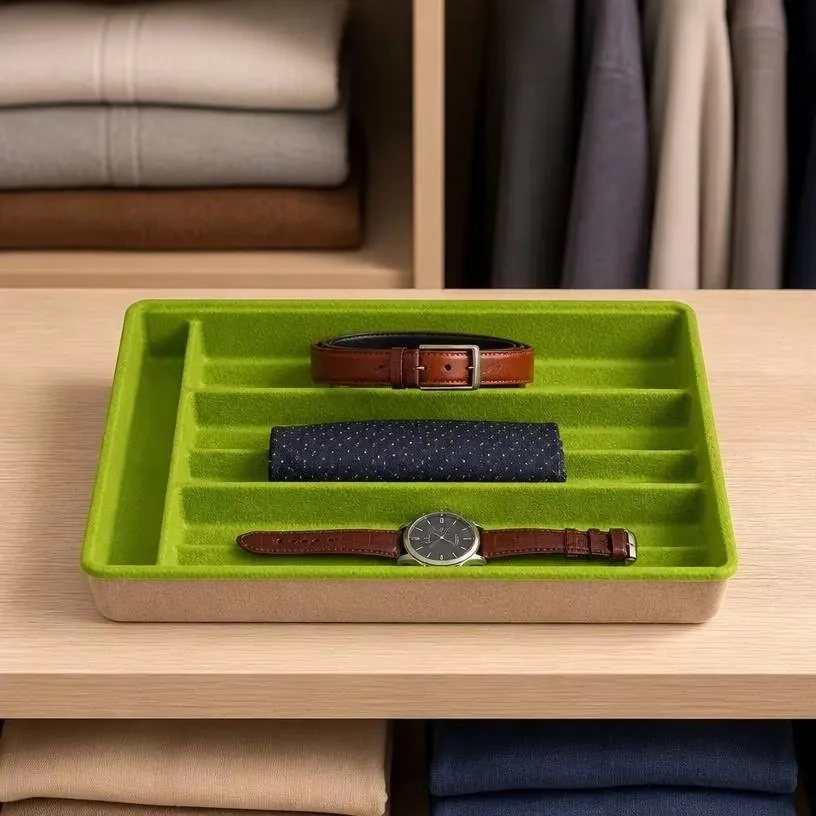
Hover to lift the frame, click to open the full-resolution file. The nightstand and wardrobe shots are what turn a kitchen accessory into a multi-category listing.
04 — FLAT-PACK & OEM
Compresses flat, patterns to your drawer
With no board inside, the tray compresses for storage and stacks in a carton — an argument that matters more than it sounds when a buyer is comparing landed cost per unit across suppliers.
The layout is the variable we can change. Send the internal dimensions of the drawer or shelf you are targeting, plus a rough idea of what goes in each bay, and we return a partition drawing before sampling.
- Layout — bay count, bay width and side column set to your contents
- Size — patterned to your drawer or shelf footprint
- Colour — face and base chosen independently from the 56-shade felt range
- Packing — flat-packed carton, poly bag or printed sleeve
- Branding — woven label, hang tag, barcode, carton mark
05 — SPECIFICATIONS
Ordering data
This tray is patterned per order — send your drawer internal width, depth and height and we return a layout drawing with the bay split marked. Tolerances ±1–2 cm on dimensions apply to soft goods.
| Zone | Quantity | Typical contents |
|---|---|---|
| Side column | 2 short cells | Watch, rings, glasses, small tools |
| Long channels | 4 | Cutlery, pens, brushes, ties |
| Total | 6 compartments | One drawer or one shelf, fully divided |
| Item | Detail |
|---|---|
| Product | Double-colour felt desk organizer tray / drawer partition tray |
| Material | Needle-punched felt face and tan base panel, stitched partitions, no rigid insert |
| Compartments | 6 as standard (2 side cells + 4 long channels); layout adjustable |
| Dimensions | Patterned to your drawer or shelf footprint; drawing issued before sampling |
| Colour | Lime face with tan base as standard; any two shades from the 56-colour felt range |
| Corners | Bound and rounded on all four corners |
| Packing | Flat-packed carton, poly bag or printed sleeve |
| MOQ | 500 pcs per colourway |
| Sample | Free sample for qualified trade buyers |
| Branding | Woven label, printed label, hang tag, barcode, custom carton mark |
06 — WHERE IT GOES
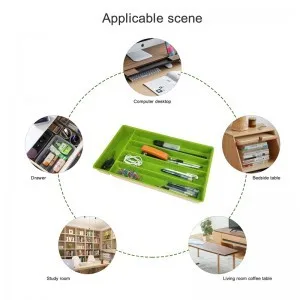
Kitchen first, then five more places
The size and layout are generic enough that one SKU sits in six different retail categories. Naming them in the copy is what lets the page rank beyond the obvious “cutlery tray” term.
Kitchen drawer
Cutlery separated by channel; felt stops the rattle of steel on steel.
Bedside table
Book, glasses, watch and clock each with a place — the tray becomes the table’s surface.
Wardrobe shelf
Belts, ties and watches laid flat instead of coiled in a box.
Desk & study
Pens, clips and small tools sorted by length in the long channels.
Coffee table
Remotes, coasters and reading glasses kept off the surface.
Hotel & hospitality
Guest-room drawers and amenity trays — felt is quieter and lighter than an acrylic insert.
07 — QUESTIONS
What buyers ask before the first order
How many compartments does the standard tray have?
Six — two short cells in a side column, plus four long channels. The side column takes a watch, glasses or small tools; the long channels take cutlery, pens or ties. A different split is a pattern change, quoted at sampling.
Will the partitions stay upright under a full cutlery drawer?
Yes. The partition walls are stitched through both the face and the base rather than glued, so they do not lean after repeated loading. Felt has enough body to hold the wall without a card insert.
Can it be cut to fit our drawer exactly?
That is the usual way we work. Send the internal width, depth and height of the drawer you are targeting and we return a partition drawing before sampling, so there is no gap at the edges.
Does the felt mark or scratch furniture?
No. The corners are bound and rounded and the base is felt, so it can sit directly on lacquered wood, glass or stone. There is no hard plastic edge to catch a surface.
Can the colour face be a different shade?
Yes. Face and base are chosen independently from the 56-shade felt range, or matched to a Pantone reference. A lab dip is approved in writing before bulk production.
How does it pack for export?
Flat, with no rigid insert, so trays stack in a carton and compress slightly under weight without taking a permanent crease. Poly bag, printed sleeve or flat-packed carton are all available.
What is the minimum order and can we start smaller?
500 pieces per colourway is the standard minimum. A smaller trial run can be discussed for a first order so you can test the shelf before committing to a full programme.
How is it cleaned?
Vacuum or brush out crumbs and dust. Spot-clean with a damp cloth and mild soap, then air dry fully. Do not machine wash — the stitched partitions will distort.
Send us your drawer dimensions and bay layout
We will return a partition drawing, unit pricing and a packing plan. Trade buyers receive a free sample before the first production run.


