
Soft Felt Fabric Storage Bin for Nursery Closet Shelves Eco Friendly Durable
OEM & Private Label · Nursery Storage · Tianjin, China
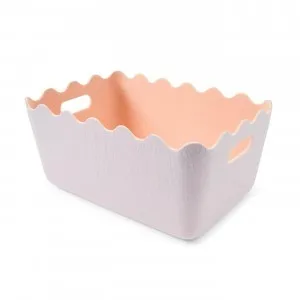
Scalloped Felt Storage Bin for Nursery & Closet Shelves — Soft Two-Tone Basket with Cut-Out Handles
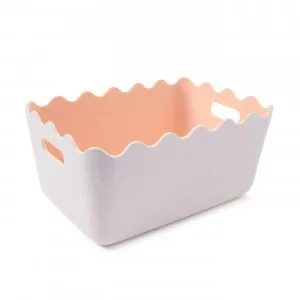
A tapered felt bin with a wavy rim and coral lining — soft enough for a nursery shelf, structured enough to stand open when empty.
The scalloped rim is what separates this from a plain felt tub. It reads as nursery decor on an open shelf, and it hides the fact that the bin is doing the least glamorous job in the room.
- Scalloped rim
- Two-tone lining
- Cut-out handles
- Soft-sided
- Custom colours
01 — WHY IT SELLS
Four details that make it a shelf product, not a utility tub
Nursery storage is bought by someone decorating a room. The bin has to look deliberate from across the room, and still survive being dragged off a shelf by a two-year-old.
The rim is the product
A scalloped edge needs a bound, stitched finish to hold its curve. That single detail is what a buyer sees first in a thumbnail — and what a plain felt tub cannot offer.
Colour where it shows
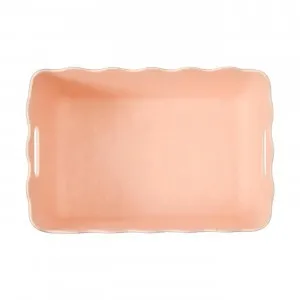
Grey outside, coral inside. Because the lining is visible over the wavy rim, the bin reads as a two-colour object from any angle without needing a print or a label.
Tapered so it sits on a shelf
A narrower base and a wider mouth mean the bin stays stable when loaded but still slips onto a shelf between two others without scraping.
Handles cut, then bound
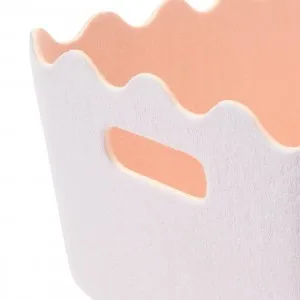
Oval grips on both short sides, cut after the rim is finished so the felt edge stays enclosed. No raw edge to stretch after the hundredth lift.
02 — MATERIAL & CONSTRUCTION
Needled felt, bound scallops, no board inside
The body is needled felt — fibre tangled into a mat rather than woven, so there is no warp or weft to fray when the bin is pulled off a shelf by one handle.
Each scallop on the rim is bound and stitched. That is the labour-intensive part of this design: a wavy edge cannot be finished on a straight binder, so the rim is worked in sections and the curve is set by the stitching rather than by an iron.
There is no card or plastic insert. The bin keeps its shape because the felt is dense, which also means it can be squeezed into a carton without taking a permanent dent.
03 — THE PRODUCT
Four views a buyer will ask for
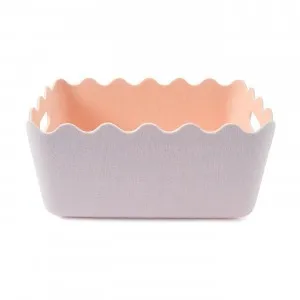
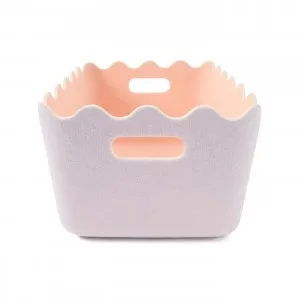
Hover to lift the frame, click to open the full-resolution file. Front, angle and top-down — the top view is the one that shows the lining colour and the interior depth.
04 — CUSTOMISATION & OEM
Forty-two felt shades, and a rim you can change
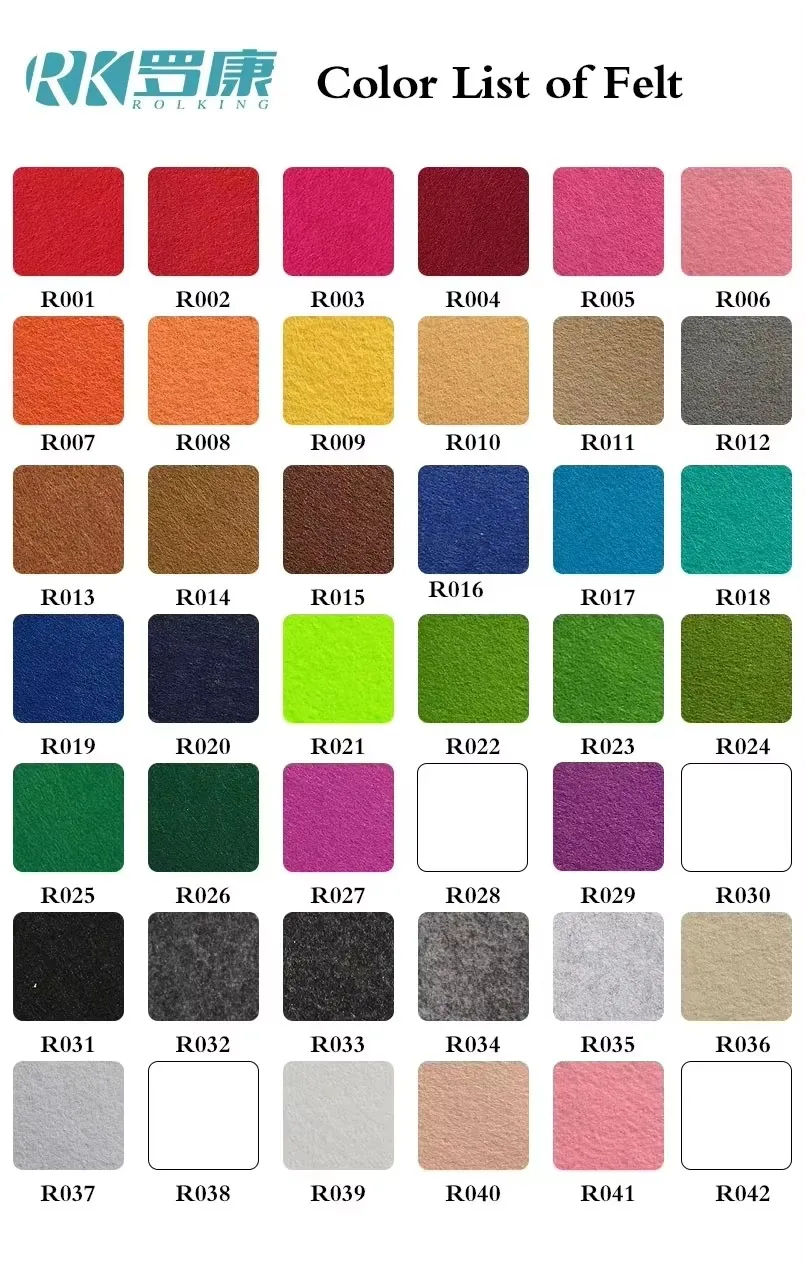
Shell and lining are picked independently, which is how the two-tone effect is built. The 42-shade range on this page is our stock felt library; anything outside it is matched as a custom dye lot.
The scallop size, the taper and the handle shape are all pattern variables. A deeper scallop, a squarer profile or a single-side handle are changes we quote at sampling rather than catalogue items.
- Colour — shell and lining from 42 stock shades or a custom match
- Rim — scallop depth and pitch set to your drawing
- Size — quoted per order; send your shelf width and depth
- Packing — poly bag, printed sleeve or nested carton
- Branding — woven label, hang tag, barcode, carton mark
05 — SPECIFICATIONS
Ordering data
This bin is produced to a shelf or closet footprint rather than a fixed catalogue size. Send the internal width, depth and height you are targeting and we return a cutting drawing before sampling.
| Item | Detail |
|---|---|
| Product | Scalloped felt storage bin / soft felt basket for nursery and closet shelves |
| Shape | Tapered rectangular body, wide mouth, narrower base |
| Rim | Scalloped edge, bound and stitched in sections |
| Handles | Oval cut-outs on both short sides, bound edge |
| Material | Needle-punched felt, no rigid insert |
| Lining | Contrast lining visible over the rim; shell and lining chosen independently |
| Colour | 42 stock felt shades (R001–R042) or custom dye matching |
| Dimensions | Quoted per order against your shelf or closet width, depth and height |
| Packing | Poly bag, printed sleeve or nested carton |
| MOQ | 500 pcs per colourway |
| Sample | Free sample for qualified trade buyers |
06 — WHERE IT GOES
Nursery shelf first, closet second
The same bin is sold as nursery decor and as closet organisation. Naming both is what lets one SKU rank for two different search intents.
Nursery shelf
Muslins, nappies and small toys — the soft rim is safe at cot height, and the lining colour carries the room’s palette.
Closet & wardrobe
Socks, vests and folded baby clothes kept upright on a shelf instead of collapsing into a pile.
Changing table
Wipes, creams and nappies within reach; the tapered base leaves room on a narrow top.
Bathroom shelf
Towels and bath toys; felt will not scratch a painted wall or a tiled skirting.
Playroom
Small-world toys and craft supplies — the open top means children actually put things back.
Gift & hamper retail
Sold filled as a new-baby hamper; the scalloped rim photographs as a gift, not a storage tub.
07 — COMPLIANCE & FACTORY
Audited, certified, and reachable
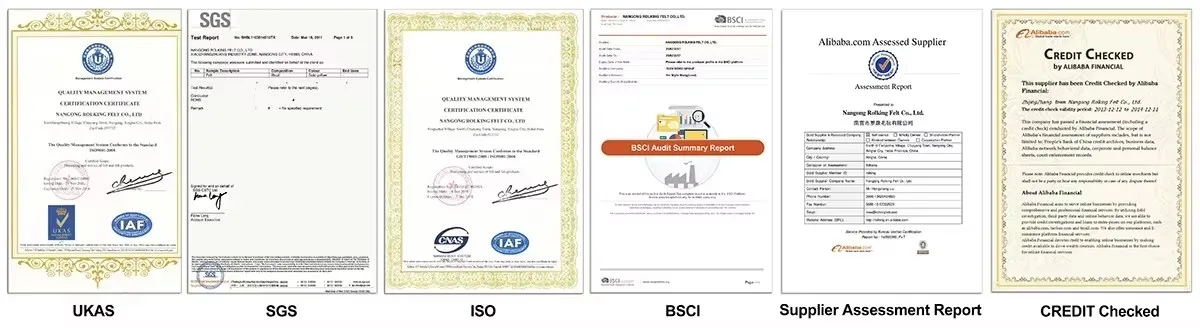
Certificates and third-party audit reports are supplied with quotations on request. The route map is included because most first orders start with a factory visit — Qinghe and Nangong are both served by high-speed rail from Jinan or Shijiazhuang.

08 — QUESTIONS
What buyers ask before the first order
Does the scalloped rim hold its shape?
Yes. Each scallop is bound and stitched, which sets the curve in the felt rather than relying on an ironed fold. It will flex if pressed but returns to the same wave.
Is the bin rigid enough to stand open when empty?
It keeps an open mouth without a board inside. It is a soft-sided bin, so it reads softer than a rigid container — that is the trade-off for it being safe on a nursery shelf and cheap to freight.
Can we choose both the shell and the lining colour?
Yes, independently. The two-tone effect on this page is grey shell with coral lining. Both are picked from the 42 stock shades or matched to a Pantone reference.
What size does it come in?
Size is quoted per order rather than fixed, because these bins are usually bought to fit a specific shelf. Send the internal width, depth and height you are targeting and we return a cutting drawing before sampling.
Will the handles tear under a full load?
No. The oval grips are cut after the rim is bound, so the felt edge stays enclosed rather than exposing a raw cut. The load is carried by the panel around the opening.
Can the scallop size or shape be changed?
Yes. Scallop depth and pitch, the taper angle and the handle shape are pattern variables quoted at sampling. A different scallop needs a new die, which is priced with the sample.
What is the minimum order and can we start smaller?
500 pieces per colourway is the standard minimum. A smaller trial run can be discussed for a first order so you can test the shelf before committing to a full programme.
How is it cleaned?
Vacuum or brush out dust. Spot-clean with a damp cloth and mild soap, then air dry fully before putting it back on a shelf.
Send us your shelf dimensions and colour pairing
We will return a cutting drawing, unit pricing and a sampling timeline. Trade buyers receive a free sample before the first production run.