
Materials & Care · 6 min read
Most Cat Beds Don’t Wear Out.
They Collapse, Trap Odour, or Only Work for One Season.
Four failure modes we kept running into — and the material decisions that remove them.
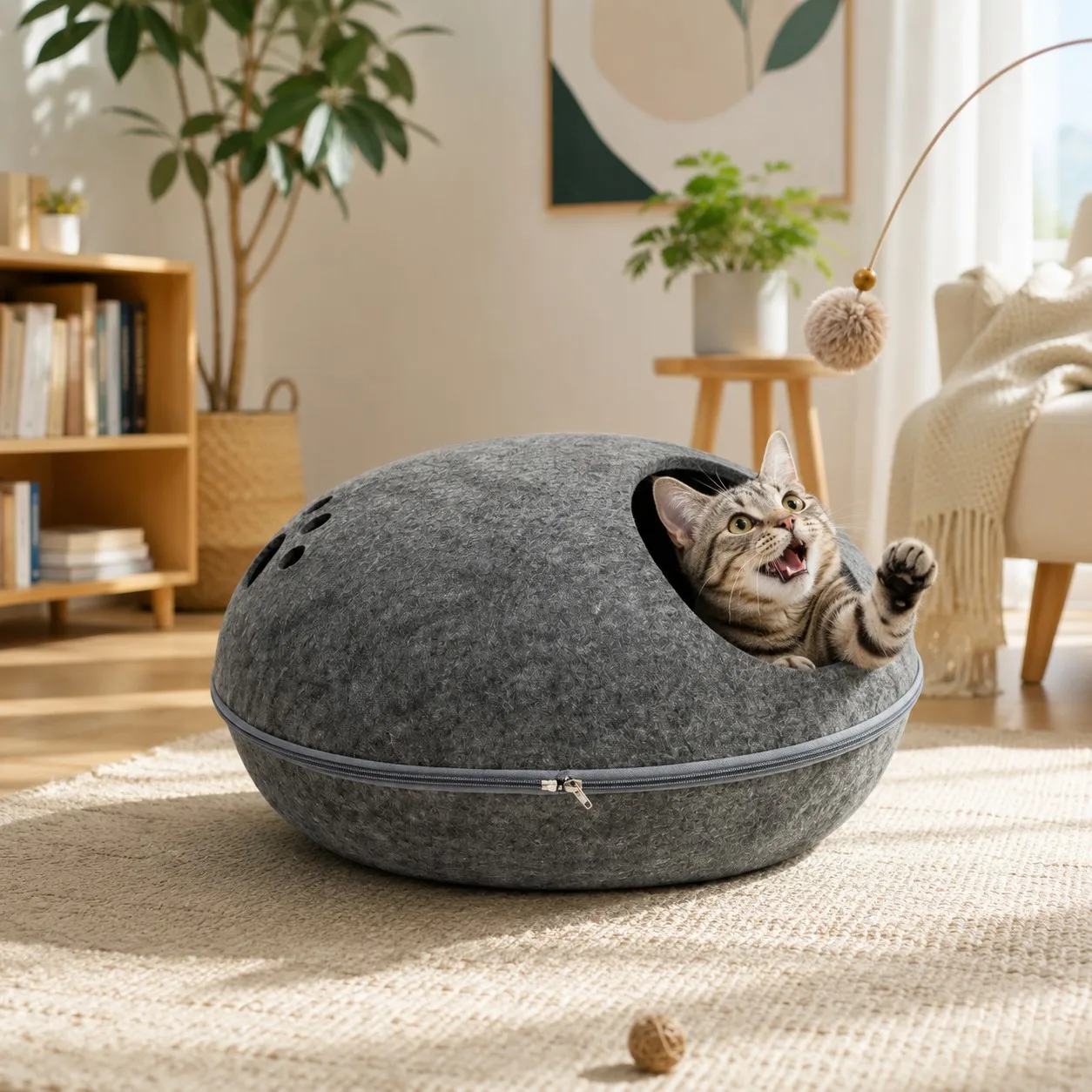
If you have owned more than two cat beds, you have probably noticed that they fail in patterned ways. Not randomly, not by brand — in the same four places, in roughly the same order, usually somewhere between the third and the eighth month.
That pattern is useful. A bed that fails by collapsing was built around a filling. A bed that fails by smell was built as one sealed unit. A bed that fails by season was built in only one shape. Each failure points back to a decision made before the bed ever reached your floor — which means each one can be designed out.
This is what we found when we took apart the beds our own cats had abandoned, and what we changed.
Four ways a cat bed dies
01 · The filling
At month three: the walls have gone soft, and the bed is a mat with a memory of being a bed.
Why: fibre fill and foam compact under a cat’s weight and never spring back. Nothing structural is holding the shape.
02 · The core
At month three: it smells faintly sour even straight out of the wash.
Why: the cover is removable in theory; the filling is not. Dander and skin oil soak into the part you cannot reach.
03 · The surface
At month three: it looks grey and matted, and the lint roller does nothing after the first pass.
Why: loop-pile plush and long synthetic fleece grip hair at the base of the pile, where no brush reaches.
04 · The season
At month three: the cat is sleeping on the tile two metres away, and the bed has become a decorative object until October.
Why: one shape, one configuration. A deep cave is the right answer for about five months of the year.
None of these are quality-control problems. They are design choices that only look fine on the day of purchase, because the day of purchase is the one day the filling is still full, the core is still clean, the pile is still upright and the cat has not yet decided whether it is too warm in there.
Felt is a structural material, not a soft one
Most people read “felt” as “cheap fuzzy fabric”. Pressed felt — the dense, matted kind, not craft felt — is closer to a thin sheet of timber than to fleece: fibres are matted and interlocked until they form a dense sheet that holds a curve on its own. Steam it into a dome and that dome is the structure. There is nothing inside it to flatten, because there is nothing inside it.
Three consequences follow, and all three are the reason this bed does not fail the way the others did:
- Shape is permanent, not maintained. A felted shell does not need to be “plumped” back into shape each week, and there is no foam to degrade quietly underneath the fabric.
- It breathes but does not leak warmth. Felt is dense enough to stop the draught rising off a floor and porous enough to let humid air out of the sleeping space — which is the difference between a cosy cave and a damp one.
- The surface is short and dense. Hair sits on top of felt instead of weaving into it. A rubber glove or a lint roller lifts it in one pass, which is not a small thing when you are the person doing it every week.
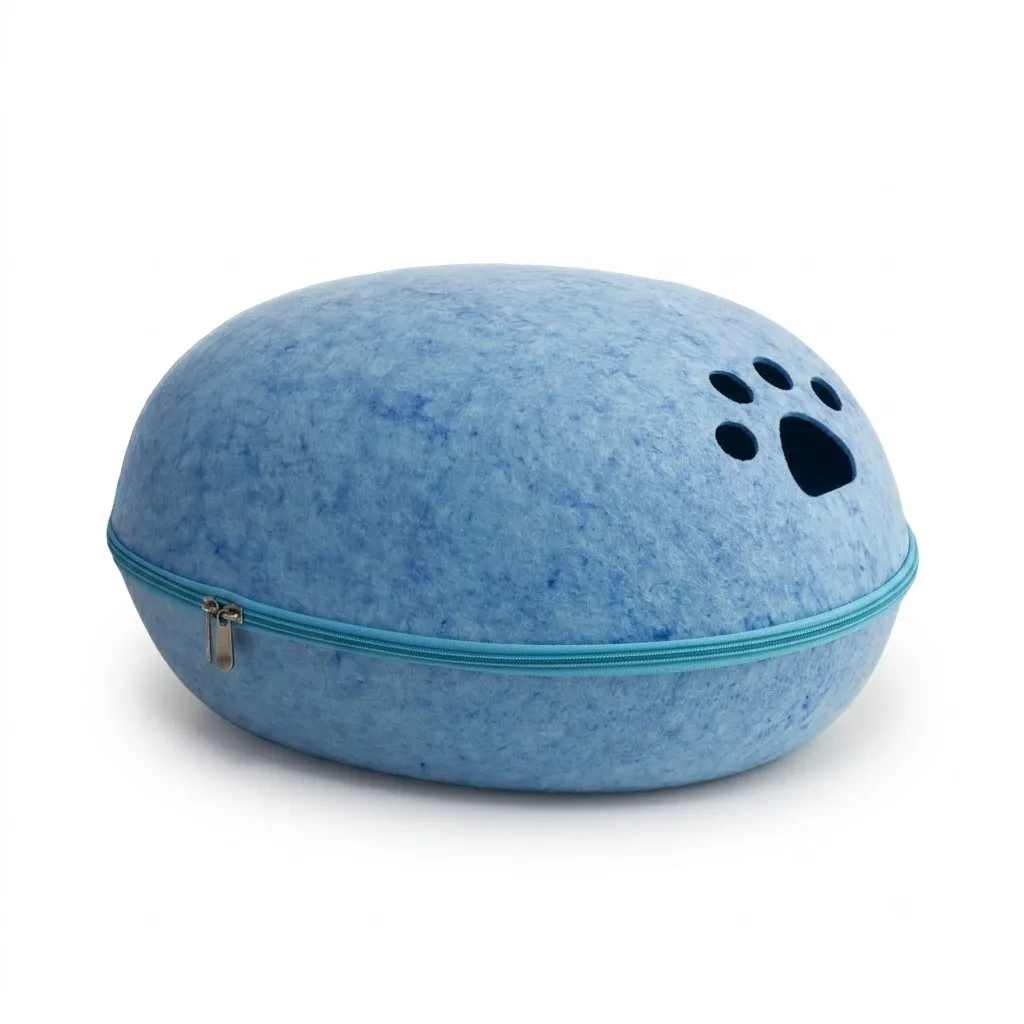
The zip is a maintenance feature — the second shape is a bonus
When a bed is one sealed shell, cleaning is a compromise: you wipe the inside, you vacuum what the nozzle can reach, and the layer that actually holds the smell stays exactly where it was. Cats are not sentimental about that. A bed that smells of last month, to a nose far better than yours, is a bed that gets abandoned in favour of a clean cardboard box.
Unzipping ours around the widest point separates the dome from the shallow base. What that buys you, in order of importance:
- Both surfaces become washable in full. Nothing is trapped between a cover and a core, because there is no core.
- Both halves dry flat. A closed dome holds moisture in the base, which is the worst possible place for it. Opened out, felt dries evenly in a few hours and keeps its shape.
- You can rotate wear. Cats pick a favourite side and work it. Flip the base over, swap which half faces the room, and the bed wears evenly instead of going thin in one spot.
- You get a second configuration. Dome for cold months, bowl for warm ones. In a centrally heated flat this is the difference between a bed used for five months and a bed used all year.
A care routine that takes four minutes a week
Felt does not need much, but it does need the right things. Two mistakes shorten a felt bed faster than any cat: heat, and agitation while wet.
| When | What to do |
|---|---|
| Every day | Shake it out over a bin, then run a rubber glove or lint roller across the seat. Ten seconds, and it removes most of what would otherwise become embedded. |
| Every week | Air it unzipped for half an hour near a window. Spot-clean marks with a damp cloth and a drop of mild soap, then let it dry flat before zipping. |
| Every 1–2 months | Cold, gentle cycle, mild wool detergent, no softener, no bleach. Reshape while damp and dry flat, away from radiators and direct sun. Never tumble dry. |
| Before storage | Wash, dry completely, store unzipped and flat with nothing heavy on top. Felt that goes away damp comes back smelling of the cupboard. |
One thing worth knowing: felt is a matted fibre sheet and will mat further if you wash it warm or agitate it wet. Cold water, low spin, no dryer. Do that and the shape you bought is the shape you keep.
The smell problem was never the fabric
Cat beds rarely smell because the outer fabric is bad. They smell because of what happens underneath it. Cat dander is a protein; skin oil is a fat. Both migrate downward with body heat and pressure, straight into the filling, and once they are in a sealed core no amount of surface cleaning gets them out. You are not cleaning a bed at that point, you are cleaning its wrapper.
Remove the core and the problem stops being structural. There is one layer, it is the same layer on both sides, and it goes in the machine. That is also why we did not line the inside with a removable plush cover: a second layer means a second place for hair and dander to sit, and one more thing to lose in the wash.
Structure, edges and claws
A cat will test a bed before it trusts it: front paws first, weight forward, sometimes a jump onto the roof. Two design decisions matter here more than any others.
The shell carries the load. There is no wire rim to bend and no frame to snap, so a cat landing on top of the dome is standing on felt that was shaped to take it. The roof does not sag inward over the months, which is the failure that quietly turns a cave into a hammock.
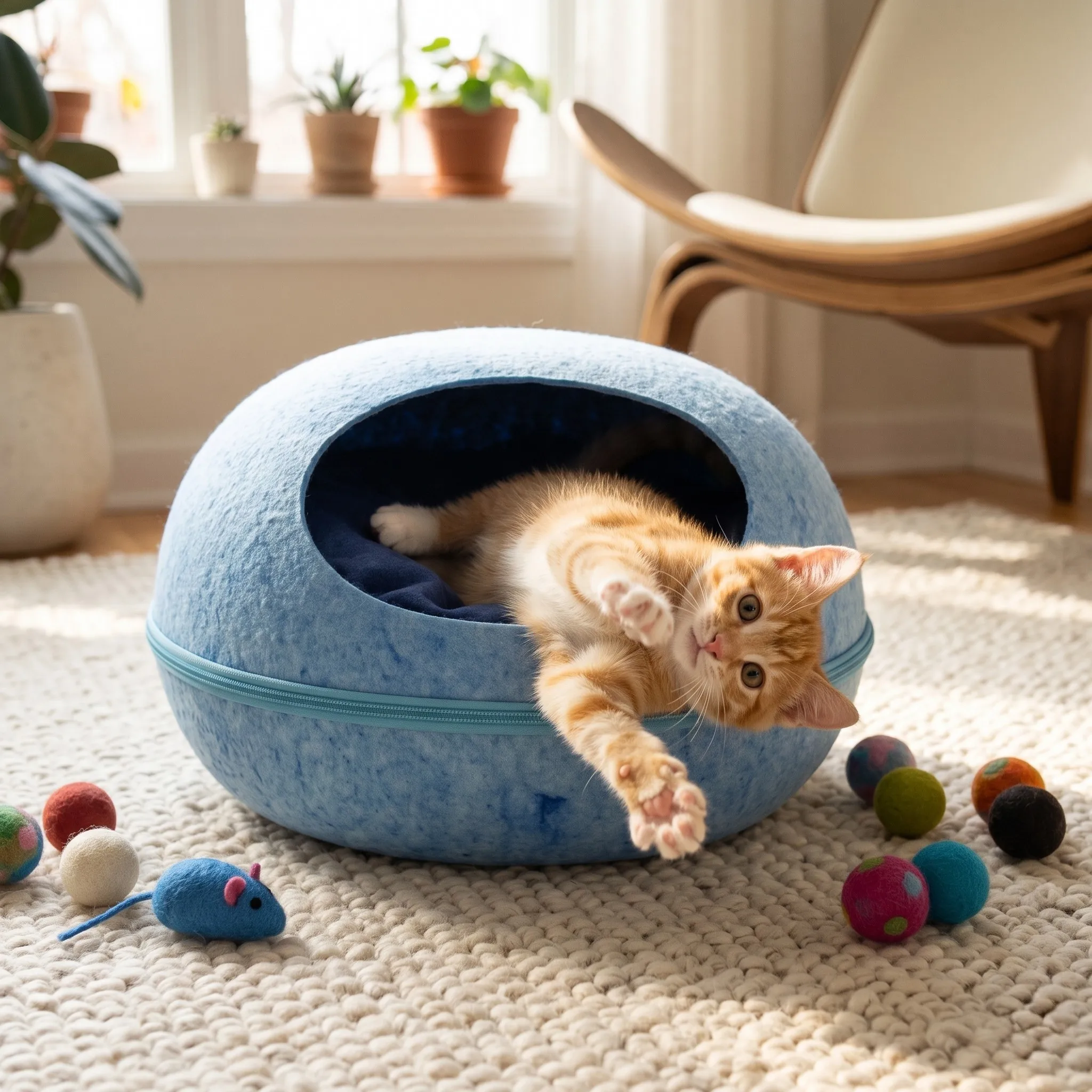
The hardware is out of the way. The zip runs along the outside of the widest seam, well below the opening, so paws and claws meet felt at every point they actually touch. The rim of the opening is thick felt with a soft edge — comfortable to rest a chin on, and nothing rigid behind it to press into a shoulder.
Where felt is the wrong choice
Four honest limits, so you can decide before you buy rather than after:
- A determined chewer. Felt is a soft fibre. Cats who chew fabric should be supervised with any textile bed, this one included.
- Very damp rooms. Felt handles damp air reasonably well, but a bed in a bathroom or an unventilated basement needs airing more often than the routine above.
- Outdoors and garages. This is an indoor bed. It is not waterproof, and it is not built to sit on concrete.
- Very large breeds. A Maine Coon or a big Bengal will be comfortable in the open bowl configuration; the dome is sized for an average domestic cat.
Six checks that apply to any cat bed
We would rather you bought the right bed than our bed, so here is the list we use ourselves, in the order that matters. It works in a shop, on a marketplace listing, and on a bed that costs four times what ours does.
- Is the shell self-supporting? Press down on the wall. If your hand meets filling that stays compressed, it will be a mat within a season.
- Can the whole thing be washed — not just the cover? Look for a zip that separates the structure, not one that removes a pillowcase from a core you cannot clean.
- Does air get in without mesh? Vents cut through the shell beat mesh panels, which tear the first time a cat lands on them.
- Is the opening the right height? Low enough to walk into, high enough that a cat lying down disappears behind the rim.
- Is any hardware where a paw lands? Run a finger around the inside of the opening. If you find a zip, a tag or a stitched seam, so will a claw.
- Is the surface short or long pile? Long pile looks luxurious and holds hair permanently. Short, dense fibre releases it.
A bed should be a piece of furniture your cat uses for years, not a soft object you replace every autumn. Almost every early failure comes down to two questions asked at the wrong moment: what is holding the shape, and what happens to the dirt. Answer those before you buy and the rest — colour, size, price — becomes a much smaller decision.
Ours is a felt shell, one opening, vents through the shoulder, and a zip that opens the whole thing for washing. It is not the cheapest bed you can buy. It is the one we stopped having to replace.
Post time: Nov-06-2026