
Materials & Safety · 7 min read
Is a Soft Felt Toy Safe for a Cat That Chews?
The question is not whether it is soft. It is what comes off it, and what it looks like at month six.
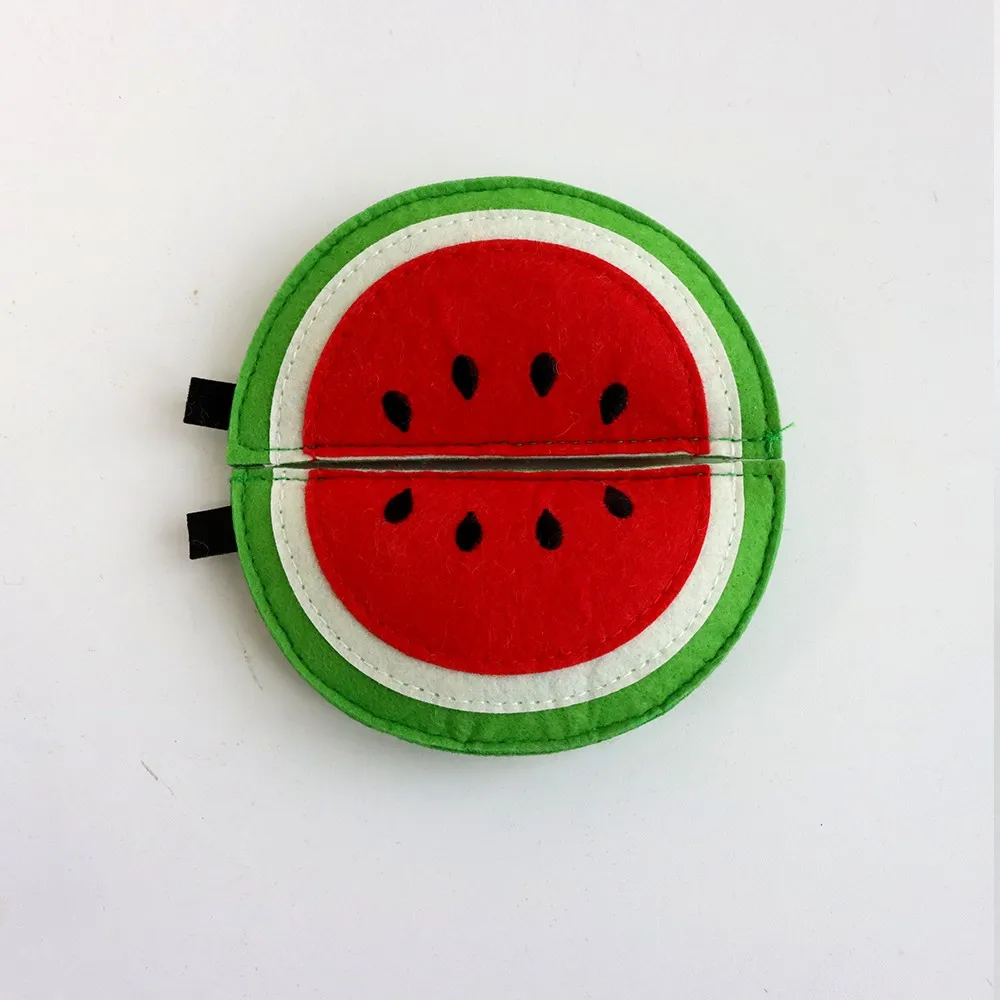
Layered felt, bound edge, double stitching, embroidered seeds. Everything the cat can reach is fabric or thread.
Cat toys are the one category of pet product where the failure is invisible until it has already happened. A bed that sags is obvious. A toy that is quietly shedding fibre into a cat’s mouth is not, which is why the useful question is not “is this soft?” but “what does this break down into?”
Felt is a good answer to that question, provided it is made properly. It is also a bad answer when it is glued, when it is filled with loose wadding, or when someone has stitched a bell to it. Here is how to tell the difference — on ours, and on anything else.
What a chewed toy actually fails on
01
Glued seams
Adhesive fails before thread does, and it fails in flakes. A toy that is glued rather than sewn has a shelf life measured in weeks.
02
Hard parts
Bells, beads, plastic squeakers and glued-on eyes are the classic foreign-body story. A cat bites through fabric far less often than it bites off a decoration.
03
Loose filling
Polyester wadding does not tear — it pulls out in tufts, which is exactly the shape a cat swallows.
04
Dye that moves
A bright toy that bleeds onto a damp cloth is a bright toy that bleeds into saliva. Test it before you hand it over.
The four-point check
Pick up any soft cat toy and run these four checks. They take about thirty seconds and they will eliminate most of what is on a shelf.
| 01 |
Is the edge stitched, or glued? Turn it inside out at the seam. Visible thread with an even stitch length is sewn. A smooth, slightly shiny bead of adhesive is glued — put it back. |
| 02 |
Can a tooth find anything hard? Run a thumbnail along the whole outline. Bells, beads, rigid eyes and plastic inserts should be absent, not “securely attached”. |
| 03 |
Does the surface come away in strands? Rub it firmly against your palm. Short, matted fibre stays put. Long pile or loose wadding lifts, and whatever lifts in your hand lifts in a cat’s mouth too. |
| 04 |
Can it be washed? A toy that cannot be washed becomes a toy that is put away. Wool, cotton and felt tolerate cool hand-washing; anything with a squeaker does not. |
How these two are built
Both toys are layered felt with a bound edge — the rim that runs the whole way around is a folded strip stitched through all the layers, which is why the outline is the firmest part of the toy. That is deliberate. It is the part a cat bites.
The decoration is thread, not hardware. The seeds on the watermelon and the zigzag on the hot dog are embroidered, so there is nothing to work loose; the black tabs at the ends are stitched through the same bound edge, and they exist because a cat needs a piece that behaves differently from the body — something to hook, flick and grab.
There is no squeaker, no bell and no loose filling. The weight comes from the felt itself, layered enough to hold a shape and light enough to be carried. Which is also the reason both survive a washing machine cycle set to cold — and the reason they should never go near a dryer.
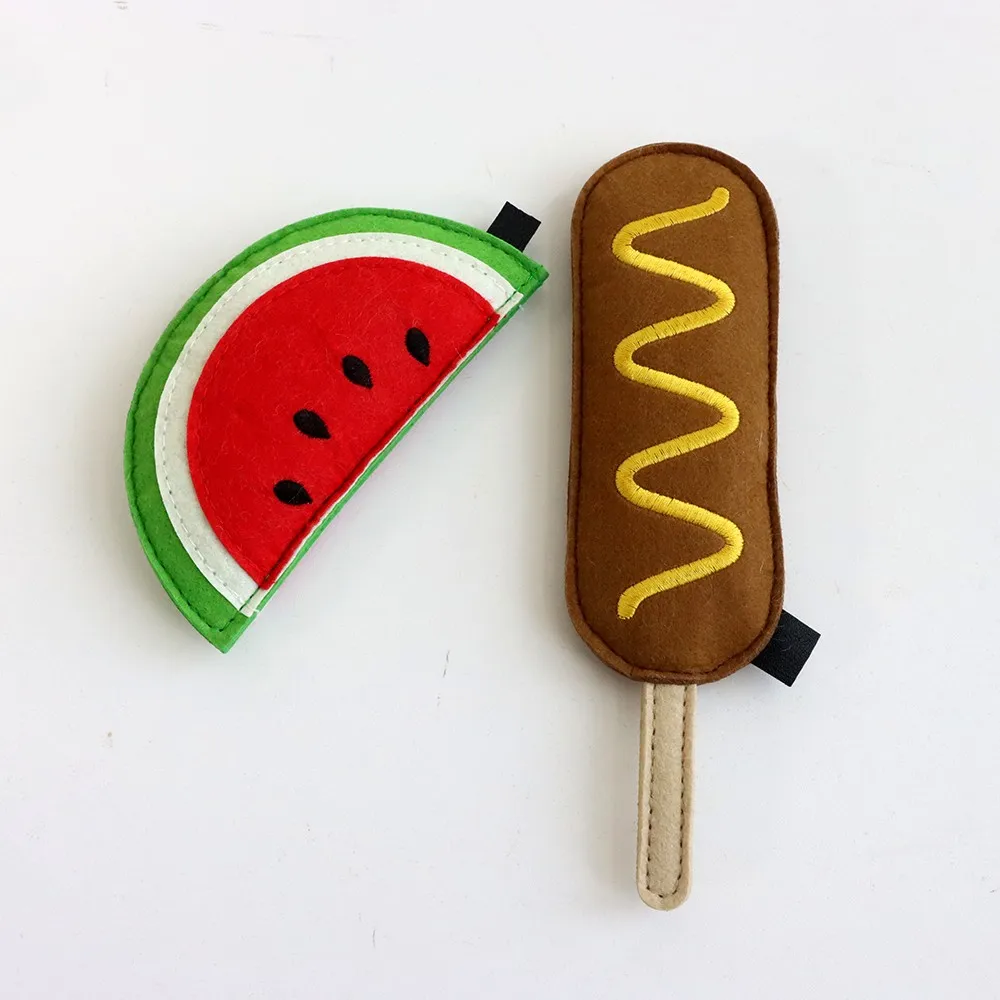
Two shapes, one construction: bound edge, embroidered detail, stitched tabs. Nothing on either toy is attached with adhesive.
What happens at month six
Every soft toy wears, and the wear is predictable. It starts where teeth land: the bound edge softens, the felt fuzzes slightly, and the embroidery begins to look less crisp. None of that is a problem. It becomes a problem at the first hole, because a hole is where a cat starts pulling fibre out instead of biting a surface.
| Stage | What to do |
| Monthly | Squeeze the whole toy, edge to edge. Any soft spot where there was a firm one is the start of a separation. |
| Monthly | Look at the tabs. If a tab is fraying at the stitch line, cut it off — a hanging thread is more attractive to a cat than the toy. |
| At the first hole | Retire it. Felt does not fray into a neat edge; it opens. A toy with a hole is a toy that is being eaten. |
| Every wash | Check the colour on a damp white cloth before it goes back in the basket. Dye that transfers to cloth will transfer to a paw. |
A toy is not safe because it is soft. It is safe because nothing on it can detach, and because you looked at it this month.
Cleaning, without wrecking it
Cool water, a drop of mild soap, and hands rather than a brush. Squeeze the water through the felt instead of scrubbing it, rinse until the water runs clear, then press it between two towels and dry it flat, away from a radiator. Felt that is dried over heat goes stiff and loses the softness that made it worth buying.
If a toy has been in a cat’s mouth for a month, a cold machine cycle in a mesh bag is fine — ours have no rigid parts to damage a drum. Just skip the dryer, and skip the fabric softener, which coats the fibre and makes the surface feel slick to a cat.
When a soft toy is the wrong choice
There is a small group of cats for whom no fabric toy is appropriate, and it is worth naming them plainly.
Cats who eat fabric. Wool-sucking, blanket-chewing and pica are not play behaviours, and a felt toy is the wrong object to offer. This is a conversation with a vet, not a product decision.
Cats who destroy rather than bite. A cat that removes pieces from every toy in minutes should be given rubber, rope or cardboard instead, and supervised with anything soft.
Multi-cat households with a guarder. A toy small enough to carry is a toy small enough to be guarded. Offer two, and put them away between sessions.
For the general question of what is safe to leave with a cat unsupervised, the ASPCA’s cat care guidance is a sensible baseline, and International Cat Care covers enrichment and play behaviour in more depth. If a toy has been partly swallowed, the ASPCA Animal Poison Control Center and your vet are the right first calls, not a search engine.
|
Felt, thread, and a stitched edge — nothing that can come off in a cat’s mouth. See the felt toy set, read our materials and care notes, or compare it with the felt cat cave made from the same cloth. |
Post time: Nov-06-2026