
Acoustics · Surfaces · 7 min read
Your Room Isn’t Noisy. It’s Reflective.
Almost nothing in a modern flat absorbs sound. Plaster, glass, concrete and paint are all mirrors, and your ears are on the receiving end.
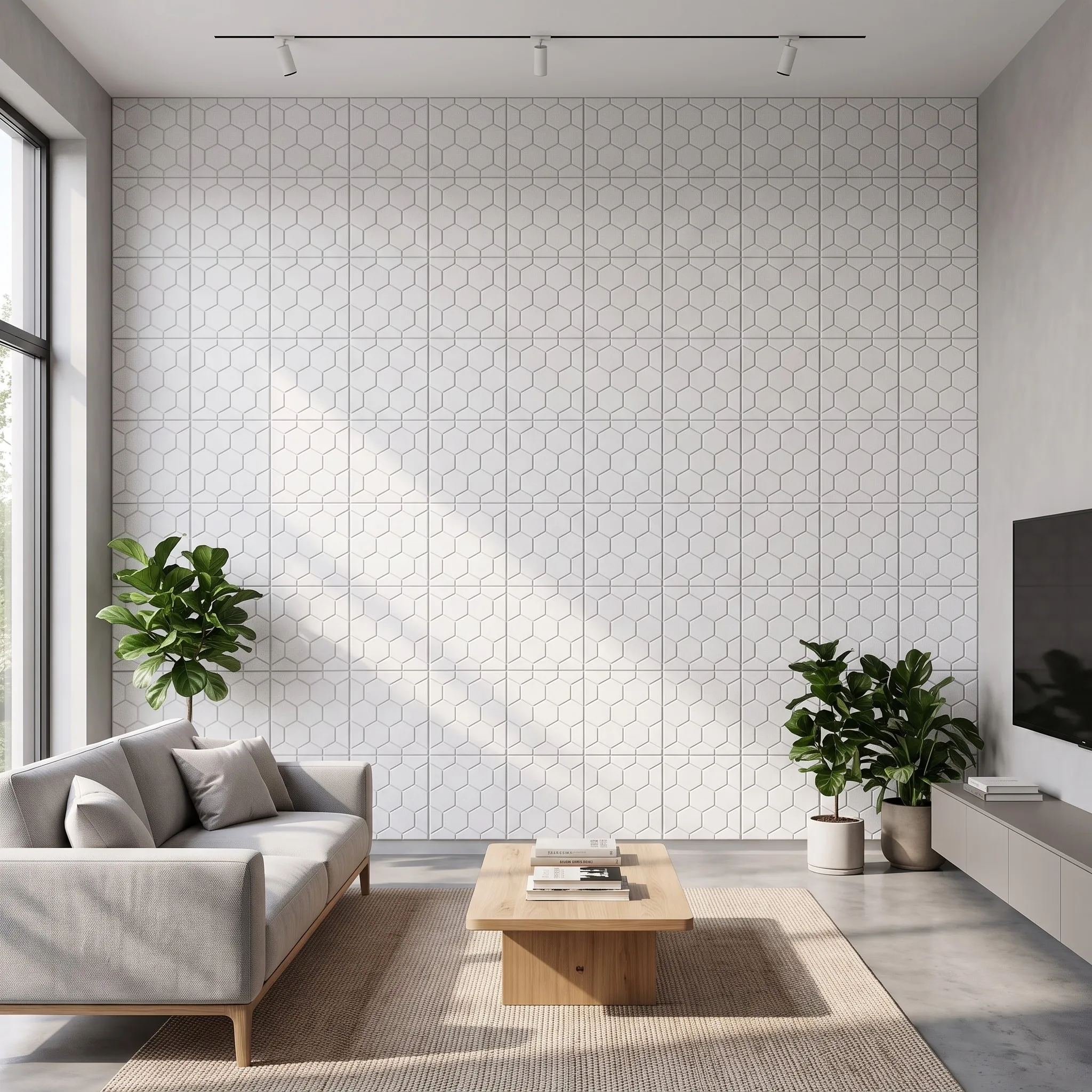
The same room, with one surface changed. Nothing about the building, the street or the neighbours is different.
When people say a room is noisy, they are usually describing something else: a room that keeps talking after the sound has stopped. Clap once in a bare hallway and you hear the clap, then the hallway. That second part is the problem — not a louder sound, a longer one.
Reverberation, without the maths
Sound travels out from a source and hits surfaces. Hard, dense, non-porous materials — plaster, concrete, tile, glass, painted board — reflect most of it straight back. Soft, fibrous, porous materials let the air movement of the sound wave travel into the material, where friction turns it into a tiny amount of heat.
That is the whole mechanism. Absorption is not blocking; it is converting. Which is why an acoustic panel does not need to be heavy or thick in the way a soundproofing wall does — it needs to be porous, and it needs to be where the sound hits.
The measurable version of this is reverberation time: how long a sound takes to decay by 60 dB after it stops. You do not need to measure it to hear it. The clap test tells you whether a room is closer to 0.4 seconds or closer to 1.2, and the difference is the difference between a room that feels calm and a room that feels like a corridor.
Three surfaces, and only one of them is easy
| Surface | Why it stays untreated |
| Floor | A rug is easy and most people already have one. It helps the top end; it rarely does enough on its own. |
| Ceiling | Acoustically the best value. Practically the last thing anyone wants to install in a flat they live in. |
| Wall | The largest bare area in the room, the easiest to reach, and the one facing the people who are talking. This is where the return is. |
That last point matters more than it sounds. Absorption works on the sound that reaches it, so a surface directly opposite the seating or the desk intercepts the first, strongest reflection — the one that makes speech muddy.
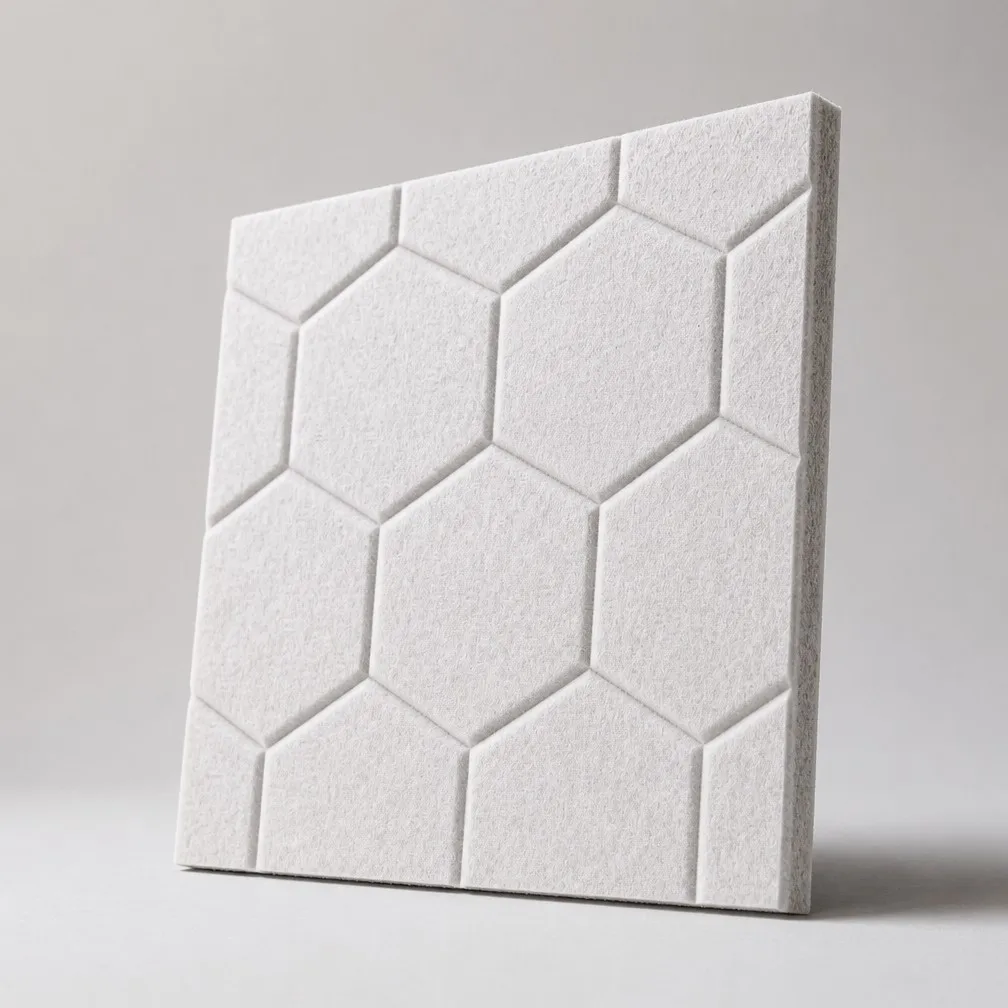
Pressed PET felt, 9 mm, embossed hexagon face. The relief is not only decorative: it keeps the face from reading as a flat tile, which is most of the reason a treated wall still looks like a wall.
Why felt, and why not foam
Cheap acoustic foam does one thing well: it kills the top end. That is why a foam-treated room sounds dead rather than quiet — the hiss and the clatter disappear, and the body of the voice is still bouncing around underneath. It also looks like a recording studio, which is why most people who try it either cover it, or take it down.
Dense PET felt behaves differently. The fibre is matted rather than open-celled, which gives it enough resistance to work further down the frequency range, and enough density to hold a shape on a wall without a frame. It also reads as a finished interior material rather than a treatment — which, bluntly, is the reason these get installed and foam does not.
| Material | Pressed PET felt |
| Module | 30 × 30 cm |
| Thickness | 0.9 cm |
| Absorption | NRC 0.8–0.9 |
| Fixing | Self-adhesive backing |
NRC is a single-number average of absorption across the speech and mid frequencies, on a scale where 0 is a mirror and 1 is an open window. 0.8–0.9 is a genuinely high figure for a panel this thin, and it is a laboratory figure — measured in a reverberation room, on a standard mounting.
Which means: a panel that absorbs 85% of the sound striking it in a lab is not a room that becomes 85% quieter. Coverage, distance, furniture and the particular wall all intervene. Treat the number as a material property, not a room outcome.
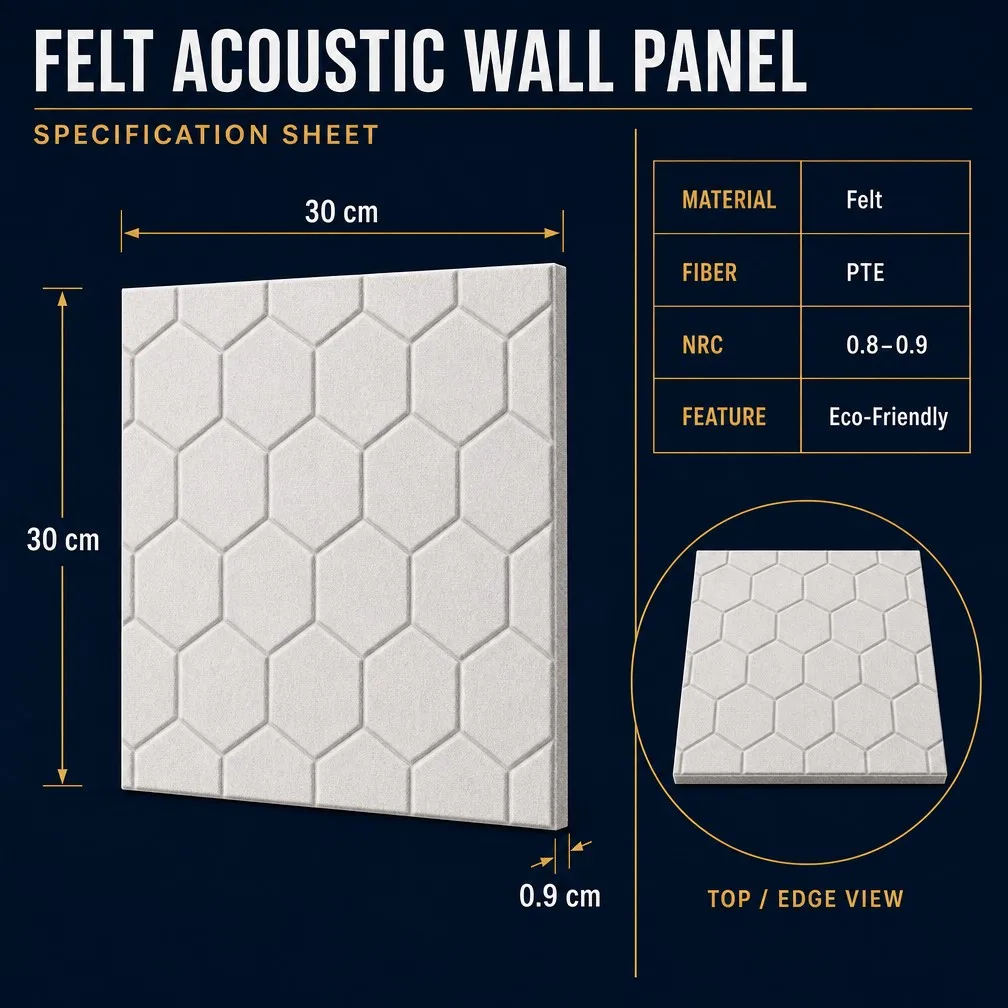
The sheet we publish, including the number we would rather quote with context than on its own.
How much wall, and where
Coverage is the variable that decides whether you hear a difference. A single panel is a decorative object. A cluster over roughly a third of one wall is usually where a normal room stops answering back.
Placement beats quantity. In order of effect:
The wall you face when seated. First reflection, biggest return. Behind the sofa, behind the desk, beside the television.
Two facing surfaces, rather than one dense patch. Reflections arrive from both sides of a room; treating only one leaves the other bouncing.
Corners and the wall behind the speakers, if it is a media room. Low frequencies collect in corners; a double layer there does more than a single layer in the middle.
Installation, honestly
Peel and stick, no tools, about ten seconds per panel once the wall is prepared. The preparation is the part that decides whether it lasts.
| 01 | Clean and dry. Dust, grease and damp are the three reasons adhesive fails. A damp patch behind a panel is worse than no panel. |
| 02 | Let fresh paint cure. Two weeks minimum. Sticking to emulsion that has not fully cured is how a panel removes a rectangle of paint a year later. |
| 03 | Dry-fit first. Keep the backing paper on, lay the grid out, and look at it from the doorway. Panel spacing is a design decision, not an accident of installation. |
| 04 | Press, do not slide. Ten seconds of firm pressure across the face. Sliding a panel shears the adhesive before it has grabbed. |
Absorption is not a barrier. It changes the room you are in, not the sound coming through the wall.
What this will not fix
A neighbour through a shared wall. That is a transmission problem: it needs mass, resilient mounting and sealed perimeters. Panels will make your side calmer and leave the neighbour exactly as audible.
Traffic through single glazing. The glass is the weak element. Nothing applied to the interior wall changes that.
Very low frequencies. A 9 mm panel is not a bass trap. If the complaint is a subwoofer or a lift motor, thinner treatment at the corners will disappoint.
What it does fix is the thing most people are actually describing: a room that returns every sound to them, so that conversation, calls and quiet evenings all take slightly more effort than they should.
Care
Vacuum with a brush head, or lift surface dust with a lint roller. Do not wet clean — PET felt holds water in the fibre and dries unevenly. Do not paint. Keep panels clear of steam and direct radiator heat, which dull the fibre over a season or two.
If a panel has to come down, warm it gently with a hairdryer on low and peel slowly from a top corner, keeping the panel close to the wall as it releases. It is slower, and it is less likely to take paint with it.
|
Nine millimetres of felt, a third of one wall, and the room stops answering back. See the felt acoustic wall panels, read the installation and coverage guide, or compare finishes in our materials notes. |
Post time: Nov-06-2026