
Hospitality · Bulk supply · 8 min read
Damp Mattresses Are a Maintenance Bill, Not a Housekeeping Problem
In a bunk room, the water that ends a mattress never touches the top of it. It forms underneath, on the cold side, where nobody looks until the smell arrives.

The pad does not show. What shows, eventually, is the underside of the mattress it protects.
Every property with slatted beds has, or will have, a mattress whose underside has gone dark. The top looks serviceable. The bottom has a tide mark that follows the slats, a smell that appears when the room has been closed for a week, and a date on the inventory tag that is years earlier than anyone expected.
Housekeeping gets blamed for it, and housekeeping cannot fix it. The mattress is not dirty. It is wet — and it is wet from the inside of the building, not from a guest.
Where the water comes from
A sleeping person releases water vapour continuously, and a room with an ensuite releases more. Warm, moist air sits above the mattress. Below it, the frame is colder — slats near an exterior wall, a steel frame, an unheated space under a bunk. Warm air migrates down through the mattress, meets the cold side, and condenses.
A modern mattress is designed to hold that moisture at the surface it can dry from. When the drying surface is the one facing the floor, it cannot dry. Add a plastic underlay and you have sealed the only route out. The consequence appears in a season or two, and it appears as mould, odour, and a mattress that has to be written off long before its useful life.
| What you see | What it actually is |
| Tide marks on slats | Condensation running along the coldest line in the assembly, which is the timber. |
| Room smells on arrival | A closed room with no air movement, holding the moisture that has accumulated under the beds. |
| Mattress replaced early | The underside failed, not the comfort layer. The visible half was still good. |
| Guest complaint | Usually phrased as “damp” or “musty”, rarely traced back to the frame. |
Four symptoms, one cause. Which is why replacing mattresses without changing the interface under them produces the same result on the same schedule.
Why the plastic underlay is the wrong instrument
Vinyl and polyethylene underlays are specified because they read as protection. Against a spill, they work. Against condensation they are the cause: they block vapour at exactly the plane where vapour is trying to leave, and they do it permanently.
They also fail quietly. They crack at the corners, they crinkle audibly under a guest, and they are the first thing a housekeeper removes when changing a bed because they look unhygienic — a signal that the item is being managed by removal rather than by design.
Waterproofing is a barrier. Condensation needs a route. One product cannot do both, and the underlay is where people keep trying.
What a felt layer changes
Needle-punched felt is an open fibre mat, one solid layer through its full thickness — no film, no foam core, no laminated backer. Laid between mattress and frame, it does three things a plastic sheet cannot.
It lets vapour through. Air and moisture move through the fibre rather than stopping at it, so the underside of the mattress keeps the drying route it lost when the frame was sealed.
It buffers. The fibre holds a small amount of moisture at the surface without reading as wet, and gives it back to the room as the room dries. That is what keeps the interface below the threshold where mould starts.
It breaks the cold bridge. Still air in the fibre means the slat is no longer the coldest surface in the assembly, which removes the condition that produced the condensation.
| Construction | Single needle-punched felt layer |
| Edge | Stitched binding, no loose fibre |
| Sizing | Cut to your dimensions |
| Maintenance | Shake out, air dry, reuse |
| Supply | Bulk, per property or per project |
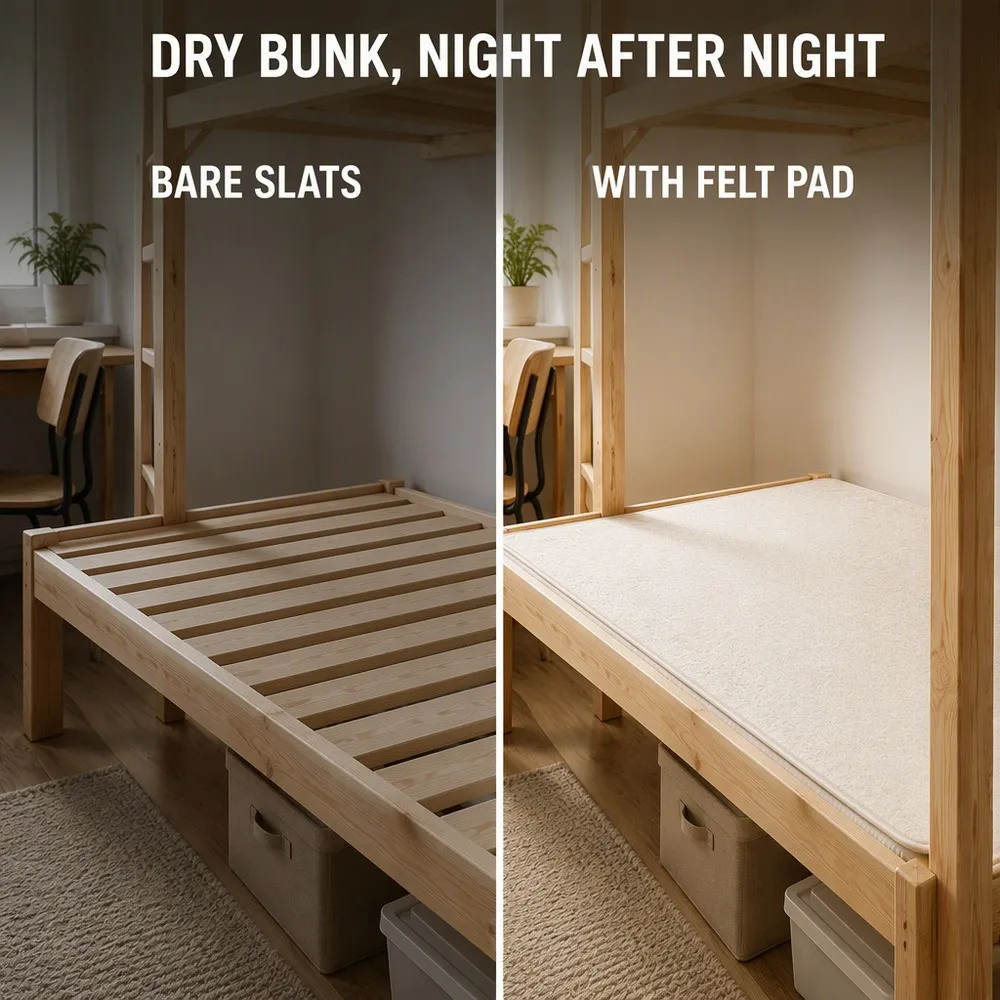
Same frame, same room, same night. The only difference is whether the space under the mattress can breathe.
Procurement notes
Sizing. Bunk frames, cabin beds and dormitory furniture are rarely standard. Because the felt cuts cleanly with a stitched edge and does not fray, you can specify by frame rather than by mattress — measure the slat area, add a 30–50 mm margin at each edge, and order to that dimension. For a rollout across mixed stock, order oversize and trim on site.
Slat spacing. A denser felt bridges gaps up to a typical bunk slat spacing without sagging into them. On wide gaps, specify the heavier build rather than doubling a light one; two layers trap air between them and defeat the point.
Wastage. Order 5–8% above bed count for trimming and rotation stock. Pads get lost between properties, and a single missing pad puts a bare mattress back into service.
Documentation. Ask us for the current composition and test documentation for your file. We would rather you specify on evidence than on a brochure, and we will tell you plainly which tests we do and do not hold.
The housekeeping cycle it adds
| When | Action |
| Turnover | Lift, shake out, replace. Ten seconds, no tools, no fitting. |
| Weekly | Air the pad while the room is being serviced — stand it against a wall, not folded on the bed. |
| Deep clean | Rotate pads between beds and inspect the slats underneath. The slat tells you what the pad is doing. |
| Seasonally | Spot clean with a damp cloth, air dry flat. Never tumble dry — heat mats the fibre permanently. |
This is the part operations teams ask about first, and the honest answer is that it adds less time than a mattress replacement schedule does. It is one more item to lift and drop.
What it does not do
It is not a waterproof mattress protector. A spill passes through. Keep the existing protector for liquids, and put the felt between mattress and frame.
It is not a ventilation system. If a room has no extract, no window opening and a bathroom door that stays shut, the moisture load is a building problem. The pad manages the interface; it does not remove the water from the air.
It is not a compliance shortcut. Do not substitute it for a specified fire barrier or contract mattress specification. Where a certificate is required, ask for ours in writing.
A ten-bed pilot, if you want proof first
Pick the ten worst beds — the ones nearest an exterior wall, or in rooms that smell on arrival. Photograph and date the underside of each mattress. Fit pads for one season, then photograph again at the same angle.
Judge it on four things: the underside of the mattress, the slats, the arrival smell in a closed room, and whether the pads survived housekeeping intact. That is a defensible basis for a property-wide order, and it costs less than one replacement mattress.
|
One layer under the mattress, and the underside stops being the part that fails. See the felt moisture pad, request bulk samples, or read the housekeeping and sizing guide. |
Post time: Nov-06-2026