
Tote Bags · Material and Failure Guide
Felt Tote Bags vs Ordinary Totes: What Fails First?
Almost every tote in the market is sold on its printed face and dies at the same three points. Here is what actually breaks, what felt changes, and what felt still cannot do — written so that the next spec sheet you send a supplier asks the right questions.

Where ordinary tote bags fail
Most tote bags are returned for a joint failure, not a fabric failure. The body is usually still intact when the bag stops being usable, which is why buying a heavier fabric so often fails to fix the problem.
- The handle attachment gives way first. A handle is a lever. Every kilogram in the bag becomes a pull concentrated at two small stitch patches. Sew the handle straight onto the body with one row of stitching and the load transfers into the fabric, so the fabric tears before the thread does. A box-X stitch backed by a reinforcement patch moves that load somewhere else.
- The bottom corners split. The base carries the whole load on a line of stitches. When a plain seam lets go it lets go at a corner, and the bag opens the way a paper bag opens.
- The cut edge is a permanent weak point. Woven fabric unravels, so every raw edge has to be hemmed, overlocked or bound. That doubled band is stiffer than the body, and it is the first place abrasion shows.
- The coating peels from the edge inward. On laminated non-woven and coated canvas, the film lifts at a folded or cut edge and then peels in a sheet. The fabric underneath is still sound; the surface is what the customer sees.
- The print cracks on the fold line. Plastisol and heat-transfer films fail along creases. A bag folded flat for shipping and folded again by the customer has a scheduled failure point built into it.
- The bag slumps. Nothing has broken, but a soft bag collapses when it is set down. Retail displays of slumped bags sell worse than the same bags standing up, and a customer loading one needs both hands.
1
1
3
4
2
2
PRINTED FACE
Three of those six failures are construction decisions rather than material decisions. That is why an expensive canvas bag and a cheap canvas bag can fail in the same place, and why upgrading the fabric rarely fixes a bag that was built badly.
Six tote types, and where each one stops
Every material in the promotional and retail tote market is a trade, and each trade has a known failure mode. Buyers usually choose on price and print quality; the failure mode turns up a season later, at the stage where nobody is comparing quotes any more.
| Type | What it does well | How it usually fails | Best fit |
|---|---|---|---|
| Cotton canvas | Takes print beautifully, soft hand, familiar to buyers | Handle tears through the body; cut edges fray; stains and shrinks | Retail merchandise with light loads |
| Non-woven PP | Lowest unit cost, holds a shape, accepts film print | Handle peels off the body; print film lifts; reads as disposable | High-volume giveaway |
| Coated or laminated paper | Crisp, premium on the shelf, cheap to print | Creases permanently, delaminates at folds, no water resistance | Boutique packaging |
| Jute | Fibre story, stiff, strong public image | Sheds fibre onto clothing, heavy, rough, limited print detail | Grocery and eco positioning |
| RPET oxford or nylon | Strong, light, water resistant, packs down small | Sporty sheen, rustles, no structure, reads as a promo bag | Travel and functional use |
| PU leather | Structured, premium, easy to wipe | Surface peels after a couple of seasons; heavy; stiff in cold | Corporate gifting |
Felt is not on that list because it is not a like-for-like substitute for any of them. It is the only material in the group that is a mat rather than a cloth, and that single difference is where the next section starts.
What felt is, and what it is not
Felt is a nonwoven: the fibres are bonded by mechanical entanglement rather than by weaving yarn, so there is no warp, no weft and no grain direction. The Association of the Nonwoven Fabrics Industry defines these materials as sheet structures bonded by entangling fibre or filaments, made without weaving or knitting.
For bags, the relevant process is needle punching. Barbed needles push tufts of fibre down through the web and back up again, thousands of times per metre, until the mat is dense enough to hold together on its own. More passes mean a denser, stiffer mat from the same fibre. Nothing is glued into a woven scaffold, because there is no scaffold.
Two families end up in tote production, and they are not interchangeable. Needle-punched PET felt — usually made from recycled polyester — is the volume material: dense, dimensionally stable, colour-fast, machine washable. Wool felt is softer, denser, costs more, and behaves differently in washing. PET felt is also vegan; wool felt is not. If either point is part of your brand promise, it decides the fibre before any other decision is made.
What felt is not: it is not leather, not canvas, not foam, and not a coated fabric unless someone has laminated a film to the back. The stiffness in a felt bag comes from fibre density and thickness rather than from a hidden stiffener, which is why thickness and weight have to be quoted as two separate numbers. Millimetres tell you how the bag will stand; grams per square metre tell you what it will weigh and cost. The same thickness at two densities gives two different bags.
Woven: yarns cross
every raw edge unravels
so it must be hemmed, bound or overlocked
Needle-punched felt: fibres entangle
the cut edge is a finished edge
no hem, no overlock, no raw seam to fail
Same cut line, two different outcomes. This is the most useful difference between felt and every woven tote material.
Schematic, not to scale.
Four things felt does that woven fabric cannot
Felt behaves like a sheet with memory, and most of its commercial advantages follow from that rather than from any coating or finish.
- It stands up. At bag thickness a needle-punched mat has enough bending stiffness to hold an open mouth. That matters in three places at once: one-handed loading at the till, packing in a warehouse, and a retail display where the bag has to look full while it is empty.
- The cut edge is already finished. Cutting felt does not start a fraying line, so an edge can stay raw, be die-cut to a profile, or be pressed flat. One less seam means one less failure point — and a silhouette that a hem would have spoiled.
- There is no grain direction. Parts can be nested in any orientation, which reduces waste on small components such as handles, pockets and dividers, and removes an entire class of cutting error on a busy line.
- The colour is the fibre’s colour. Felt is dyed at fibre stage, so a scuff or a fresh cut shows the same colour instead of a white core. That is the difference between a felt bag and a coated or printed bag after six months of use.
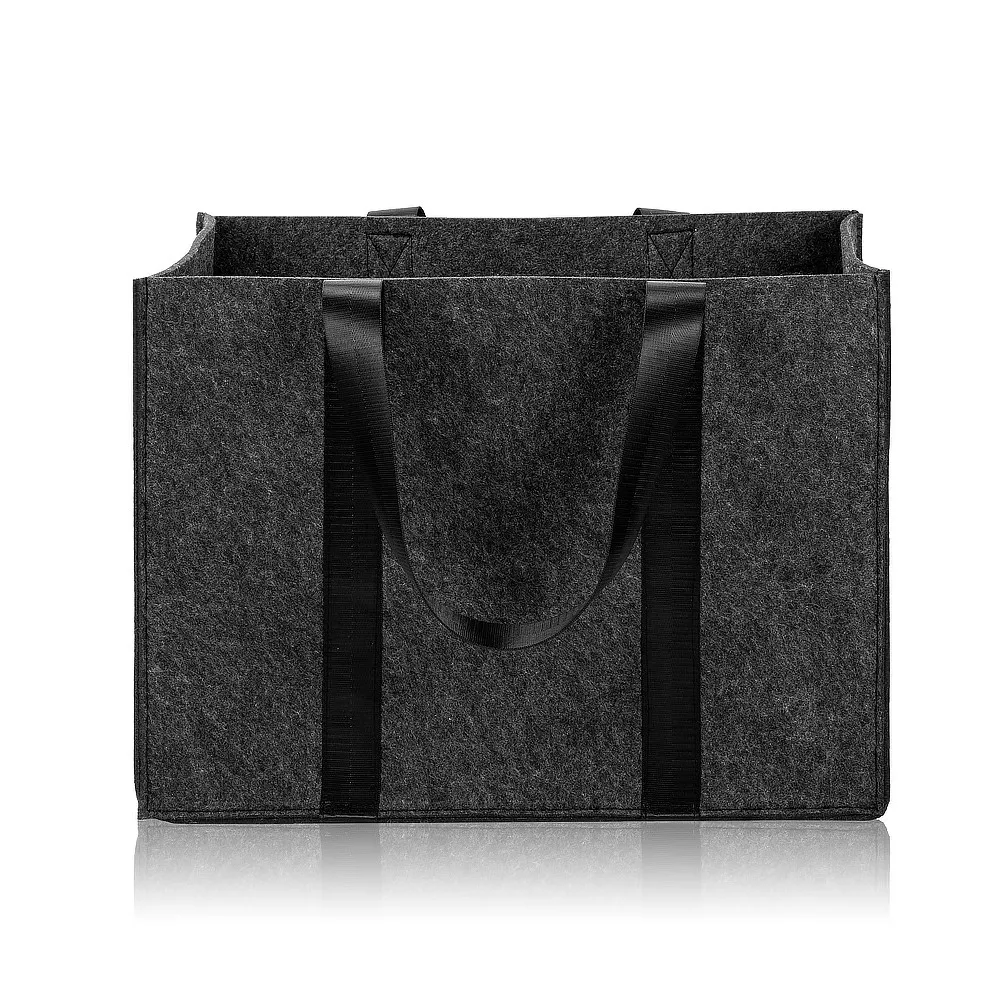
Two more advantages show up in specific briefs rather than in every order. Felt absorbs impact, so a bottle carrier or a laptop sleeve gets genuine cushioning from the mat itself instead of from added foam. And felt is quiet: no rustle when it is set down, which buyers in gift, hospitality and premium retail notice before they can explain why.
What felt does not do
Felt’s limits are as specific as its advantages, and they are the ones that turn into complaints when they are left out of the brief.
- It is not waterproof. Felt wicks. A splash spreads sideways and reaches the contents before it reaches the floor. If the use case is outdoor, transit or food, the answer is a laminated back panel or a separate lining — not a thicker felt.
- It pills where it rubs. Bottom corners, handle edges and any point that meets a coat will show surface pilling. Wool pills faster than PET. If the bag is worn over outerwear daily, this belongs in the test plan, not in a later negotiation.
- Stiffness is not strength. A felt tote holds its shape, but the load still hangs from the handle attachment. Thicker felt does not repair a bad joint; it only makes the bag that failed look more expensive.
- Fine print detail is limited. The surface is fibrous and absorbs ink, so hairlines thicken and small reversed-out text closes up. Bold shapes, laser engraving and applied patches work. Four-point type does not.
- Batch colour moves. A fibre-dyed mat carries a legitimate lot-to-lot tolerance. For a programme that runs across seasons, fix the tolerance and approve a physical standard — never a screen colour.
- PET felt holds static. It builds a charge and attracts dust and pet hair; wool is less prone. For electronics or lint-sensitive contents, raise it at the sampling stage.
None of these is a reason to avoid felt. They are the reason a felt bag quoted from a photograph disappoints: the photograph shows what felt looks like, and every one of these points decides what it does.
The build details that decide service life
On a felt bag, four construction decisions matter more than the felt itself — and all four are visible in a sample if you know where to look.
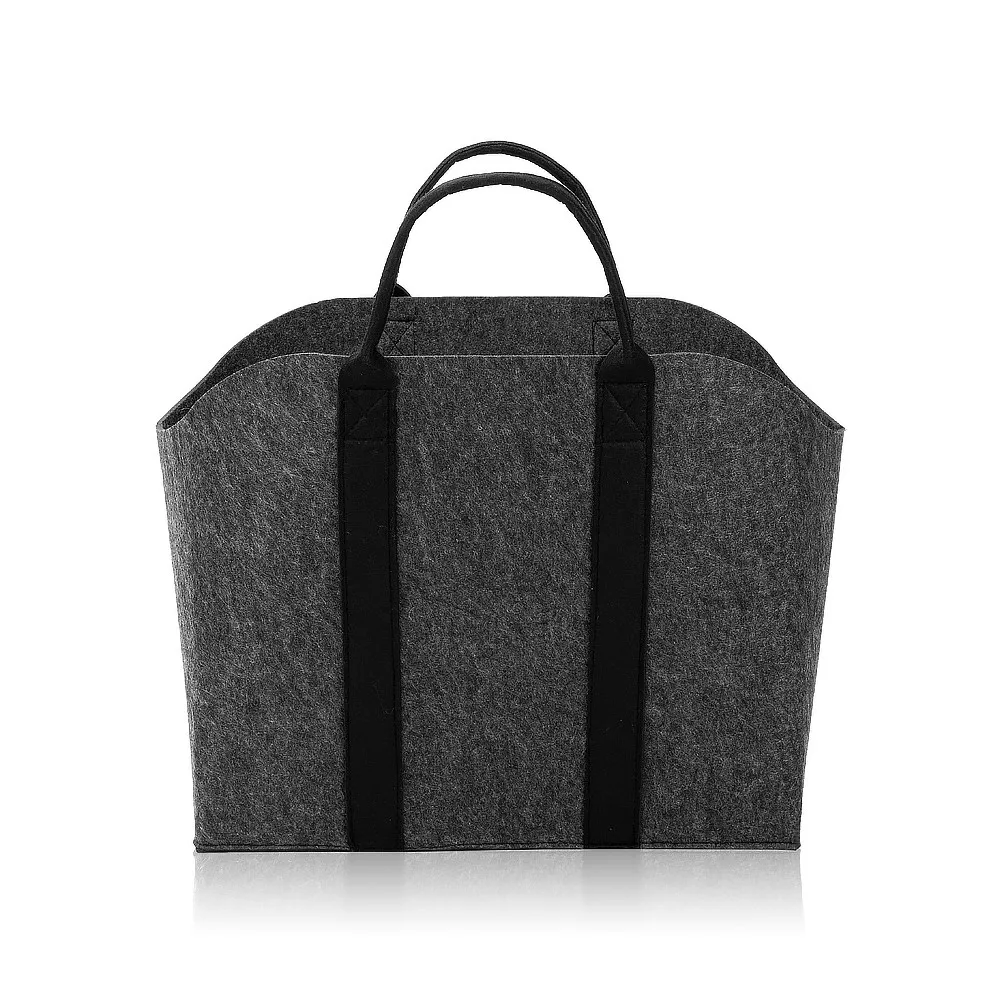
- Handle attachment. Look for a box-X stitch over a reinforcement patch rather than a single row of stitching through the body. Then look at the handle material: woven webbing carries tension better, while a felt handle keeps the bag looking like one continuous surface but can stretch under load. Specify the stitch pattern and the stitch density, not just the handle width.
- The base. A separate bottom panel spreads the load and lets the bag sit flat; a folded gusset is lighter and cheaper. Either is fine. What is not fine is a single-stitched seam at the corner, which is where a tote opens.
- Edge treatment. Raw die-cut is the cleanest and the most felt-specific choice; folded-and-stitched is more forgiving; binding is the most abrasion-resistant and the least elegant. Pick one deliberately, because it is the first thing a buyer will notice at arm’s length.
- Lining. A lining is not decoration. It hides the seam allowance, adds the pocket that turns a tote into a work bag, and — for laptops and clothing — stops fibre transfer onto the contents.
Branding on felt, ranked by how it wears
Five decoration methods are common on felt bags, and they age differently. The one that survives the longest is usually not the one on the sample the buyer approved.
| Method | Look | How it wears | Constraint |
|---|---|---|---|
| Screen print | Flat, opaque colour | Abrades along fold lines and high-friction edges | Bold shapes only; hairlines fill in |
| Heat transfer | Photographic, gradients, full colour | Film edge lifts where it is rubbed | Needs a smooth, flat panel |
| Embroidery | Raised, textural, premium | Colour is the most durable of the five | Dense stitching can distort thin felt |
| Laser engraving | Tone-on-tone, no added colour | Permanent — there is nothing to peel | Monochrome only; slight smell when new |
| Deboss or heat press | Impressed, low contrast, subtle | Permanent, cannot delaminate | Low contrast; needs a dense felt |
| Woven label or patch | Stitched-on badge, crisp detail | Very durable, replaceable in repair | Adds thickness and a visible seam |
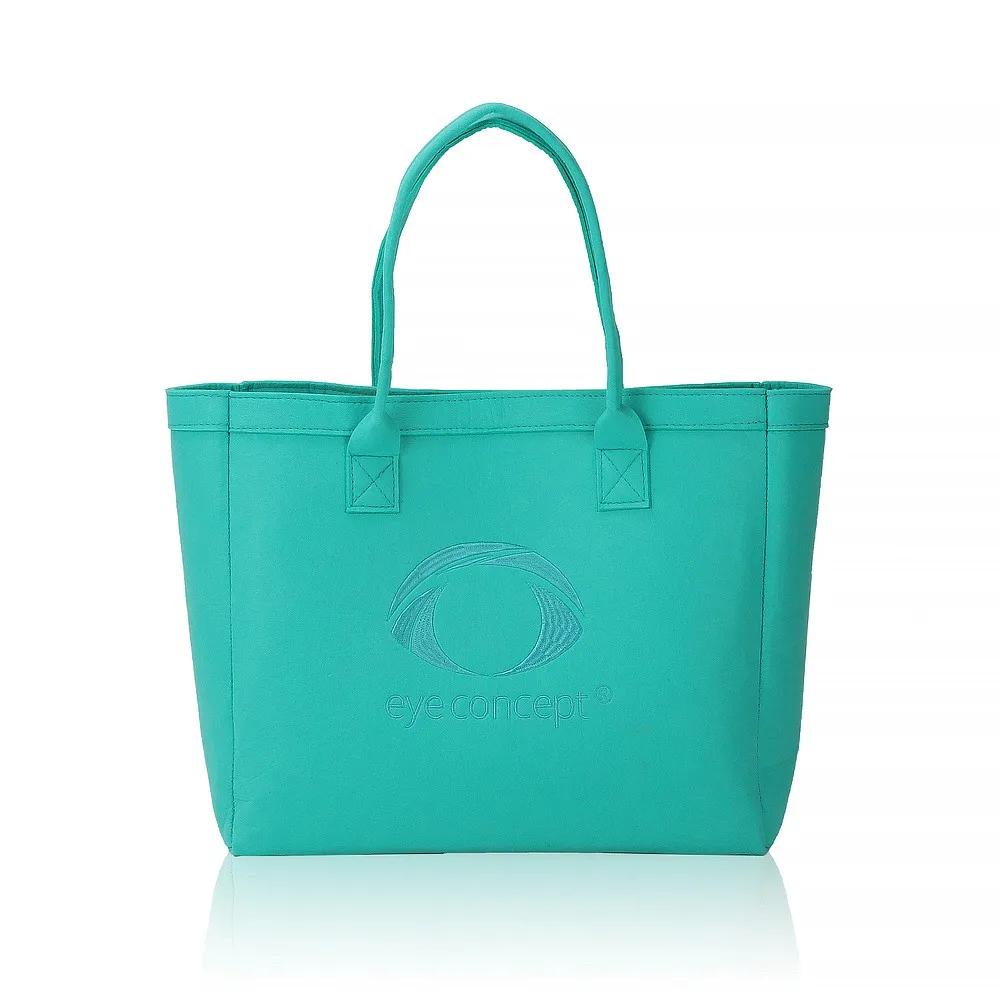
The most durable answer is usually the least colourful one. Laser engraving and deboss leave no film and no ink, so they cannot delaminate — they simply stay. Heat transfer is the method buyers ask for most, because it reproduces a logo exactly. Those are two different briefs, and choosing between them is a decision about the second year of ownership, not the first photograph.
Questions buyers ask before the first order
These six come up in almost every felt bag enquiry, and each one has an answer that is more useful than a yes.
Can a felt tote bag carry a laptop?
Yes, with a lining and a reinforced base. Felt cushions a device better than canvas because the mat itself absorbs impact, but the weight still hangs from the handle attachment, so that joint is what has to be tested. A lining matters for a second reason: it keeps felt fibre off the screen and off clothing.
Is felt waterproof?
No. Felt wicks and holds moisture, so a spill spreads and reaches the contents. A laminated back panel or a coated lining changes that; making the felt thicker does not. Do not print “water resistant” on an unlaminated felt bag, because the first rainy day produces a complaint the material cannot answer.
Can felt bags be washed?
PET felt can go through a cold machine wash inside a laundry bag, then air dry with no tumble cycle. Wool felt should be hand washed cold, never wrung, and dried flat, and it will mat and shrink slightly. In both cases the decoration ages faster than the felt, so wash it according to the print method as well as the fibre.
Will the logo peel off a felt bag?
Only if there is a film to peel. Laser engraving and debossing change the surface of the felt and cannot delaminate. Heat transfer and screen print sit on top of the fibre and can lift or abrade. When a supplier quotes a decoration, ask what the method is and how it ages, not only how it looks in the sample photo.
Is recycled felt actually recycled?
Only a certificate answers that. Ask for the scope certificate and the transaction certificate, then confirm the company in the Textile Exchange certified-company directory. The Global Recycled Standard allows business-to-business claims from 20% recycled content, but a consumer-facing label requires at least 50%, so the same bag can legally carry different wording depending on who reads it.
Does felt pill, and does it matter?
Felt pills at high-friction points such as bottom corners and handle edges, and wool pills faster than PET. Whether it matters depends on the use: a bag that rubs against a coat every day will show it within a season. If that is the brief, specify an abrasion test instead of settling it with an argument later.
What to put in the spec sheet
A photograph gets you a price. A spec sheet gets you a product you can reorder, which is the difference between one successful campaign and a supplier you can keep.
| Specification | Why it decides the outcome | What to write |
|---|---|---|
| Fibre | Sets hand-feel, care, cost and every material claim | Needle-punched rPET felt or wool felt, with the recycled percentage and certificate number |
| Thickness | Controls stiffness and whether the bag stands | Millimetres, with the acceptable tolerance |
| Weight | Controls cost and density, independently of thickness | Grams per square metre |
| Colour | Fibre-dyed batches vary by nature | Pantone reference, an approved physical standard, and a lot tolerance |
| Handle | The first component to fail | Webbing or felt, width, box-X stitch, reinforcement patch, stitch density |
| Base | Carries the entire load | Separate base panel or gusset, seam type, double-stitched or bound |
| Edge | The visible signature of the material | Raw die-cut, folded and stitched, or bound |
| Lining | Structure, pockets, and fibre transfer | Material, pocket layout, whether it must block fibre |
| Decoration | Decides how the logo ages | Method, artwork file, placement and finished size |
| Tests | The only thing that settles a disagreement later | Abrasion, colourfastness to rubbing, and the chemical requirements of the destination market |
Two of those ten fields — handle attachment and base construction — will decide most of the complaints you receive. They are also the two that suppliers leave unspecified most often, because the buyer did not ask.
Next step
Send the brief, not only the photo
A felt tote is a short list of decisions made in the right order: fibre, thickness, handle joint, decoration. Send the use case and the load, and we will come back with a construction that holds — or say plainly where felt is the wrong material for the job.
A brief that gets a useful answer
- Fibre and format — rPET or wool, thickness and weight if already known
- Construction — handle type, base, lining, edge treatment
- Decoration — method, artwork, placement, finished size
- Market — where it will be sold and which claims must be supported
- Volume and timing — quantity, launch date, reorder expectation
Post time: Oct-22-2026