
Storage & Material Guide
Why Do Felt Storage Baskets Outlast Fabric and Plastic Bins?
The six ways cheap storage boxes fail in real homes, how a dense felted wall fixes each one, and where a felt basket actually earns its place — written for buyers who have to answer for returns.
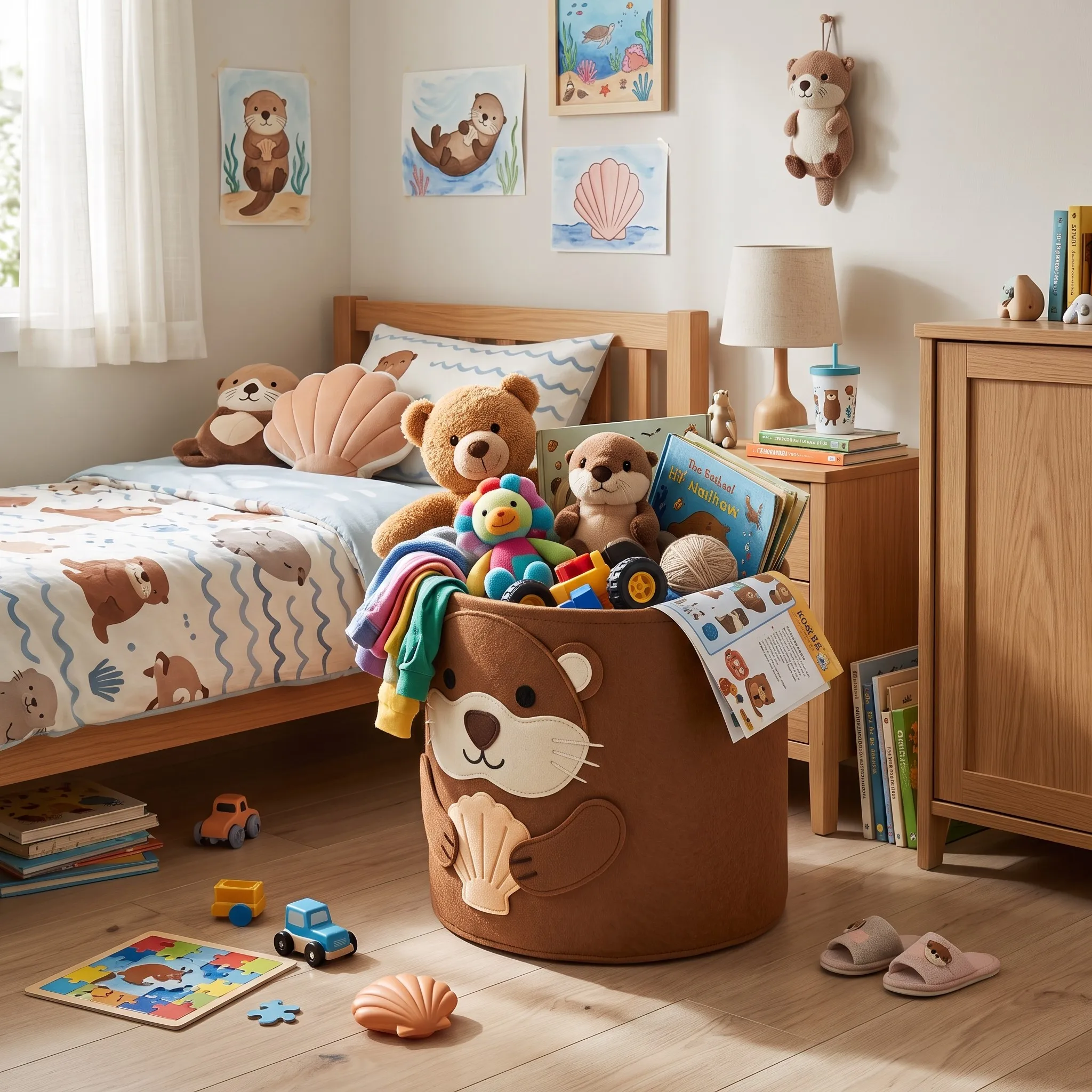
Why cheap storage bins end up in the bin
Storage is bought to solve a mess, not to be admired — and that is exactly why it fails. The container is chosen on price, then asked to survive a nursery floor, a bathroom shelf and a humid autumn for years. Six failures show up again and again.
- The rigid tote that cracks at the corner. Plastic is stiff, not resilient. Stacked weight and a cold room find the weakest corner first — and the same material goes cloudy and reads like warehouse equipment in a bedroom.
- The fabric bin that sags. A thin panel with a zip across the top photographs well and collapses the moment it is half empty. The zip, the insert or the base board is usually the first part to give up.
- The cardboard box that quietly softens. Cheap and light, but one damp season and it loses its shape, keeps the smell of the humidity, and cannot be wiped clean.
- The woven basket that snags. Wicker and rattan grip knitwear, shed splinters into a child’s room, and go musty in the one room where storage matters most: the bathroom.
- The non-woven bag that never stands up. It folds, creases with every use, and only holds anything as long as a wall is behind it.
- The container that stores the mess and adds to the clutter. Everything is put away, and the room still looks untidy — because the box itself is the thing spoiling it.
Look at the first five together and one design decision explains all of them: a thin, unsupported wall. Rigidity without resilience, or softness without structure. That is what generates the returns, the one-star reviews and the customer who concludes that storage simply does not work.
The question to put to a supplier is not “how cheap can you make it” — it is “what does the sample look like after a month of use, with half of its contents taken out?”
What a felt basket does differently
A dense felted wall solves the structural half of that list, because the wall itself is the structure. There is no fabric skin stretched over a board and no frame holding the shape up — the felt is thick and dense enough to carry its own.
- It stands up empty. Stand it on the floor or a shelf and it stays standing, which means it looks like a product in a showroom, on a retail shelf and in a customer’s photograph.
- It recovers. Felt is dense but compressible, so a basket that is compressed inside a carton and pressed in transit returns to its shape instead of holding a permanent crease.
- There is nothing to break. No zip, no grommet, no wire frame, no hard corner and no insert to lose. Fewer components is fewer failure modes — and a shorter returns conversation.
- The edges are soft. A rounded felt rim matters in a child’s room: nothing sharp at knee height, nothing to pinch fingers, nothing that rattles when it is dropped.
- The face is a design surface. Stitched appliqué and embroidery turn the container into part of the decoration, which is the reason it stays out in the room instead of being hidden behind a cupboard door.
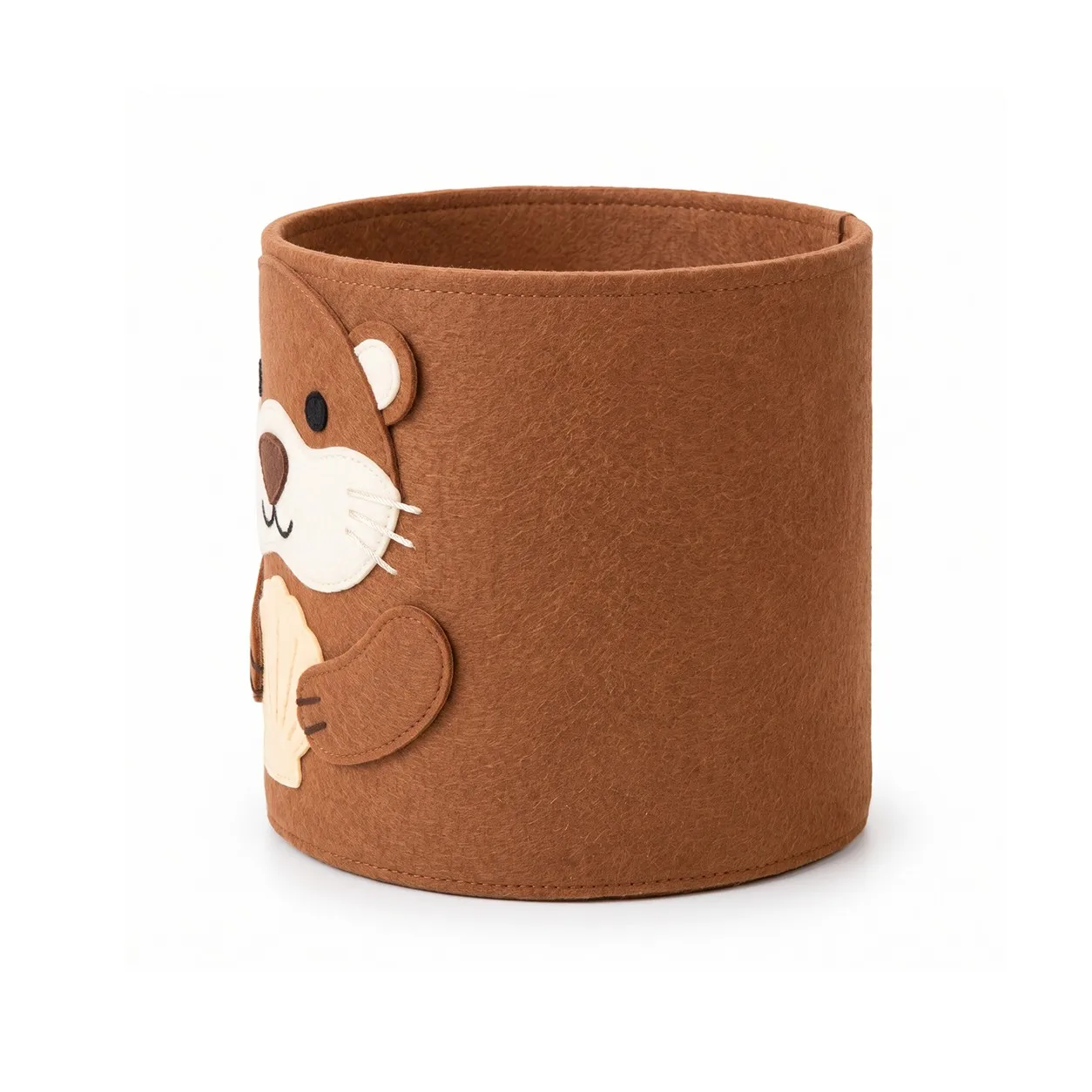
Where it earns its place: five rooms, five jobs
A storage basket only justifies its price when it is the right answer in a specific room. These are the five where felt outperforms a rigid tote or a thin fabric bin.
The nursery and playroom. Toys multiply faster than anyone plans for, and the floor is where they live. A basket at child height lets a small child put things back without help, and because it is soft and light, tipping it over is not an accident waiting to happen. This is also the room where the object has to look good enough to leave out.
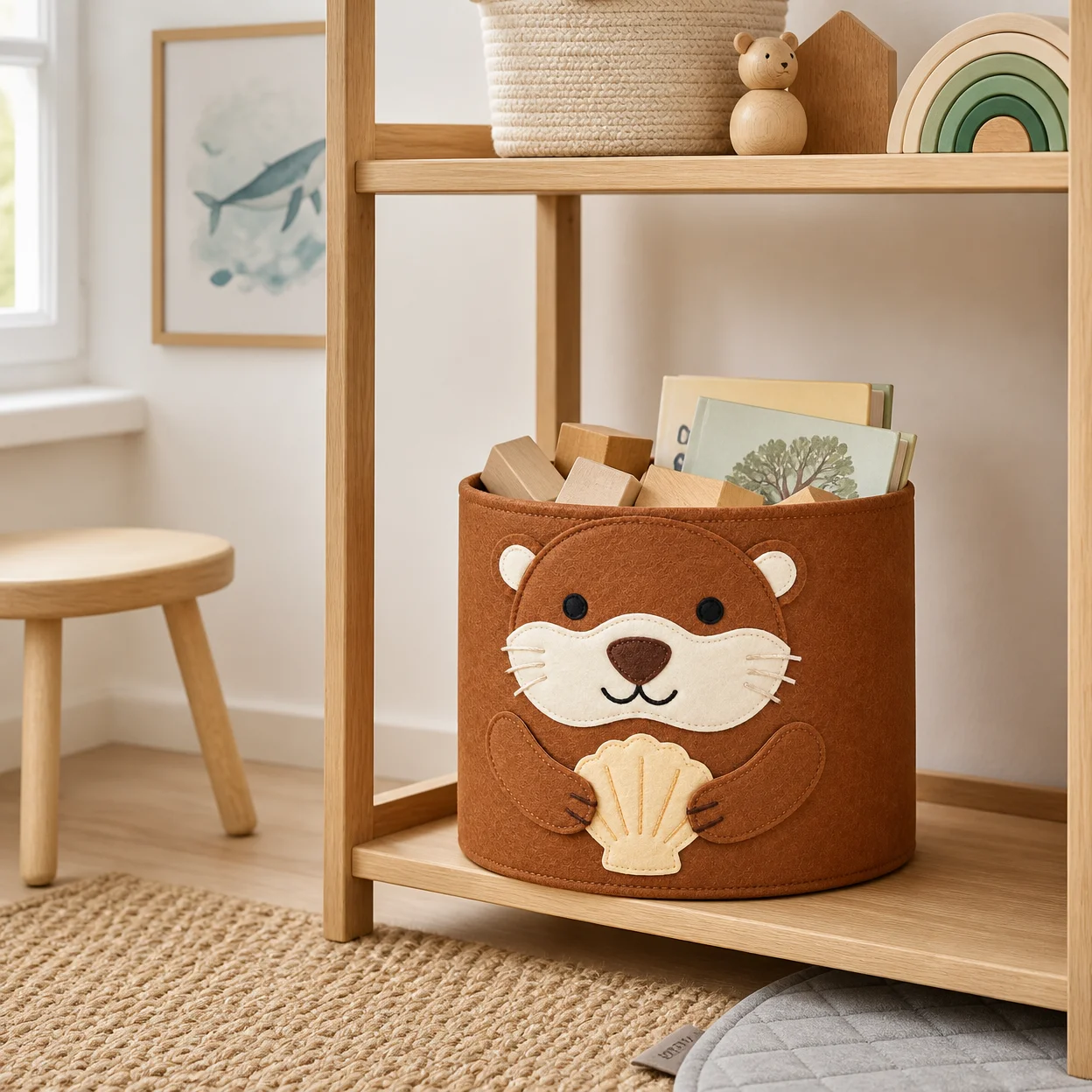
The bathroom and laundry corner. Rolled towels, bath toys and spare toiletries behave better in felt than in a plastic crate: the wall is air-permeable rather than sealed, the surface takes a damp-cloth wipe, and there is nothing metal to rust or rattle on tile.
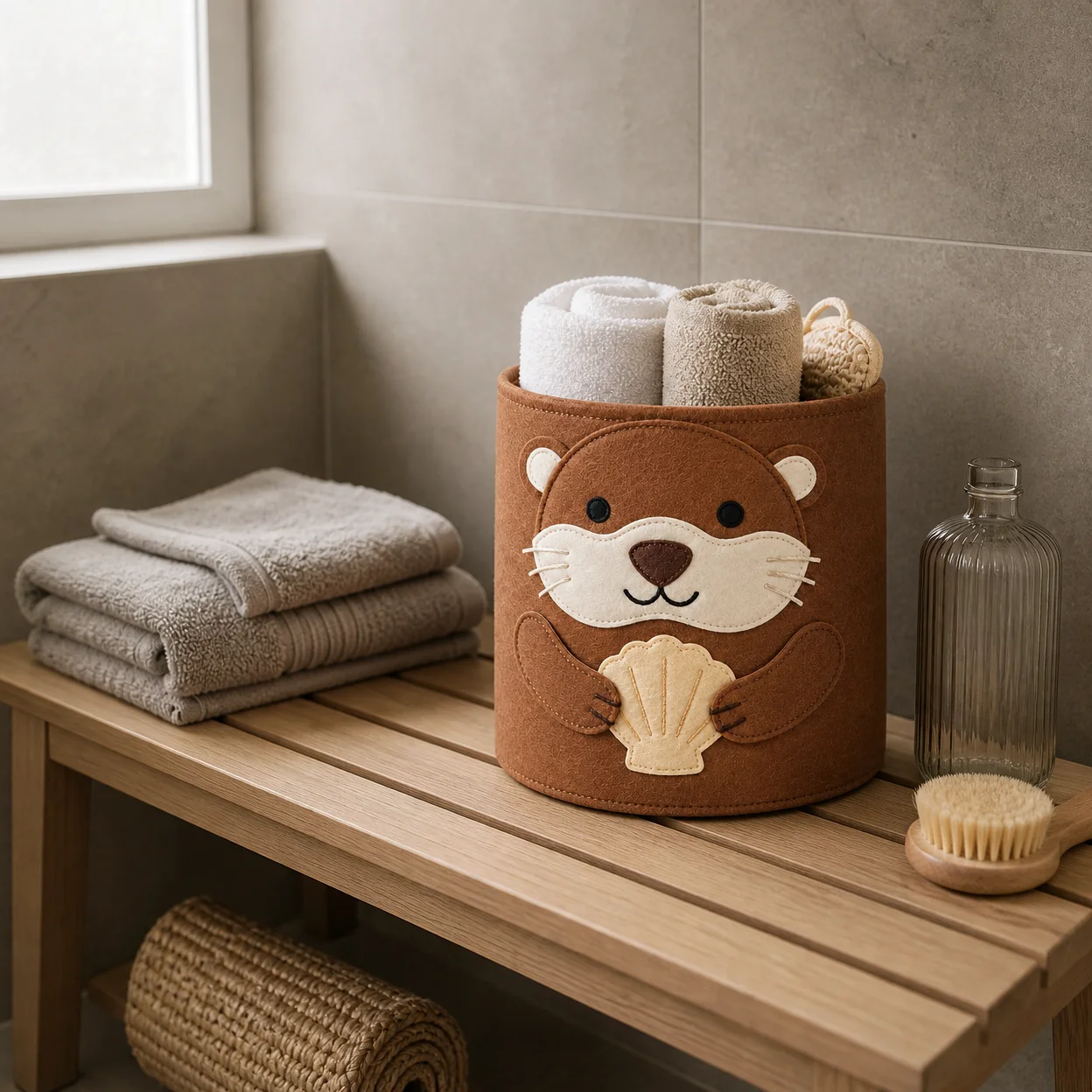
Beside the sofa. Throws, magazines, remotes and the tablet end up on the floor because there is nowhere else to put them. A low felt basket becomes the landing zone, and a stitched character face makes it part of the living room rather than a box that has been allowed in.
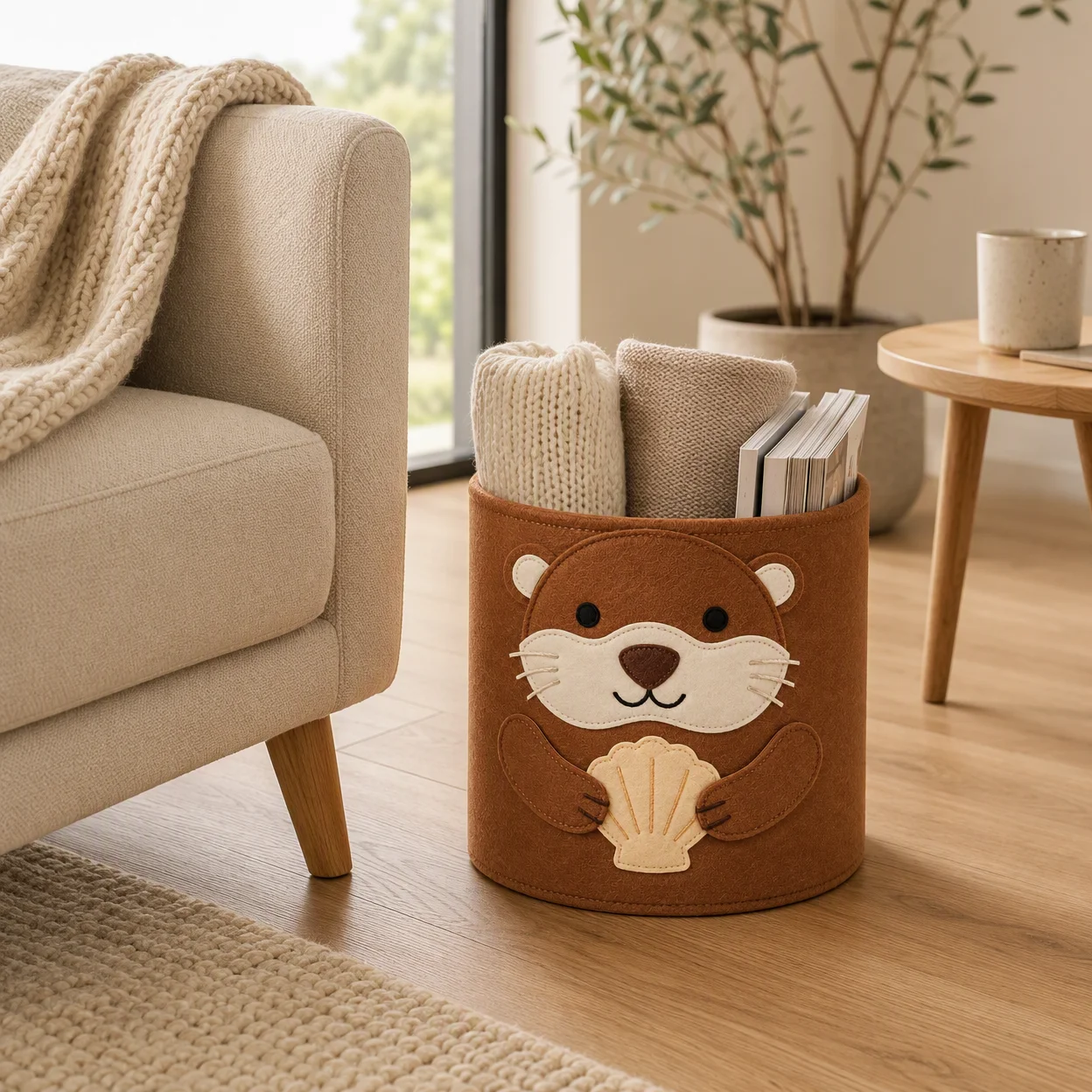
The hallway or mudroom. Gloves, hats, scarves and the dog lead arrive wet and get dropped. A felt basket absorbs that shuffle, and its soft edges do not scuff skirting boards or paintwork the way a hard-sided crate does.
The pet corner. Toys, brushes and folded towels. Felt does not clatter on hard floors, does not scratch them when the basket is dragged, and is quiet enough to sit in a living room.
Five rooms is also five retail stories from one construction: the same basket sold as nursery storage, bath storage, living-room storage, entry storage and pet storage — with different sizes, colours and appliqué.
Felt vs plastic, canvas and cardboard
The comparison that matters is not “which is cheapest to buy in” but “which one is still in use in two years”. This is the honest version of that table.
| What the customer notices | Felt basket | Plastic tote | Canvas / oxford bin | Cardboard box |
|---|---|---|---|---|
| Stands up when empty | Yes — the wall is the structure | Yes, but visibly industrial | No — it sags once half full | Only while new |
| Recovers after packing and shipping | Dense felt springs back | Yes, until a corner fails | Creases stay creased | Never fully |
| Edges and child safety | Soft rounded rim, no small parts on the body | Hard or sharp corners | Soft but a zip and puller | Cut edges and dust |
| Cleaning | Damp cloth, vacuum, careful hand wash | Wipe clean, but stains hold | Washable, then out of shape | Not cleanable |
| In a humid room | Air-permeable, dries out when aired | Sealed, can trap damp | Can stay damp and smell | Softens and smells |
| How it looks in a furnished room | Decorative — a design object | Utility — hidden away | Neutral, rarely a feature | Temporary |
| Customisation | Colour, size, appliqué, label, packaging | Mould cost, limited design | Print or heat transfer | Print only |
What to check before you place a bulk order
Six checks turn a basket you liked in a photograph into an order you can repeat. All of them can be done with one sample on a table.
- Stand it up empty. Take it out of the bag, put it on a table and walk away. If the rim slumps, the wall is too thin for the size — and that single fact explains most of the returns you would otherwise absorb.
- Press the wall and let go. Dense felt springs back. A felt-faced panel glued over card or foam creases and keeps the crease, which is what tells you where the money went.
- Look at the rim and the base. Ask how the top edge is finished and how the base is reinforced. A folded and stitched rim holds the opening’s shape; a simply cut edge frays with use and is the first place a felt basket starts to look tired.
- Check the appliqué and the stitching. Pull gently at the stitched face, check that thread ends are secured and look for puckering in the wall around the appliqué. This is the part of the product a customer photographs close up.
- Ask for the test documentation your market requires. Colours and textile components are the parts most likely to be questioned at import, especially for a children’s range. Request the reports that apply to your destination market rather than accepting a general assurance — the OEKO-TEX STANDARD 100 criteria are a common reference point for textile testing, and the US Consumer Product Safety Commission publishes the requirements that apply to products sold to US consumers.
- Pack one the way you would ship it. Compress a basket into your intended carton, leave it a few days, then unpack it. It is the cheapest test of both the wall and the packaging configuration you are about to pay for.
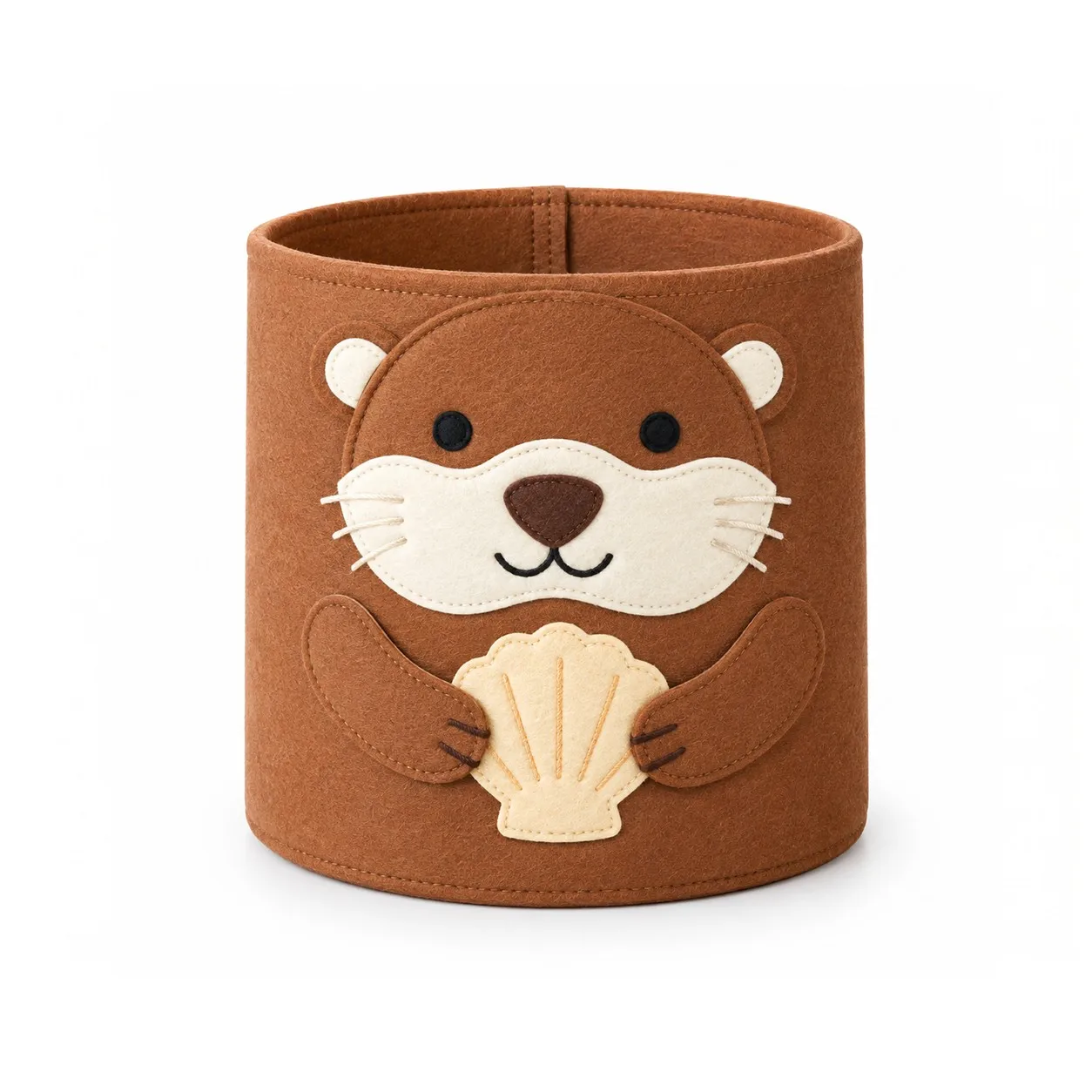
Customisation: shape, colour, appliqué, private label
The construction stays the same and almost everything the customer sees can change — which is what makes one basket work for five different retail stories.
- Shape and size. Round, square or with cut handles; and a small–medium–large family so one range covers a shelf, a floor and a wardrobe.
- Colour. Natural neutrals that do not date, or dyed to your palette. Agree every batch against a physical sample rather than on a screen.
- Appliqué and character design. The face is a stitched pattern, not a mould: proportions, ear and paw shapes and the object held in the paws can all be redrawn for your range.
- Private label. Woven label, hang tag and printed care label — all of them belong on the plain side or the base, so they do not compete with the front.
- Retail packaging. Kraft sleeve, polybag, insert card and the carton configuration itself, which is where a flat-packed design saves freight on every container.
- Coordinated sets. Two or three sizes in one palette ship and sell as a nursery set, a bathroom set or a housewarming bundle.
Two notes from the buying side. Keep the artwork files for your own character designs, so a reorder two seasons later does not depend on someone else’s memory. And confirm the packaging configuration before the first production run — retro-fitting a carton after the fact is the most expensive way to save freight.
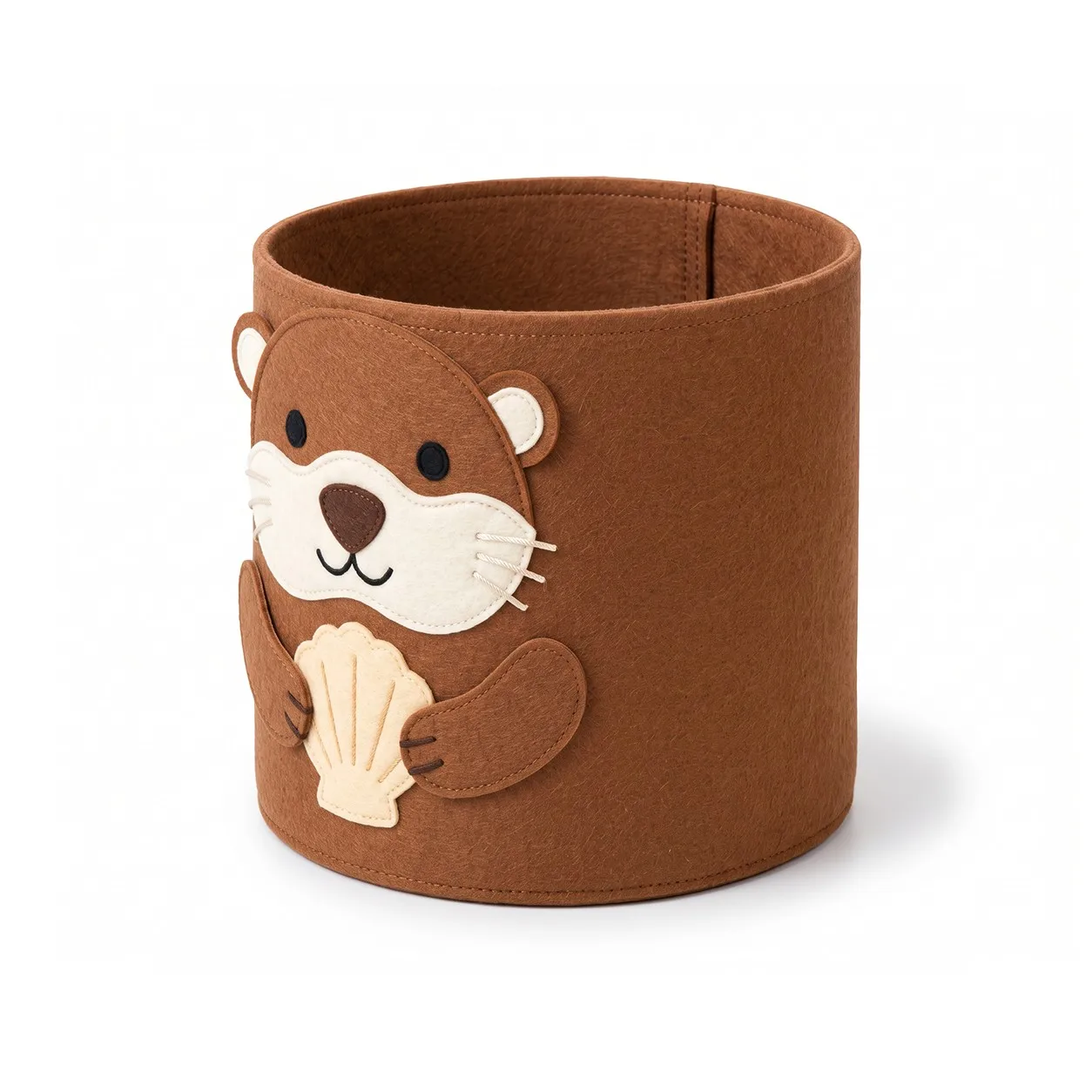
Care and lifespan
Felt is forgiving, but three habits decide whether the basket still looks new in two years.
- Dust and crumbs. A vacuum with a brush attachment, or a damp cloth, and then let it air-dry. That handles most of what a toy basket collects.
- A deeper clean. Hand wash cool with a mild detergent, press rather than wring, reshape it while it is still damp, and dry it flat and away from direct heat.
- Heat and agitation. Keep it out of tumble dryers and off radiators. Heat plus movement is what makes felted fibres stiffen and shrink — and a shrunken basket cannot be un-shrunk.
- Reshape once a season. For a retail programme, a short care note telling customers to empty and reshape the basket keeps a display piece looking like a display piece for longer.
Frequently asked questions
Will a felt storage basket stand up when it is empty?
It will if the felted wall is dense enough for the size. Test it on the sample rather than the catalogue: take it out of the bag, stand it on a table and leave it. A wall that is too thin slumps at the rim, and that is the single most common cause of returns on storage products.
Is a felt basket suitable for a child’s room?
The body has no hard edges, no zip and no wire frame, and felt is light enough for a small child to move. Check that any appliqué, trim and label are stitched down securely, and for a children’s range ask your supplier for the documentation your destination market requires.
Can the character design be changed for our own range?
Yes. The face is a stitched appliqué, so it is a pattern rather than a mould. Colours, proportions, ear and paw shapes and the accessory held in the paws can all be redrawn — and the same basket can carry a completely different character for a different market.
Will it hold up in a bathroom or a laundry room?
Felt is air-permeable rather than sealed, so it dries out once it is aired, and the surface takes a damp-cloth wipe. Avoid leaving the basket in standing water or directly in a shower spray, and let a damp room do what it does best: dry the basket out between uses.
Next step
Planning a felt storage range?
Tell us the room, the size family and the character you have in mind. We will quote the construction with it — wall density, rim and base finish, appliqué, labelling and packaging — and agree all of it on a sample before a production run.
To quote accurately, we need
- Destination market and whether it is a children’s range
- Size family one size, or small / medium / large
- Character artwork or a direction for us to design from
- Packaging kraft sleeve, polybag, hang tag, carton
- Target volume so tooling and freight are quoted honestly
See the full range of felt home storage, or compare this basket with our felt storage basket specification on the product page.
Post time: Oct-12-2026