Laundry Care · Claims Guide
Do Wool Dryer Balls Really Replace Fabric Softener?
Fabric softener is a coating you deposit; a felted wool ball is a machine that moves air. Here is what each one actually does on a real load — and how to word the four claims on a retail pack so that every one of them survives a return request.
What fabric softener actually does
A softener is not a cleaner. Detergent lifts soil off the fibre; a softener does the opposite job and puts something back on. The American Cleaning Institute compares it to the conditioner that follows your shampoo: softeners coat the surface and also penetrate the fibre, lubricating it and reducing friction between fibres.
The active ingredient in most liquids and dryer sheets is a cationic surfactant — usually a quaternary ammonium compound. It carries a positive charge, so it bonds to the negatively charged surface of cotton and similar fibres, and by sitting between them it interferes with the hydrogen bonding that makes washed fabric feel stiff and wrinkled.
That deposited film is the entire mechanism. It is why laundry comes out fluffier, why static drops, why the scent survives for days, and why the institute can note that softeners also reduce pilling and can shorten drying and ironing time. Four consequences follow, and each one matters if you buy, spec or sell these products.
Nothing you tumble can copy the deposit
Softening, in the softener sense, is a deposit. A ball rolling in the drum cannot transfer a cationic film onto your towels, however much wool is in it. Any product that promises the softener effect from a felted ball is promising a chemistry it does not have.
The film has costs, and dose decides them
Softeners are hydrophobic by nature, which is why the absorbency question keeps coming up. The institute’s own position is that used at the correct dose they do not spoil towel absorbency; the complaints cluster around over-dosing, which leaves a waxy build-up in the fibre and in the machine.
It is not for every load
The institute is explicit that softeners should be avoided on children’s sleepwear and on any garment labelled flame resistant, because the coating can reduce flame retardancy. That is a caution about the coating — a warning that a ball, which deposits nothing, does not trigger.
On skin, the literature is genuinely mixed
A 2023 review of quaternary ammonium compounds and contact dermatitis in Clinical, Cosmetic and Investigational Dermatology covers reports of both irritation and sensitisation, while noting that results vary with the specific compound and concentration. The institute’s position is that softeners are dermatologically tested and safe when used as directed, and it points sensitive-skin households to fragrance- and dye-free formulas. Both statements can be true at once, and neither is a reason to tell a customer the coating is not there.
The one-line summary: fabric softener is a lubricant you apply. A wool dryer ball is agitation you already bought with the machine. The two do not occupy the same job description.
What a felted wool ball does instead
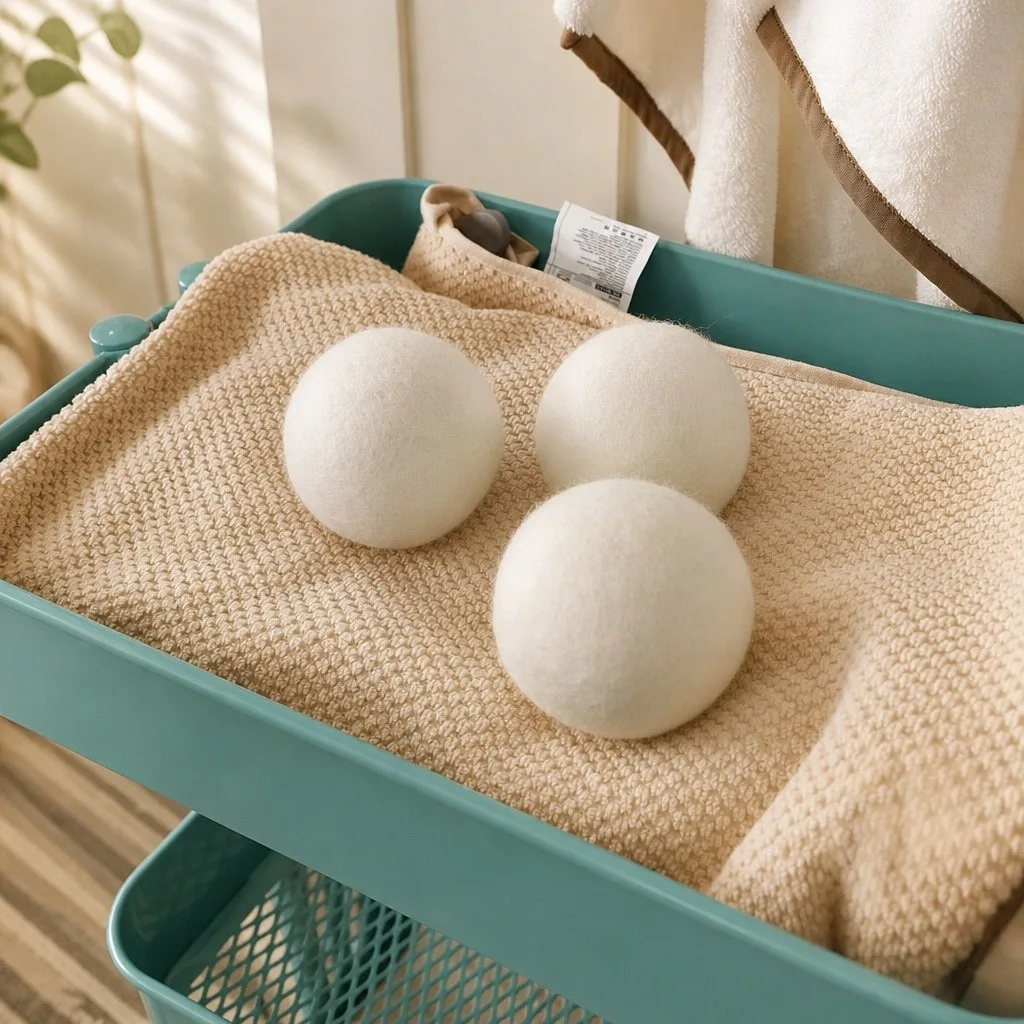
A felted wool ball works entirely by moving things. There is no chemistry to deposit, which is precisely why it cannot soften the way a softener does — and also why it leaves nothing behind to complain about. Four mechanisms do the whole job.
- It separates layers. In a tumble dryer the enemy is a load that sits in a tight clump. ENERGY STAR describes the requirement directly: the drum must let a full load tumble freely, with space left over for hot air to circulate. Balls push between layers, so more fabric surface meets moving hot air instead of other fabric.
- It adds mechanical action, not lubrication. The felted surface bats fabric against itself and against the drum wall, which fluffs fibres and shakes out creases. It is the same reason a towel shaken hard comes out softer than one left folded.
- It buffers moisture. Wool takes on and releases vapour slowly, so the drum air stays a little less bone-dry at the moment the load finishes. That matters for the next point.
- It keeps charge from building. Static in a dryer comes from heat and tumbling creating a charge imbalance. Fabrics that rub less and dry slightly less aggressively build less of it.
What it removes from the routine
There is a real, verifiable gain here that has nothing to do with softening. ENERGY STAR advises scrubbing the lint filter monthly if you use dryer sheets, because sheets leave a film on the filter that reduces airflow and over time can affect the motor. A felted wool ball adds no film, so the filter keeps the airflow the dryer was designed around. For a household, that is the honest version of “reduce drying time”: you are not buying speed, you are refusing to buy a blockage.
The four claims on the pack, checked one by one
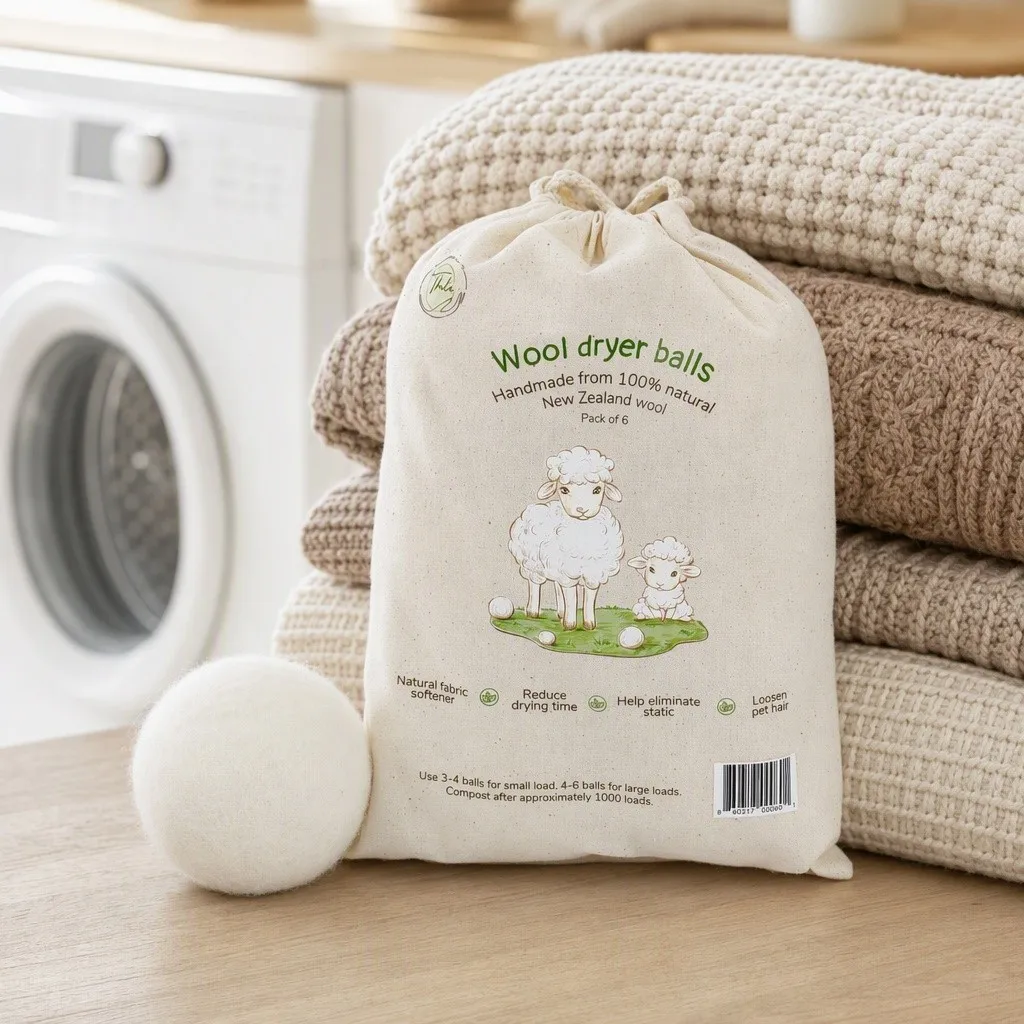
Most retail packs in this category carry the same four benefit icons. Three are defensible with small wording changes; one is not defensible at all as it usually appears. This is the part a buyer should review before placing a print order, because every one of these lines is a sentence a customer can hold you to.
| Line on the pack | What a shopper hears | Defensible as written? | Wording that survives |
|---|---|---|---|
| “Natural fabric softener” | It does what my softener does, without chemicals | No — softening here is a deposited film, and a ball deposits nothing. The American Cleaning Institute states directly that dryer balls will not provide the benefits of a fabric softener or dryer sheet. | “Reusable dryer-sheet alternative — fluffs by tumbling, leaves no coating” |
| “Reduce drying time” | My loads will finish faster | Partly — the mechanism is real and measurable in direction, not in a promised percentage: separated layers present more surface to moving hot air, and no sheet film builds up on the lint filter. | “Helps reduce drying time — separates layers so hot air reaches more fabric” |
| “Help eliminate static” | No static, ever | Partly — the verb is too strong. Fabrics that rub less build less charge, and a little residual moisture gives charge somewhere to go; over-dry the load and static returns regardless. | “Helps reduce static — keeps fabrics apart and gives charge a path away” |
| “Loosen pet hair” | My blanket comes out hair-free | Yes, as written — “loosen” is the accurate verb. The felted surface lifts hair off the fabric and tumbling carries it to the lint filter. Do not let anyone upgrade this to “removes”. | Keep it. “Loosens pet hair into the lint filter” |
And one line that needs paperwork, not an icon
A fibre-origin line — “100% natural New Zealand wool”, for example — is a traceability claim, not a performance claim. It cannot be supported by how the ball behaves in a drum; it is supported by documents from the mill or supplier that follow the fibre from the grower to your finished pack. Keep those papers on file before the artwork goes to print, and keep the wording on the pack narrow enough to match them exactly.
The test every claim has to pass: can you state the mechanism in one sentence, without adverbs? “It separates the layers, so hot air reaches more fabric” passes. “It eliminates static naturally” does not, and it is the sentence a customer will quote back to you.
Wool ball vs softener vs dryer sheet
Put side by side, the three sit in different categories: one is a reusable mechanical aid, two are chemical delivery formats. The table below is the comparison worth putting in a buyer presentation.
| Point of comparison | Felted wool ball | Liquid fabric softener | Dryer sheet |
|---|---|---|---|
| What it leaves on the fibre | Nothing | A lubricating cationic surfactant film | A heat-activated softening film |
| How it works | Mechanically — separates layers, adds agitation | Lubricates fibres and blocks hydrogen bonding between them | Same chemistry, released in the drum by heat |
| Static | Reduced, because fabrics rub less and dry less aggressively | Reduced — the film carries charge away | Reduced |
| Scent | None, unless the user adds a drop of oil | Designed-in, long-lasting fragrance | Designed-in fragrance |
| Towels and absorbency | Unaffected — no hydrophobic film | Dose-dependent; the American Cleaning Institute considers correct dosing safe for absorbency | Dose-dependent, same principle |
| Lint filter | No residue; clean it on the normal schedule | No sheet film | ENERGY STAR advises scrubbing the filter monthly, because sheets leave a film that restricts airflow |
| Garments labelled flame resistant | Adds no coating | Advised against, per the American Cleaning Institute | Advised against |
| End of life | Wool is a protein fibre that biodegrades in soil or water | Plastic bottle and packaging | One sheet per load |
How many balls a load actually needs
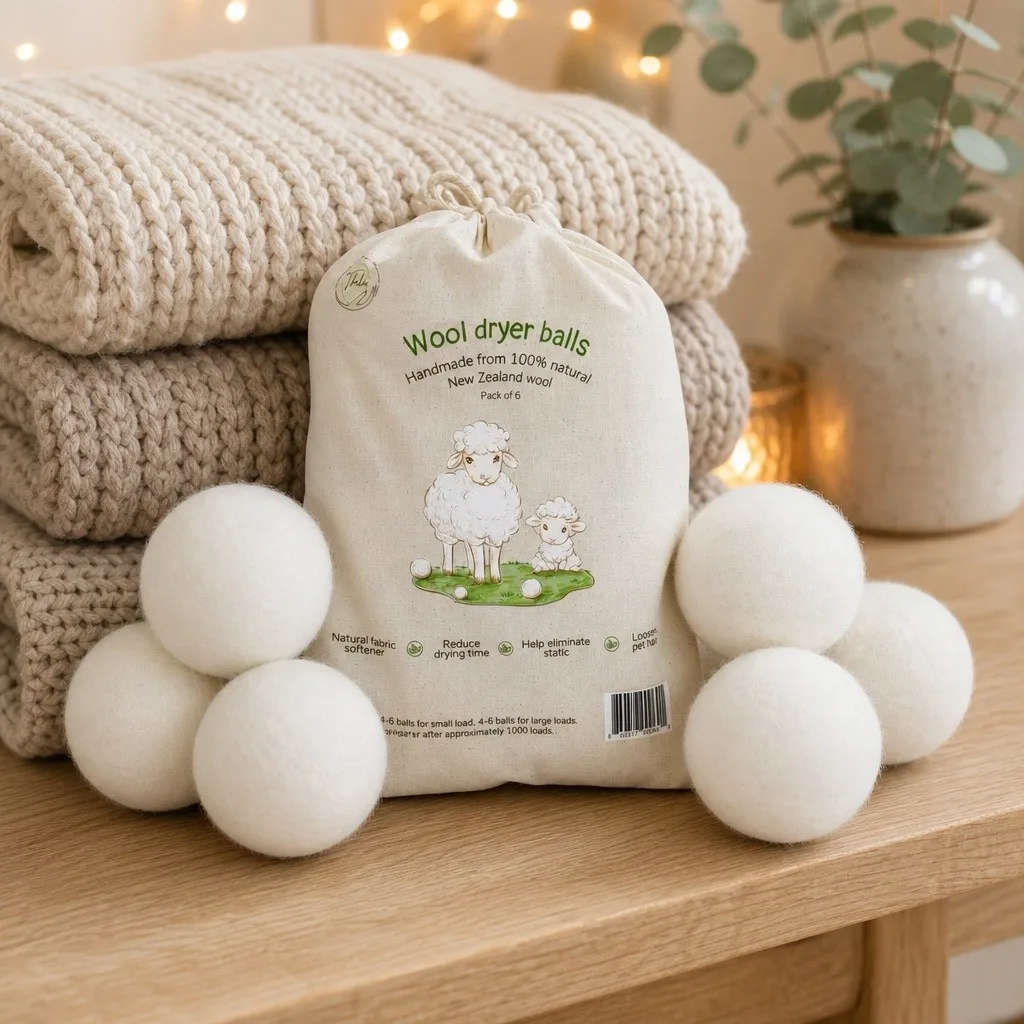
Count is the variable most households get wrong, and it decides whether the product works at all. A pack of six in a large drum, used three at a time, gives two households’ worth of use; the same six in a small drum is a spare set. The pack convention — three to four for a small load, four to six for a large one — is a sensible starting rule because it scales the ball count with the volume of fabric that has to be kept apart.
| Load | Balls | What to watch for |
|---|---|---|
| Small load, everyday mixed laundry | 3 | You should hear the balls tumbling. Silence usually means they are sitting on top of a clump. |
| Full load | 4–6 | If the drum looks packed, split the load instead of adding balls — a crowded drum has no room for hot air, which is the whole mechanism. |
| Bulky items: bedding, towels, jumpers | 6 | Bulky items stay folded and hide their own moisture. Fewer items per load does more than extra balls. |
| Delicate or small load where you want minimal agitation | 3 | Reduce heat and lengthen the cycle rather than reducing the ball count to zero — with no balls you are back to a clump. |
Both the bag format and the ball count are settled at the sample stage, not in the print shop. If you are specifying a range rather than buying for one household, the formats we produce to order are set out on our wool dryer ball range.
Softness and scent without a coating
Households who drop softener usually miss three things, and each has a different honest answer. The first is the slippery feel, which no tumbling product can reproduce. The other two — scent and static — can be recovered. The one thing that cannot be recovered by any product is a load that has been over-dried.
| What is missed | Honest answer | What to do instead |
|---|---|---|
| The slippery, coated feel | Not reproducible by tumbling. A ball can fluff a load, not lubricate it. | Use less softener per load rather than more; dry to a “less dry” setting. If the feel is the household’s real requirement, keep the softener and use balls for airflow and to replace sheets. |
| The scent | Wool carries no fragrance of its own. | One drop of essential oil on a single ball, allowed to dry before it goes in the drum. Test on a spare cloth first — oils can transfer, and citrus oils can mark pale fabric. Re-oil every few loads. |
| Static in dry, heated rooms | Reduced, never eliminated. | Use automatic termination instead of a timed cycle, choose lower heat for longer, and take the load out when it is dry rather than when the timer ends. |
That last row is worth stating plainly, because ENERGY STAR’s guidance on clothes dryers already makes the case: automatic termination prevents wear and tear on clothes from over-drying. Over-drying is also what brings static back into a load that was handled correctly up to that point. A wool ball is not a fix for a cycle set too long.
Care, lifespan and the line on the bag
A felted wool ball is a durable product with one vulnerability: moisture it cannot get rid of. Keep it dry and it lasts for many hundreds of loads; seal it damp in a bag and the same ball fails in weeks. The care routine is short.
- Let the balls cool and dry between loads. Tip them out of the drum with the laundry instead of leaving them inside a closed machine.
- Store them dry. The drawstring bag is for dry storage and for the shelf — not for a set that is still warm and damp from a cycle.
- Hand wash occasionally, gently. If the surface has picked up oil or lint, wash with mild soap in lukewarm water, squeeze rather than wring, reshape by rolling between your palms and dry fully in the air. Hot water and detergent soakings tighten and compact the felt.
- Do not machine wash them into a felting ball. They are already felted; another hot wash cycle only makes them denser and less bouncy.
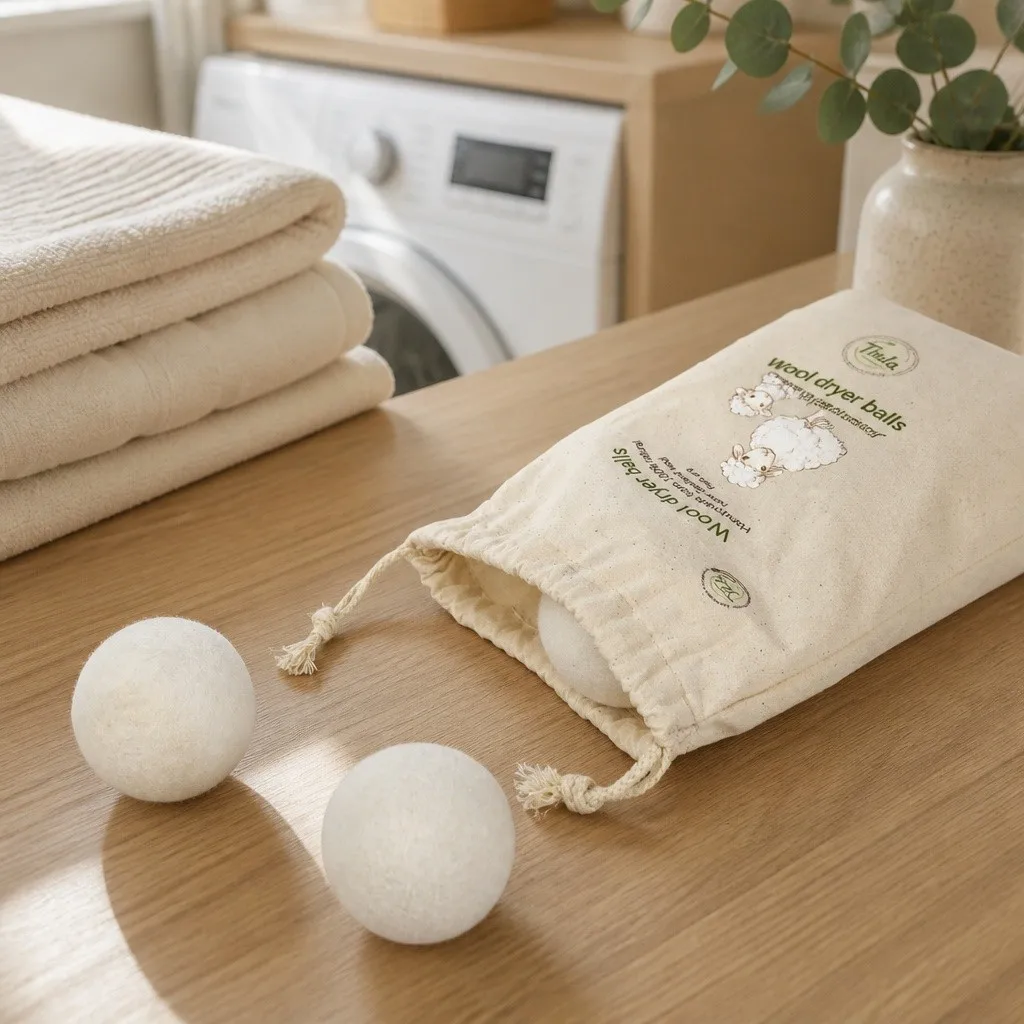
When a ball has stopped working
One test answers it: press the ball between finger and thumb. A working ball compresses and springs straight back. In use, the felt gradually tightens, the surface collects lint and oil, and the bounce goes. Once a ball stays flattened, feels dense and hard, or starts to smell musty even after it is dry, it has finished its job.
“Compost after approximately 1,000 loads” — two claims in one line
This line is doing two jobs, and they have very different evidence behind them.
The end-of-life half is well supported. Wool is keratin, the same family of protein as human hair, and micro-organisms break it down in soil or water. The Woolmark Company reports that 100% Merino wool fabric can biodegrade by 95% after 15 weeks of burial in soil, with the rate varying by soil, climate and wool type, and notes that on burial wool returns nutrients as a slow-release fertiliser. The International Wool Textile Organisation adds that in the right conditions wool products almost completely degrade after six months in the ground, releasing sulphur, nitrogen, phosphorus and potassium, and that research in New Zealand measured 20% biodegradation across wool types within 90 days in marine conditions. Set against that, synthetic fibres persist and shed: Woolmark cites a single polyester fleece shedding more than 1,900 fibres per wash.
The service-life half — the specific number of loads — is a performance claim about one product, not a property of wool. It can only be supported by the brand’s own test data or by a defined test method. For a buyer, that distinction is worth acting on: “compostable at end of life” is a claim the fibre itself backs up; “approximately 1,000 loads” is a claim your own testing has to back up, and if you do not have it, the safer line is to say what the fibre does rather than how long the ball will last.
Questions we get asked
Will wool dryer balls make my clothes as soft as fabric softener?
No. Softener deposits a lubricating film, and a felted wool ball deposits nothing — it only fluffs a load through tumbling. Expect laundry that feels fluffed and less stiff, not laundry that feels coated and slippery.
Can I use wool dryer balls and fabric softener in the same load?
Yes. They do different jobs and do not cancel each other out. The complication is the delivery format: ENERGY STAR advises scrubbing the lint filter monthly if you use dryer sheets, because the sheets leave a film that restricts airflow. Wool balls add no film, so if you use both, keep cleaning the filter on that schedule.
Are wool dryer balls safe for towels?
Yes — and this is where the trade-off flips in their favour. Softeners are hydrophobic by design, which is why the absorbency debate exists at all. A wool ball puts no film on terry loops, so towels keep the absorbency they were bought for.
Do wool dryer balls eliminate static completely?
No, and any pack claiming “eliminate” is inviting a complaint. Balls help because fabrics that stay apart rub less, and a little residual moisture gives the charge somewhere to go. Over-dry the load and the static returns.
Do wool dryer balls remove pet hair?
They loosen it. The felted surface lifts hair off the fabric and the tumbling carries it into the lint filter — which is why “loosen” is the verb to print. A heavily coated blanket may still need a second pass through the machine.
How do I know when a wool dryer ball has stopped working?
When it no longer springs back. Press it between finger and thumb: a working ball recovers immediately. With use the felt tightens and collects lint and oil; once it stays flattened, or smells musty even when dry, it is finished and can be composted.
Private label & OEM
Building your own wool dryer ball line?
Rolking makes felted wool products to order — wool dryer balls, cotton drawstring bags printed or plain, and pack configurations built around the counts your market actually buys. If the retail copy needs to survive a return request, that conversation belongs at the sample stage, not after the print run.
Have this ready when you enquire
- Market and channel — EU, UK, US or AU, and retail, marketplace or DTC
- Pack size — three, four, six or your own count
- Ball spec — diameter and weight you want the sample made to
- Bag and artwork — drawstring cotton, print or label, and the claims you intend to print
Post time: Oct-20-2026