New Zealand Wool Dryer Balls: Why the Wool Source Decides the Product
Two dryer balls can look identical in a photograph and behave completely differently after thirty cycles. The difference is almost never the shape. It is the wool — its staple length, its crimp, and how much of it is actually in the ball rather than in the label.
New Zealand wool has a commercial reputation in this category for a reason that is easy to state and hard to fake: the fibre is long, strongly crimped and resilient, so it needles into a felt that holds its density instead of relaxing into a soft shell around a hollow centre. That is the property that decides whether a ball still separates a wet load in month six.
In this guide — jump to a section▾
Slice a ball in half. A needled ball is uniform to the centre.
Why the Wool Source Decides Performance
Dryer balls work mechanically. They need mass and density to travel between layers of wet fabric, and they need a resilient felt structure to keep that density through hundreds of hot, damp cycles.
Staple length is the first variable. Long fibre entangles into a stable three-dimensional web when needled; short fibre produces a felt that looks correct on the surface and sheds from the inside. Crimp is the second. Crimped wool traps air and recovers its shape after compression, which is what allows a ball to spring back rather than flatten into a disc. Lanolin content plays a smaller part, mostly in how the fibre behaves during felting.
This is why a wool ball cannot be specified by weight alone. Two balls of the same mass can differ in how much of that mass is structural fibre and how much is air. The one that compresses to half its diameter and stays there will not do the job, no matter what the label says.
Needle Felting vs Wrapping: How the Ball Is Built
There are two ways to make a wool dryer ball, and they are not equivalent.
Wrapping means taking a core — often a synthetic ball, sometimes a low-grade wool offcut — and winding yarn or wool roving around it. It is fast, cheap, and produces a consistent sphere. The weakness is structural: the outer layer and the core are separate systems. In the drum, the outer layer compacts and the ball delaminates from the inside, and the core never contributes to moisture handling.
Needle felting means barbed needles drive fibre through the body repeatedly until the whole cross-section is interlocked. The result is one material, not a shell around a filler. It is slower and it consumes more fibre, which is why the two constructions are priced differently.
For a buyer, the test is a cut. Slice a ball in half. A needled ball is uniform to the centre. A wrapped ball shows a distinct core, and if that core is polyester, the “100% wool” claim has already failed.
RWS and What It Proves to a European Buyer
Wool sourcing has become a procurement question rather than a marketing one, particularly in northern Europe where retail buyers are asked to demonstrate that fibre does not come from practices their customers would reject.
The Responsible Wool Standard addresses animal welfare and land management, and traces the wool from farm to finished product through chain of custody. For a European retail account, that certificate is increasingly the difference between a listing and a rejection — and it is not something a trading company can produce retroactively for a shipment already on the water.
Rolking has been producing felt since 1983, works across nine production lines with more than eighty workers, and holds BSCI, RWS, ISO 9001 and GRS certification with REACH compliance declared. BSCI covers the social compliance audit that larger European accounts ask for; RWS covers the wool itself. Between them, they answer the two questions that otherwise stall a purchase order.
Density, Diameter and What to Specify
The specification that matters is a combination, not a single number. Diameter sets how the ball behaves in the drum; density sets whether it keeps behaving that way.
A ball that is too small travels less between fabric layers. A ball that is large but light rides on top of the load. The useful specification therefore states diameter and weight together, with a tolerance across the batch, and describes the felt by its compression behaviour — how far it compresses under hand pressure and whether it returns.
Three further fields belong in a purchase order. Wool content as a percentage with the core construction described explicitly. Colourfastness, which becomes critical the moment a coloured ball meets a wet white load. And for any decorative design, whether the appliqué is needle-felted into the body or applied separately. Add a wear test to the approval step: twenty cycles, then weigh the ball and inspect the surface, because a ball that has lost mass has lost fibre and that fibre is now on somebody’s laundry.
Decorative Needle-Felted Designs as a Gift SKU
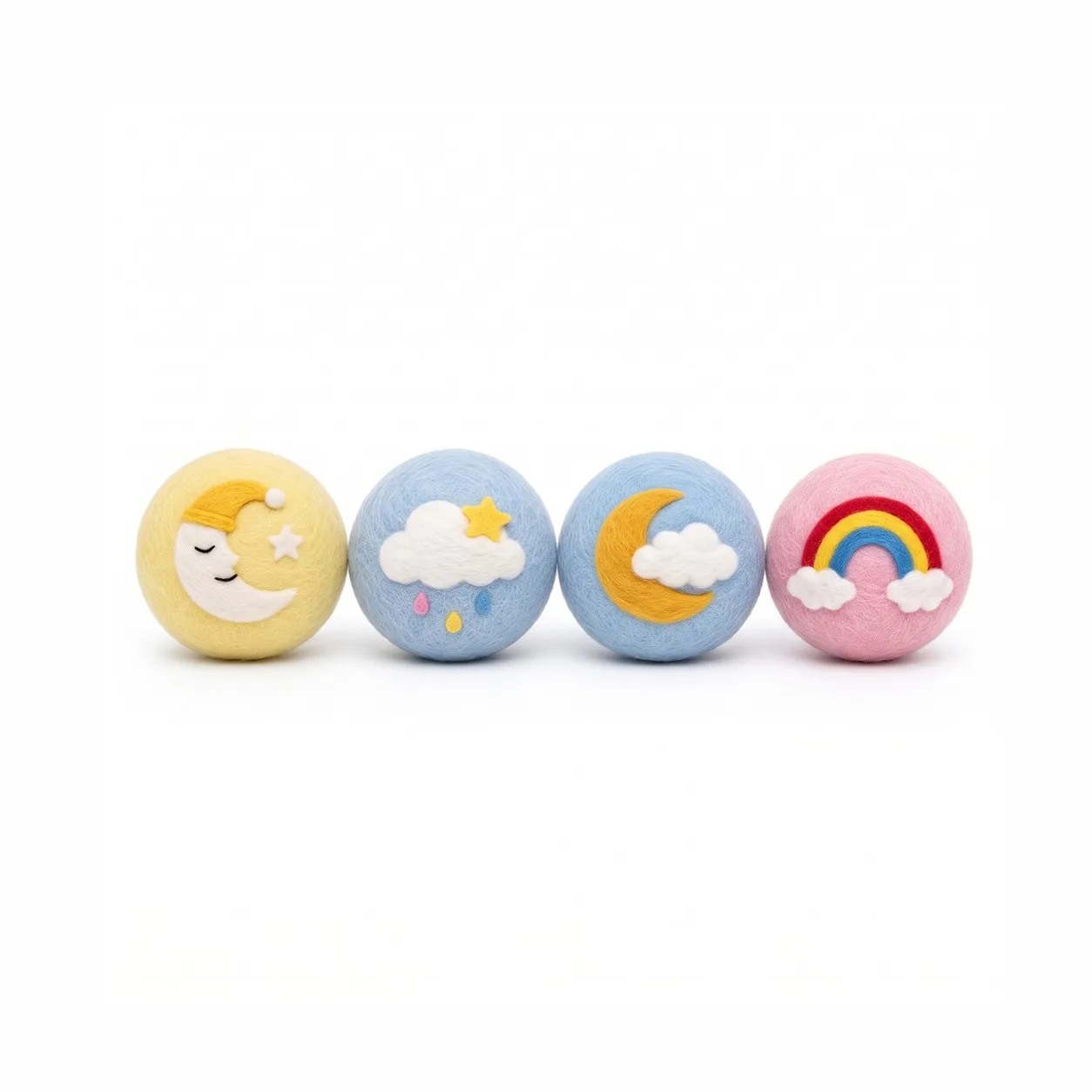
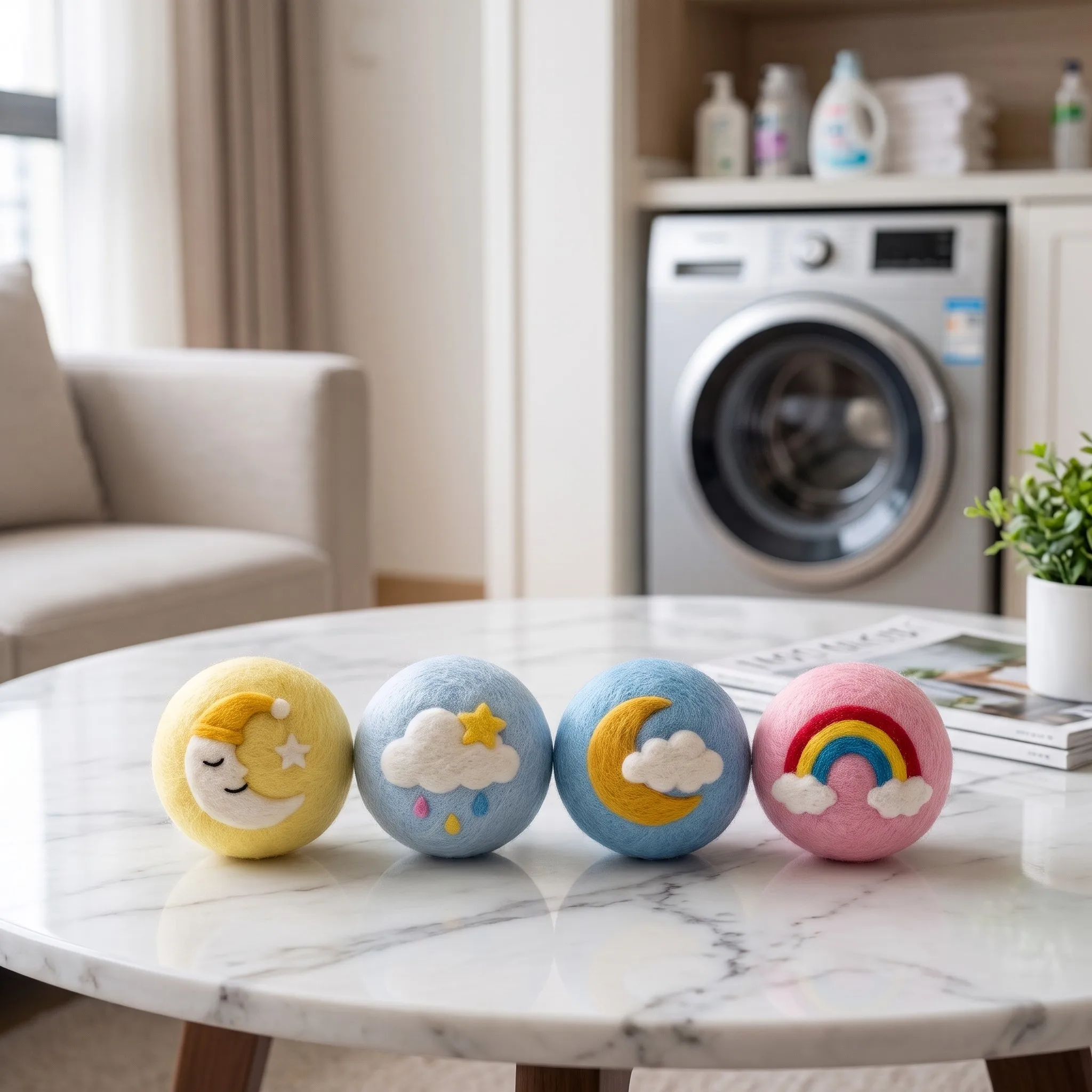
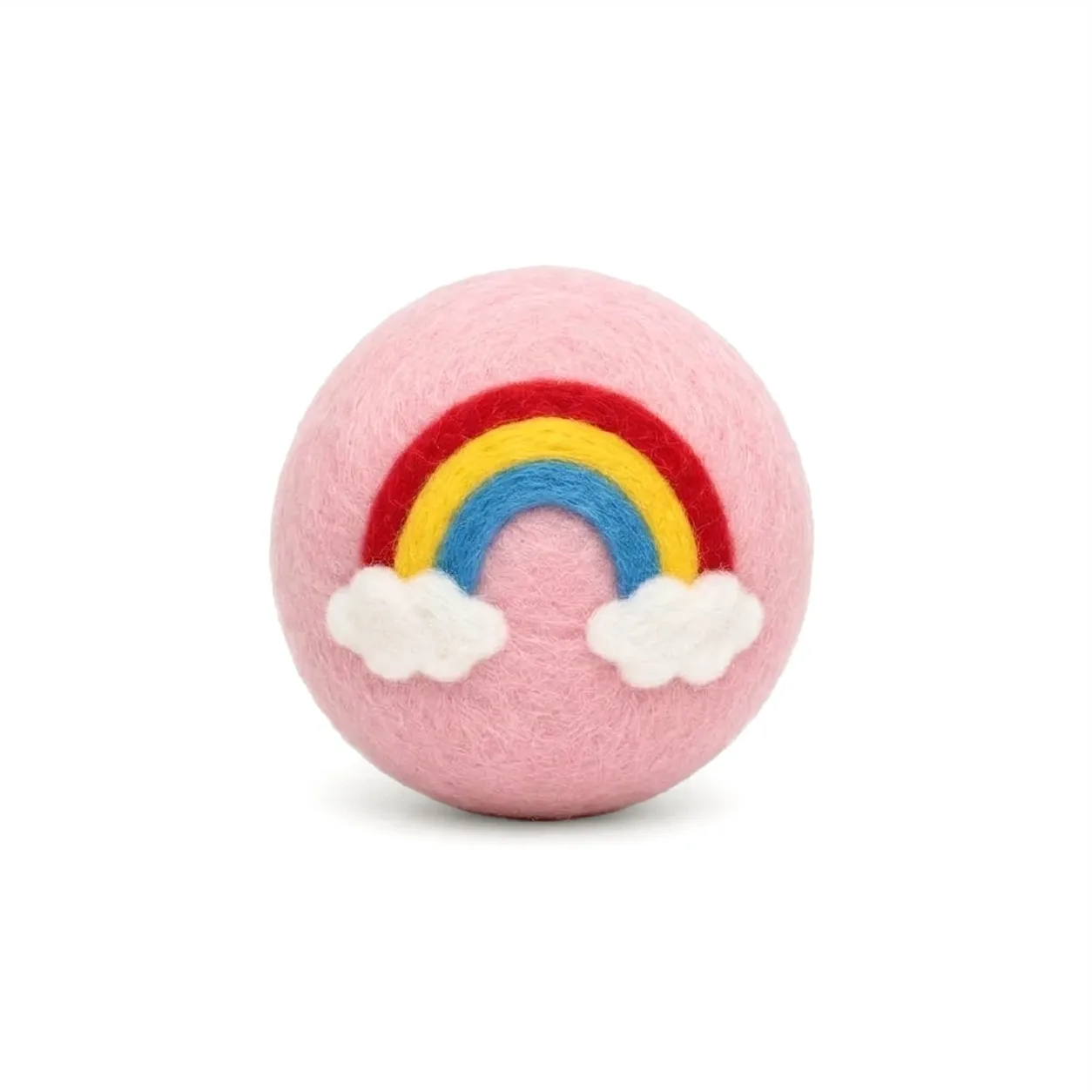
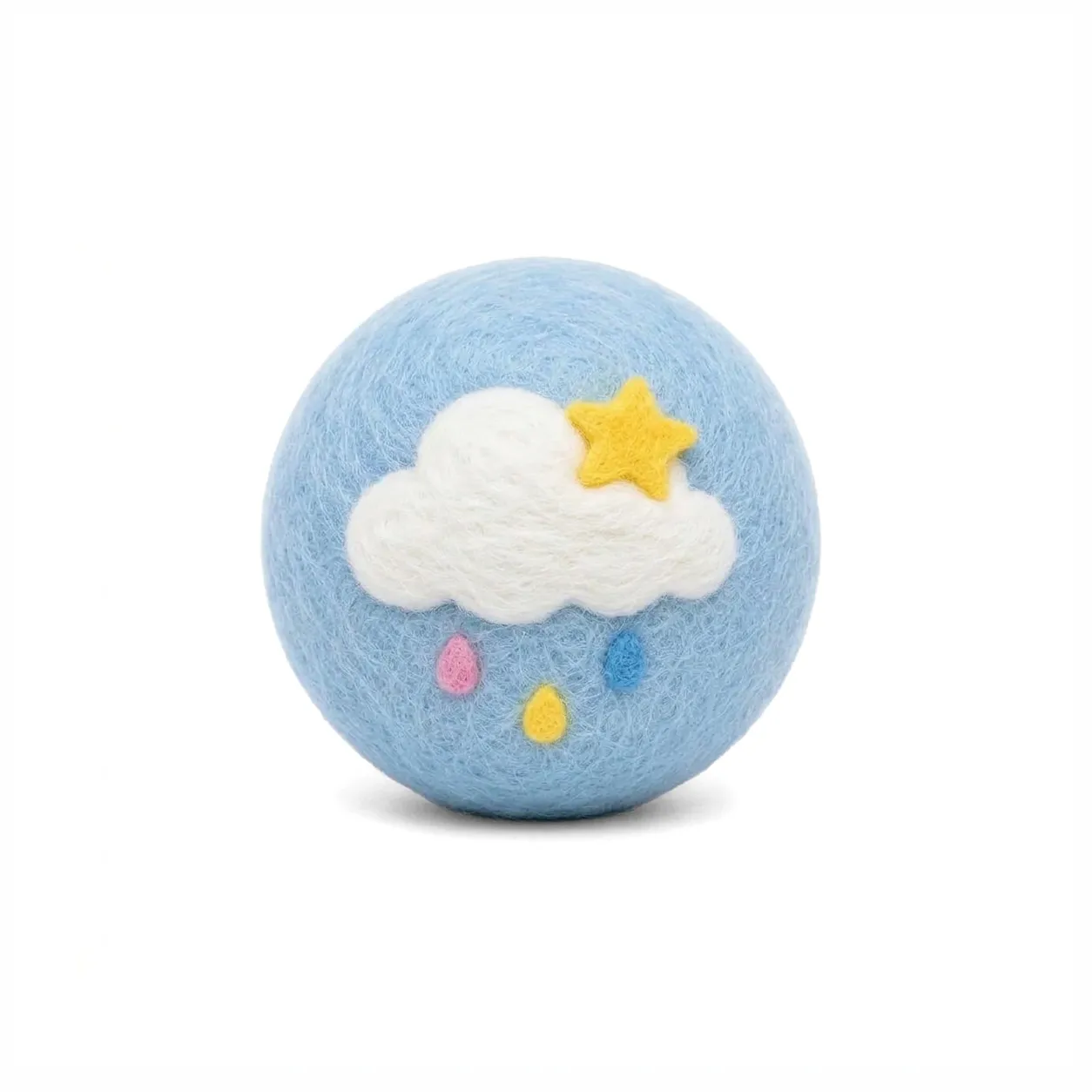
A moon, a rain cloud, a rainbow — needle-felted onto a wool ball — changes what the product is. It stops being a laundry consumable and becomes a gift: a baby shower present, a nursery ornament, a small branded item that a retailer can put at the till.
That is a legitimate and valuable line, and it needs its own discipline. Because the design is built from the same fibre as the body, needle felting integrates it into the felt structure; the decoration becomes part of the ball rather than a layer sitting on it. That is the only method that survives the drum.
Two commercial notes. First, decorative sets sell at a higher price but carry a higher labour cost, because needle felting a design is hand work and does not scale the way the body does — the sample lead time reflects that. Second, the packaging should make the intended use explicit. A set sold as a laundry accessory will be used as one and must be colourfast under heat and moisture; a set sold as an ornament has no such exposure. Clear positioning protects both the product and the review score.
Drying Performance: What to Claim and What Not To
The honest mechanism is worth understanding, because it determines what can be claimed on a box.
A dense wool ball separates layers of wet fabric, which opens air paths through the load. It repositions fabric against the airflow. It absorbs some surface moisture and releases it into the air stream. The result is more even drying, fewer overdried hot spots, reduced static, and a time saving that varies with load size, machine type and how much water the wash retained.
What a ball cannot do is compensate for an overloaded drum or a restricted vent. It also cannot be quantified as a single percentage across every household, which is why fixed claims of a large time reduction tend to generate returns rather than repeat orders.
For a private-label programme, the more durable positioning is the one that survives measurement: less lint, less static, no chemical softener, and a product that replaces a consumable with something reusable. Those claims hold up in a customer’s own laundry, and they are the ones that produce a second purchase.
From 1983: Volume Production of a Difficult Shape
A sphere is an awkward thing to manufacture at volume in felt. It has no seam to hide variation, no flat face to calibrate against, and the density has to be consistent through the centre as well as at the surface.
Four decades of felt production is relevant here mostly as process control: consistent fibre blending, controlled needling density, and a quality gate that checks weight and compression rather than only appearance. With more than eighty workers, most of whom have spent over a decade in the felt trade, the knowledge that a batch is drifting tends to exist on the floor before it appears in a measurement.
For a buyer, that translates into two practical things. A repeat order that arrives close to the approved sample, and a supplier who can explain what changed when it does not. In a product where the customer cannot see the difference in a photograph, that consistency is the whole of the quality story.
Frequently Asked Questions
Does the wool source really change how a dryer ball performs?▾
Yes, through staple length and crimp. Long, crimped fibre needles into a felt that keeps its density, which is what allows the ball to keep separating fabric layers over time. Short fibre produces a ball that looks right and compacts early.
How can I tell a needled ball from a wrapped one?▾
Cut it open. A needle-felted ball is uniform wool to the centre. A wrapped ball shows a distinct core, which is often synthetic — in which case a 100% wool claim is not accurate.
What should I specify when ordering?▾
Diameter and weight stated together with a batch tolerance, wool content with the core construction described, colourfastness, and the fixing method for any decorative appliqué. A compression test on a sample answers more than a density figure that cannot be verified.
Are the decorative designs suitable for use in a dryer?▾
If they are needle-felted into the body, yes — the design is part of the felt structure. A glued appliqué is a different product and should not go in a drum. Confirm the method in writing before approving artwork.
What certifications matter for the European market?▾
RWS for the wool source, BSCI for social compliance, ISO 9001 for the quality system, and REACH for chemical compliance, with OEKO-TEX Standard 100 where the end use involves babies or small children. Buyers should ask for the certificate that references the material actually shipped.
Can these be produced as a private-label gift set?▾
Yes, including printed cartons, insert cards and barcode placement. Decorative designs are hand needle-felted, so the sampling lead time and the minimum order reflect the labour in the artwork rather than only the wool.
Send Us the Room, We’ll Send the Numbers
Tell us the wall dimensions and what the room is used for. We’ll come back with a panel count, a layout and a sample in your colour.
Post time: Nov-25-2026