
3D Acoustic Wall Panels: Specifying a Panel That Survives a Submittal
A 3D acoustic wall panel is usually bought twice. The first purchase is the design decision — pattern, colour, depth, coverage. The second is the submittal, and that is where a surprising number of otherwise good products stop.
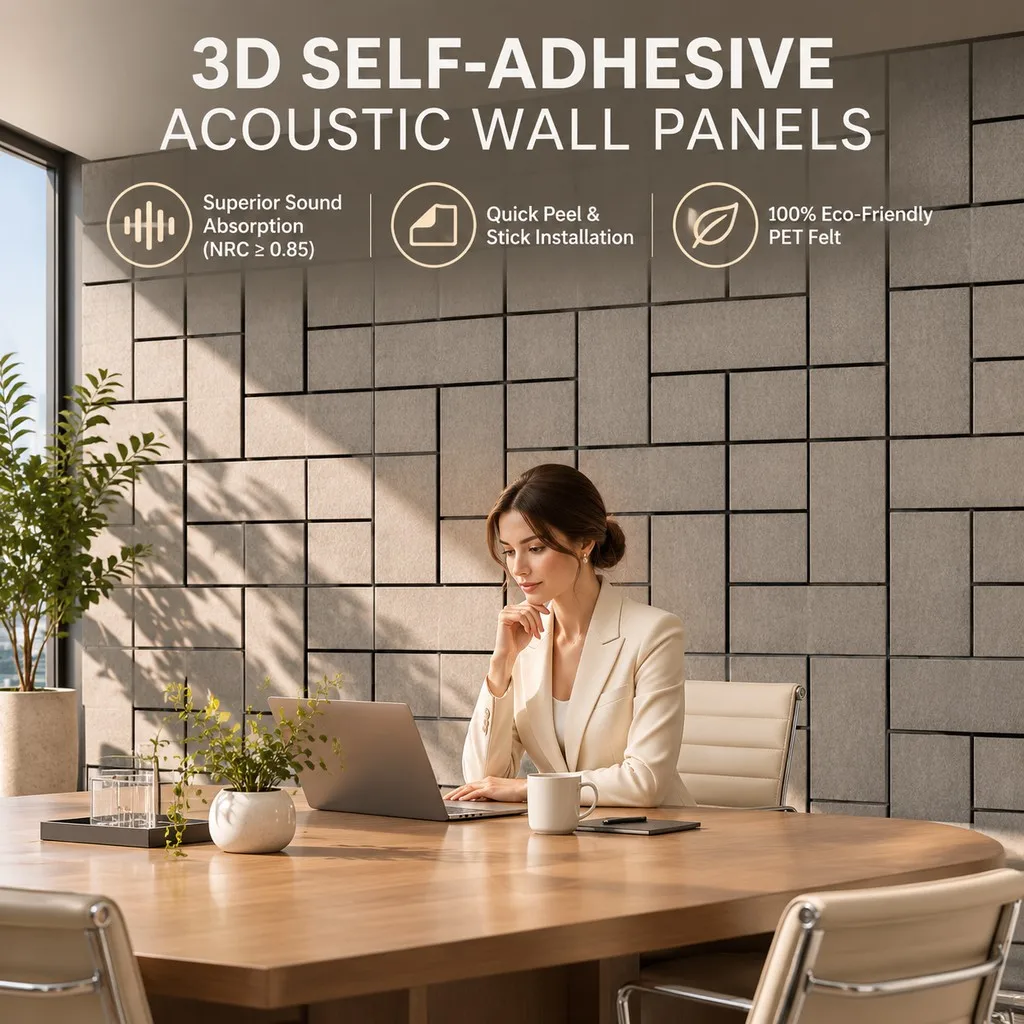
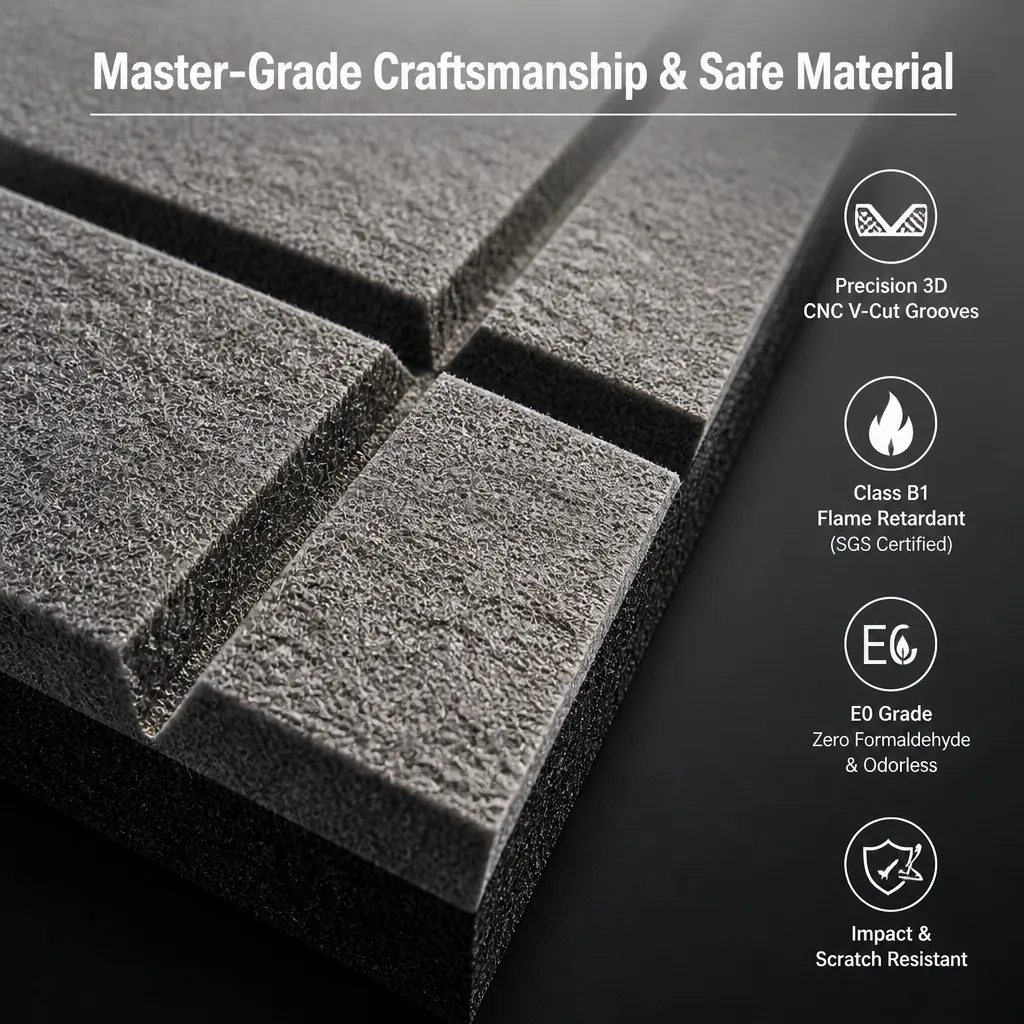
The panel described here is a dual-layer composite: a 3D CNC-cut PET felt face bonded to a high-density black acoustic baseboard, with a pressure-sensitive adhesive backing and a peelable release liner. It is declared at NRC 0.85 or above, Class B1 flame retardant, and a low-emission board grade. Those three declarations are all defensible. The problem is that two of them are written in a language a European or American reviewer does not use, and the gap is not technical — it is documentary.
In this guide — jump to a section▾
The problem is that two of them are written in a language a European or American reviewer does not use, and the gap is not technical — it is documentary.
Why a Dual-Layer Panel Solves What a Single Felt Tile Cannot
A thin felt tile is a mid and high frequency absorber. It removes the reflections that make a room sound bright and hollow, and it does that well. It has almost no effect below roughly 250 Hz, because a porous absorber needs thickness comparable to a meaningful fraction of the wavelength it is meant to engage.
The dual-layer construction attacks that limit from a different direction. The CNC-cut face provides the visible 3D surface and the mid-high absorption. The high-density baseboard beneath it acts as a denser resistive layer with its own mass, which extends useful absorption downward and damps the resonance a thin tile develops when bonded directly to a hard wall. Stacking two absorbers with different flow resistance is a standard way to broaden the absorption curve without doubling the installed depth.
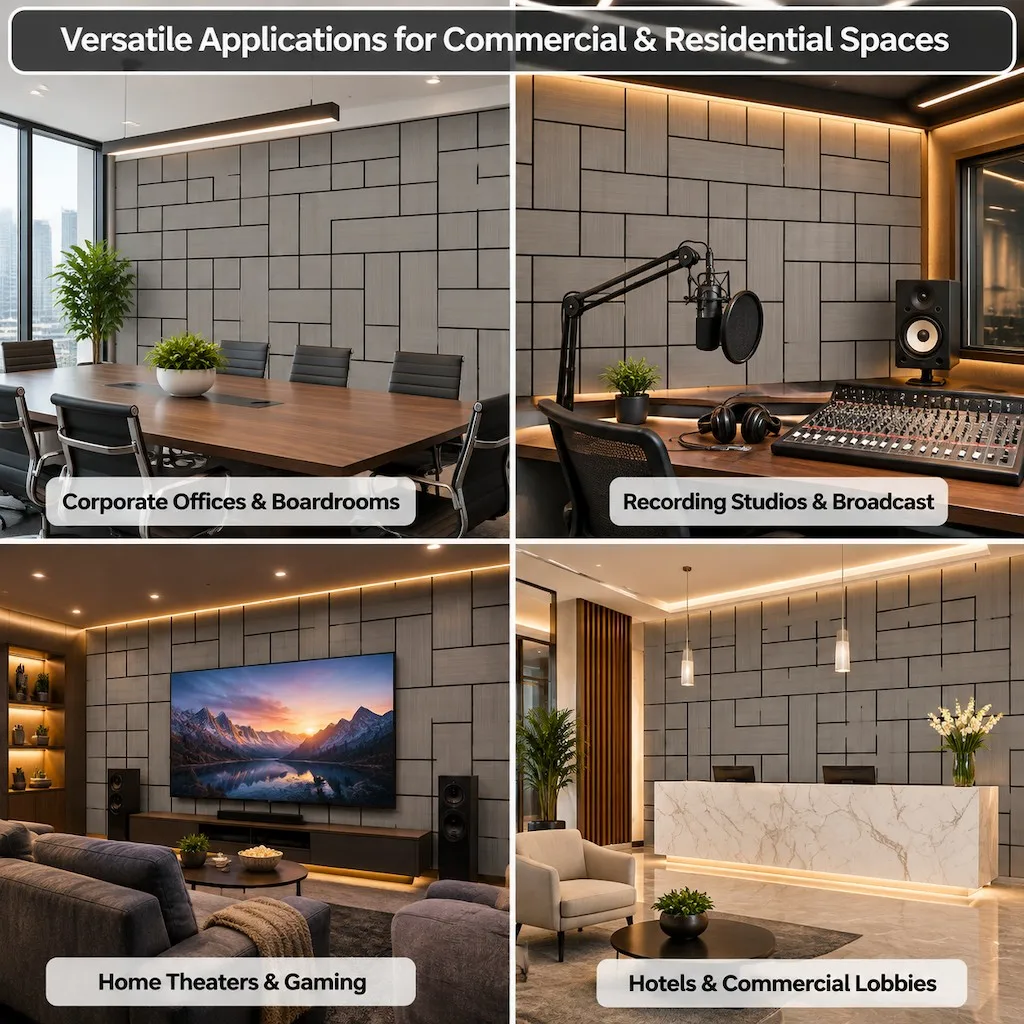
Where this matters in commercial work: meeting rooms where the complaint is that speech is tiring rather than inaudible, hotel corridors, small cinema rooms, broadcast positions where the microphone hears the room, and reception areas finished in stone or tile. In all of those, a decorative tile gets rejected as insufficient and a bass trap is unnecessary. The dual-layer panel occupies the space between.
Reading NRC 0.85 Correctly
NRC is the average of absorption coefficients at 250, 500, 1000 and 2000 Hz, rounded to the nearest 0.05. It is a surface property, measured in a reverberation room to a recognised standard, and it does not include any frequency below 250 Hz.
Two consequences follow. First, NRC is a comparator, not an outcome: it tells a specifier how a panel ranks against another panel, not how quiet a room will become. Second, a panel with a high NRC can still leave a room with a low-frequency problem, because the metric stops at 250 Hz. Any proposal that leans on NRC alone to answer a bass complaint is answering a different question.
The metric to quote in a submittal is the NRC with the test standard behind it — ISO 354 or ASTM C423, depending on the market. Where a project has a real low-frequency requirement, the answer is usually additional depth or dedicated corner treatment, not a higher NRC on the same thickness.
The Submittal Problem: B1, EN 13501-1 and ASTM E84
Class B1 comes from GB 8624, the Chinese reaction-to-fire classification. It is a real test result, produced in a real laboratory, and it is not the document a European or American reviewer can file.
In the EU the framework is EN 13501-1, which classifies reaction to fire with additional sub-classes for smoke production and flaming droplets. A wall panel in a public interior is commonly specified at B-s1,d0 or better. In the US the reference is ASTM E84, expressed as Class A, B or C from flame spread and smoke developed index, with Class A being what most commercial interiors require.
The commercial cost of this gap is asymmetric. A supplier who ships a B1 panel into a European fit-out and only learns at submittal stage that the classification is not accepted has lost the order and the relationship, and has usually already paid for the freight. The question belongs at sample stage, and it needs to be specific: which standard, which laboratory, and does the report describe the complete assembly rather than only the felt face. A dual-layer panel is a composite, and a report for the face material alone does not cover the product being sold.
Low-Emission Claims in English: E0 and What Reviewers Actually File
E0 is a board grade from Chinese and Japanese classification systems. It is a legitimate indicator of low formaldehyde emission. It is not a grade that exists in the EU or US regulatory framework, so a sheet that says only “E0″ leaves a compliance reviewer with nothing to attach to a file.
What that reviewer needs is an EN 717-1 chamber result for the EU, and for the US either CARB Phase II or TSCA Title VI compliance, with a California Proposition 65 statement increasingly requested by larger accounts. A chamber test result is the document; a grade name is the shorthand.
There is a second emission source in this product that the board grade does not cover. The pressure-sensitive adhesive is a chemical system, and the odour noticed in the first days after installation is usually the adhesive rather than the felt. For retrofit work in occupied buildings — a hotel floor, an office with staff in it — the operative question from a facilities manager is what off-gasses in week one and whether a low-VOC adhesive is available. That question is rarely asked at specification stage and almost always asked on site.
Pattern, Thickness and the Design Review
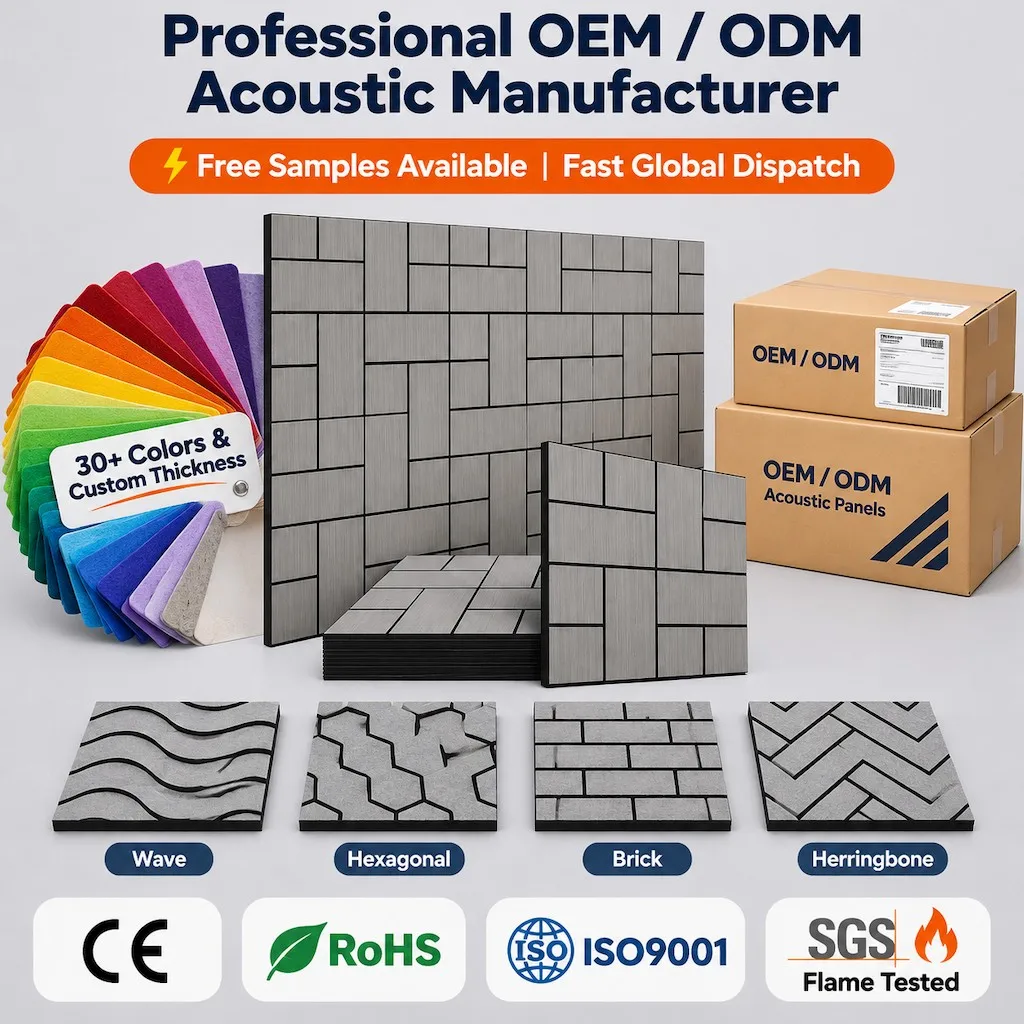
Four patterns are produced — wave, hexagonal, brick and herringbone — and they behave differently under light in ways that matter to a designer and to a buyer approving a sample.
The V-groove depth controls the shadow line. A deeper cut reads as a stronger relief and, because exposed surface area rises slightly with depth, contributes marginally to absorption. The same colour applied across four patterns will not read as the same colour, because the proportion of shadow to lit face differs. Raising this at design stage prevents a colour complaint later that is actually a pattern decision.
Thickness is the lever buyers underuse. It drives both the depth of the relief and the low-mid absorption, so a project that wants a stronger 3D effect and better performance in the 250 to 500 Hz region can often be satisfied with custom thickness rather than with more coverage. That is a cheaper answer than adding square metres.
Adhesive, Substrate and Service Life in Commercial Use
A pressure-sensitive backing performs on a prepared substrate and fails on an unprepared one. The four recurring failures are freshly painted walls where the paint is still curing and the adhesive slides, dusty plaster where the bond forms to dust rather than wall, damp or cold surfaces where the adhesive cannot wet out, and textured or vinyl wallcoverings where contact is limited to the high points.
In commercial use the substrate question is compounded by what happens at the end of the fit-out. A panel bonded to a plasterboard wall is straightforward to remove with heat and a slow peel; the same panel on a painted wall will usually take the paint with it. For leased space and for exhibition or event work, that is a real cost and should be discussed before the specification is fixed rather than after.
Ceilings require mechanical retention regardless of the adhesive rating. Overhead bonding is not a defensible primary fixing in a commercial building.
Volume, Colour Consistency and Container Planning
Two operational issues decide whether a repeat order is profitable.
The first is colour consistency across production runs. With a palette of thirty or more colours, availability is rarely the problem; matching the previous run is. For phased delivery or a retail range, the buyer should approve a sample drawn from the production batch and retain a physical reference piece, so a later shipment can be compared against something real rather than a screen or a colour card.
The second is freight. Panels are flat, bulky and light, so a container fills on volume before it reaches a weight limit. Carton configuration designed around the pallet module, rather than around a round number of panels, is the difference between a workable landed cost and a marginal one — and it is settled at quotation stage or not at all. Ask for the carton dimensions and the units per pallet before you compare unit prices, because two quotes that look identical per panel can differ substantially per container.
Frequently Asked Questions
Is a 3D acoustic panel a soundproofing product?▾
No. It absorbs sound within the room and reduces reverberation. Blocking transmission through a wall needs mass, sealing and decoupling. The two requirements should be separated before a specification is written.
What NRC can be expected and to what standard?▾
The declared value is 0.85 or above. For a submittal, the figure should be accompanied by the test standard — ISO 354 or ASTM C423 — because NRC without a standard behind it is a claim rather than a specification.
Will a Class B1 rating be accepted in Europe or the US?▾
Not directly. Class B1 is a GB 8624 classification. European reviewers work to EN 13501-1 and US reviewers to ASTM E84. Buyers should request the report matching their market at sample stage, and confirm it covers the full dual-layer assembly.
Are the panels suitable for a hotel or office refurbishment while the building is occupied?▾
That is the intended use, and the constraints are substrate preparation and adhesive odour rather than installation method. Clean, dry, dust-free walls, a low-VOC adhesive where available, and a trial panel before the wall is committed.
Can pattern, colour and thickness be customised?▾
Yes. Four patterns are standard, with custom colour matching and custom thickness available, along with printed cartons and barcode placement for private label. Custom thickness also changes the acoustic behaviour, so it should be fixed before the acoustic calculation rather than after.
What coverage does a typical room need?▾
It depends on the surfaces that generate the strongest reflections rather than on a fixed percentage. The wall behind the speaker or screen, the side walls at seated ear height and the rear wall carry most of the benefit in a small room. Larger rooms should be calculated rather than estimated.
Send Us the Room, We’ll Send the Numbers
Tell us the wall dimensions and what the room is used for. We’ll come back with a panel count, a layout and a sample in your colour.
Post time: Nov-25-2026