
Felt Toy Storage Baskets: What Keeps a Soft Bin Standing After a Year of Toddlers
Most soft storage bins look correct on the day they are photographed and fail within a season. The rim ovalises, the base sags into a curve, the sides crease where the fabric was folded, and the appliqué face lifts at one corner.
None of those failures are caused by the design. They are caused by four construction decisions — the base, the felt weight, the seam, and the attachment of the decorative face — and each one can be settled correctly at sample stage or discovered painfully at the returns stage.
In this guide — jump to a section▾
The commercial risk in this product is not the first sample. It is the fourth container.
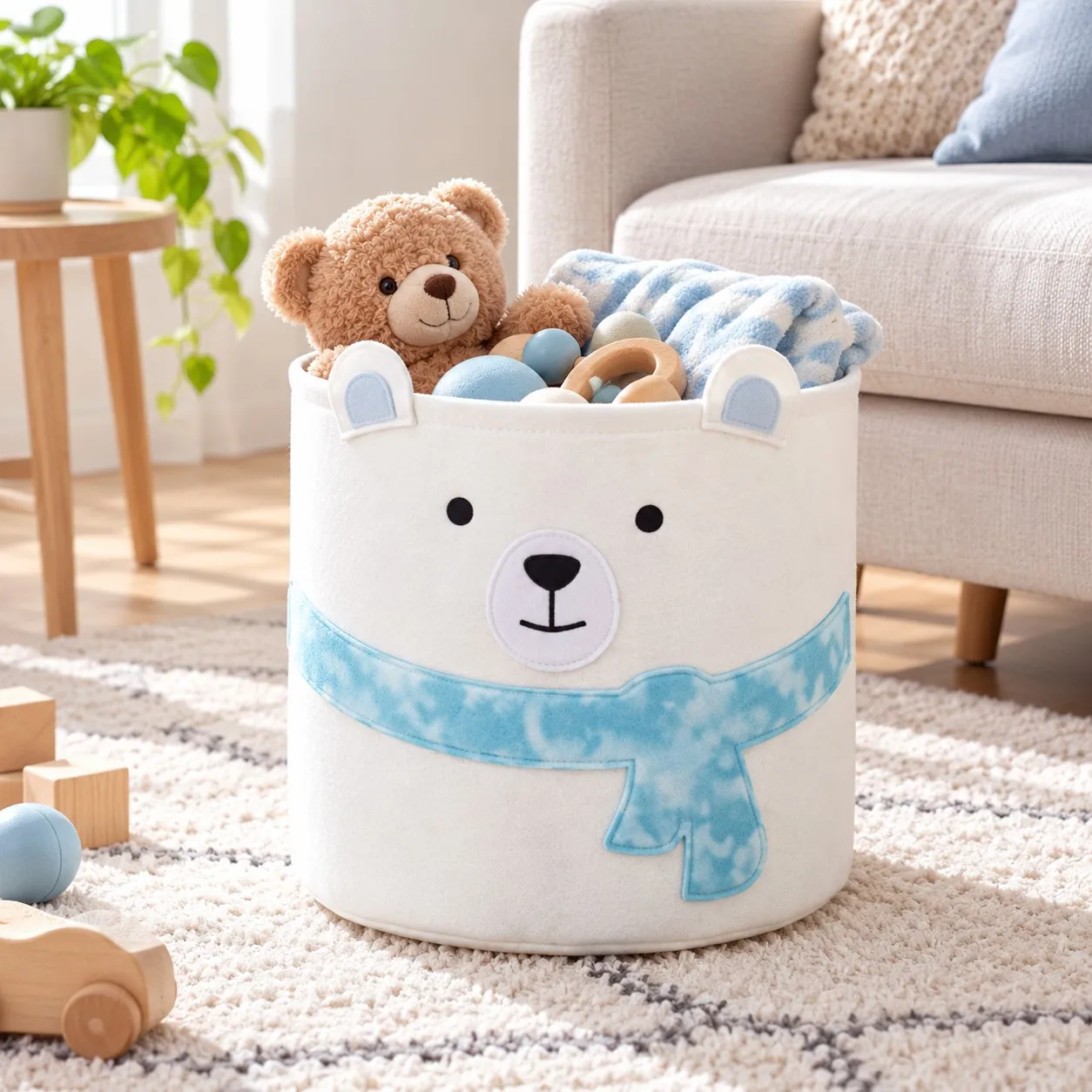
Why Soft Sides Need a Firm Base
A felt cylinder is a tube with no structural memory in its footprint. Once it is loaded, the wall carries no vertical column and the load resolves into the base. If the base is a single layer of the same felt as the body, it deflects, the footprint changes shape, and the rim follows.
A rigid base panel — a board insert or a moulded polymer sheet, captured in a reinforced seam so that it cannot shift — converts the tube into a vessel. The panel takes the load, the wall only has to hold the contents in, and the footprint stays round.
The detail that matters is how the panel is captured. A panel dropped loose into a pocket can migrate and eventually wear through the base seam. A panel held in a double-stitched channel, or bonded into a base assembly, stays where it was placed. Buyers who ask only whether there is a base, and not how it is held, tend to receive the first version.
Felt Thickness: What 2 mm and 4 mm Do Differently
Thickness is the most over-simplified specification in this category, because two felts of the same thickness can behave differently depending on density, and neither property is visible in a photograph.
A light felt of around 2 mm gives drape, softness and a low unit cost. It also has limited resistance to a loaded wall, and it creases more readily when compressed in a carton. A heavier felt of around 4 mm stands on its own when empty, resists the bowing that comes from a full basket, and recovers from compression far better — which matters because compression is exactly what happens in a shipping container.
Density is the second half of the story. A needled felt with high fibre entanglement at the same nominal thickness will hold shape better than a loosely needled one, and it will also resist pilling on the outer face where hands and toys rub. That is a property of the needling process, not of the fibre alone, which is why the same specification from two factories can produce two different products.
The practical test is compression recovery: fold the wall over, hold it for a minute, release, and watch. A felt with adequate density returns most of the way; a light one keeps the crease.
The Face: How Appliqué Is Attached and Why It Matters
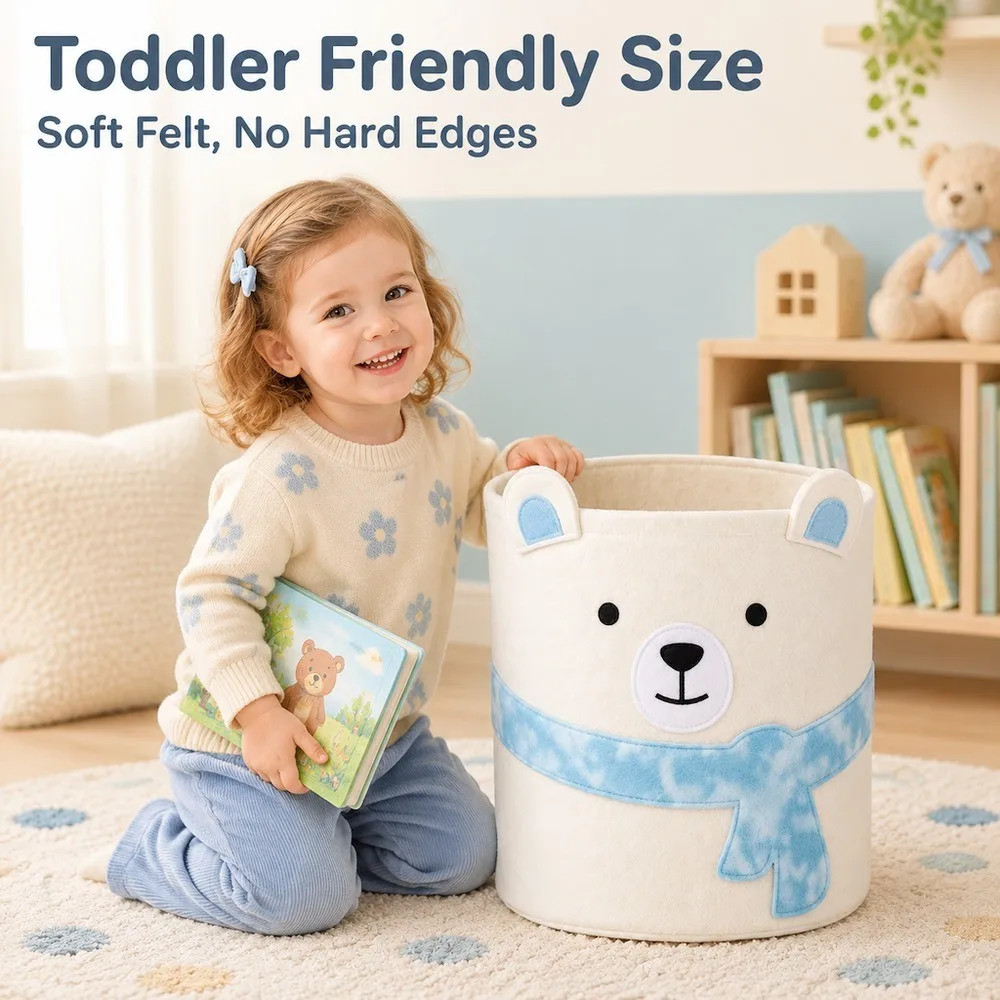
The bear face is the commercial reason the product exists, and it is also the first place a soft bin fails in service.
Eyes and nose are small elements on a curved surface, which is the worst combination for adhesive. Curved surfaces peel from the edge inward, and heat in a nursery or a container accelerates it. A glued appliqué that looks perfect in a sample can lift within weeks.
The robust methods are stitching with adequate stitch density and a backing layer, or needle felting the element into the body so that the fibre of the design and the fibre of the wall are the same continuous mass. Both survive handling; the needle-felted version also removes the possibility of a detached small part, which is the reason it is preferred for anything that will live at a toddler’s height.
This is a specification item that should be written down and tested, not inferred from a sample. A pull test on the finished item, at a stated force, with a stated pass result, is a normal requirement for a nursery product and a reasonable thing for a buyer to demand.

Toddler Testing: Drop, Pull, Tipping
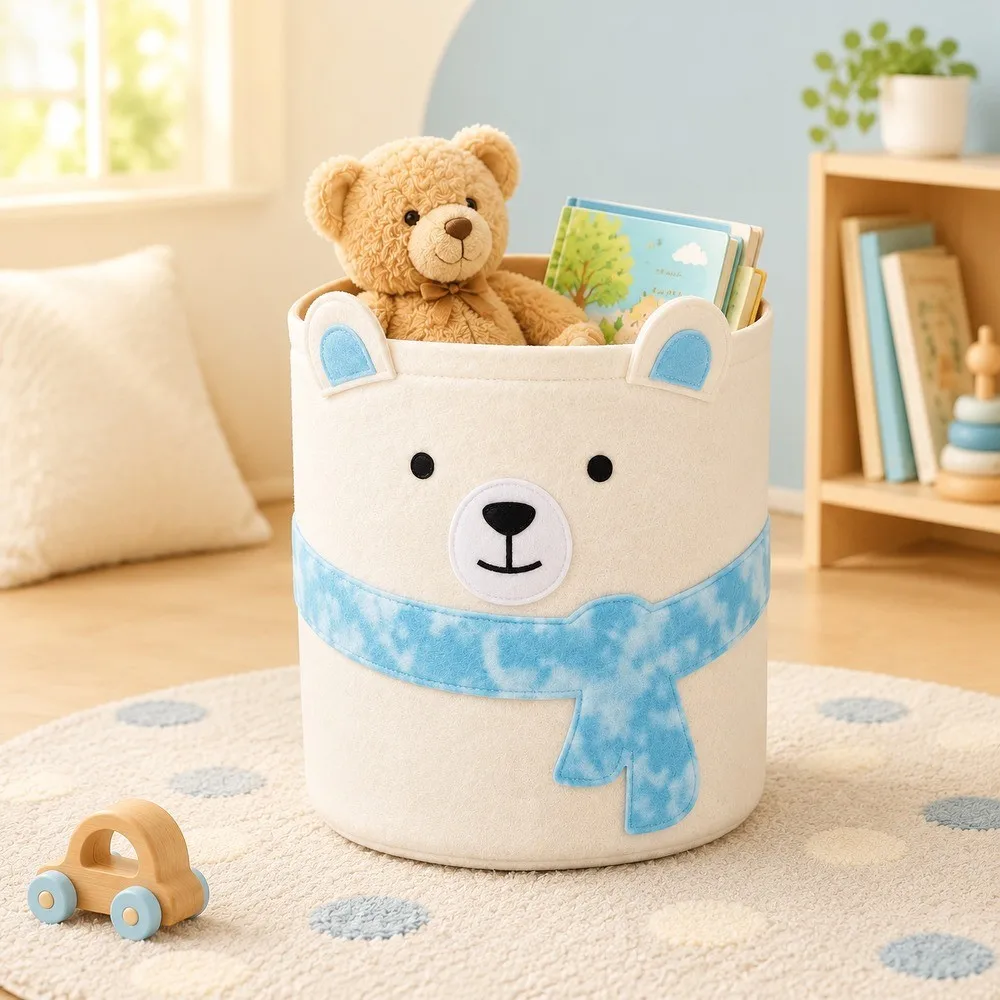
A storage basket in a child’s room is used in ways a buyer’s test protocol rarely anticipates. It is dragged, sat on, tipped over and used as a step.
Three tests cover most of the failure modes and need no laboratory. Load it to working capacity and leave it for a day, to check the base and rim. Pull the appliqué elements firmly in several directions, to check attachment. Tip it over repeatedly onto a hard floor, to check whether the rim deforms and whether the base panel moves inside its seam.
The safety argument that should be made loudly is the structural one: no hard frame, no sharp edge, no hinged lid. A felt bin in a toddler’s room is safe because it has nothing to fall against and nothing to trap a finger. That is a genuine product advantage and it deserves to be in the copy rather than implied by a photograph.
Colour Range Without Colour Drift
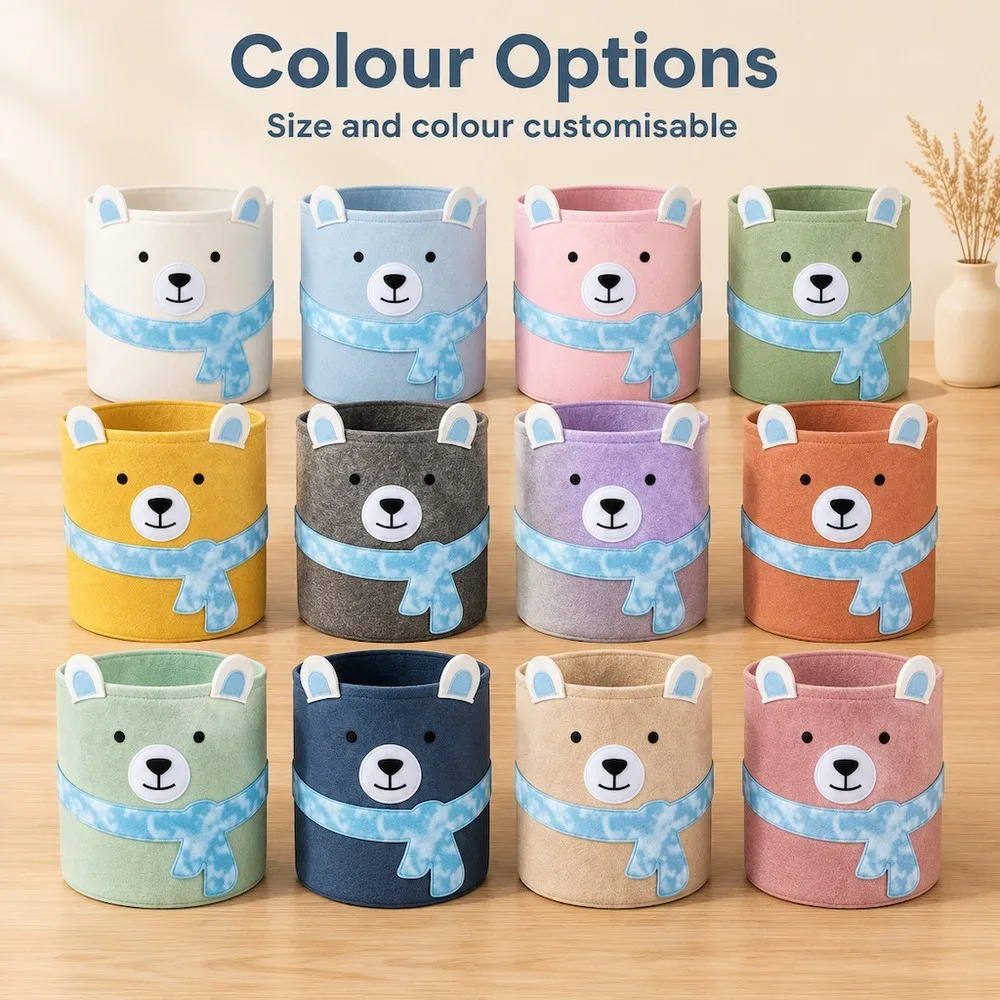
A range that runs from natural through pastel to deep navy is a dyeing programme, not a swatch card.
Two things drift. The dyed lot drifts, because a pale shade shows a small shade difference that a saturated one hides. And the finished appearance drifts with pile direction and surface finish, so two baskets from the same lot can read slightly differently on a shelf depending on which way the face was cut.
The controls are unglamorous and effective: dye in lots sized to the order, retain a physical standard per colour, match each new lot against the standard rather than against a digital reference, and cut the appliqué elements from a consistent direction.
There is also a use-side issue worth raising with a retailer. Pale colours show dust and marks; dark colours show lint, and felt attracts lint. A range that includes both needs a care card that addresses both, or the reviews will.
Care, Cleaning and Realistic Life
Felt is a nonwoven and it does not respond well to agitation. A basket put through a warm machine cycle mats, shrinks and loses its shape permanently.
The honest care regime is vacuuming with a brush attachment, spot cleaning with a damp cloth and mild detergent, and air drying flat away from direct heat. That should appear on the label and in the online listing, because a customer who expects to wash it will not be persuaded otherwise after the event.
Life expectancy depends on the base and the felt density rather than on the face. A basket with a captured panel and a dense wall will hold its form through years of light domestic use. One with a loose base and a light wall will look tired within a season, and the face will still be perfect, which is what makes the failure confusing to the customer.
There is a useful diagnostic in that. When a returned basket arrives with an intact face and a collapsed body, the fault is structural, not decorative, and it traces back to the base panel or the felt density — which means it can be corrected on the next run rather than argued about.
From Sample to Container: Consistency at Volume
The commercial risk in this product is not the first sample. It is the fourth container.
What keeps production consistent: a written specification covering dimensions, felt weight and density, base construction, appliqué method and colour standards; first-article approval against a retained sample held on both sides; and an in-process check at a defined interval rather than only at final inspection.
What breaks it: verbal specifications, a reference sample kept only at the factory, and dimensional changes accepted after the carton has been designed. All three are common, and all three show up as a complaint on a repeat order rather than the first — by which point the retailer has committed shelf space.
One further point belongs here. Because the product is bulky and light, the carton design is part of the quality story: a carton that compresses in a stack produces creased baskets, and a crease in felt does not fall out. Carton strength and stacking height should be agreed with the same seriousness as the felt specification.
Frequently Asked Questions
Will a felt basket stay round when it is full of toys?▾
It will if the base is a rigid panel captured in the seam. Without that, the wall bows and the footprint deforms under load, whatever the felt thickness. Ask how the panel is held, not just whether one exists.
Is a thicker felt always better?▾
Thicker felt holds shape better and recovers from compression, but density matters as much as thickness. A densely needled 2 mm felt can outperform a loosely needled 4 mm one. Compression recovery is the test that reveals the difference.
Can the decorative face detach?▾
Only if it is glued or poorly stitched. Needle-felting the elements into the body, or stitching with adequate density and a backing, removes the failure mode. A pull test on the finished item is the appropriate check.
Are these baskets safe in a toddler’s room?▾
The soft construction — no hard frame, no sharp edge, no hinged lid — is the safety advantage. The small appliqué elements are the part that needs testing, and they should be attached so that they cannot separate.
How should a felt basket be cleaned?▾
Vacuum with a brush attachment and spot clean with a damp cloth and mild detergent. Do not machine wash at temperature; agitation mats and shrinks the felt.
Can dimensions and colours be customised?▾
Yes, both. Note that a dimensional change alters the carton and therefore the container load, so dimensions should be fixed before packaging is designed.
Send Us the Room, We’ll Send the Numbers
Tell us the wall dimensions and what the room is used for. We’ll come back with a panel count, a layout and a sample in your colour.
Post time: Nov-25-2026