
Felt Pin Boards That Look Like Wall Art: Why Cut-Out Felt Beats Cork
A felt pin board does two jobs that are usually sold as two products. It holds notes, drawings and photographs on the wall, and it is worth looking at when nothing is pinned to it. Cork does the first badly and the second not at all. Printed canvas does the second and cannot hold a pin.
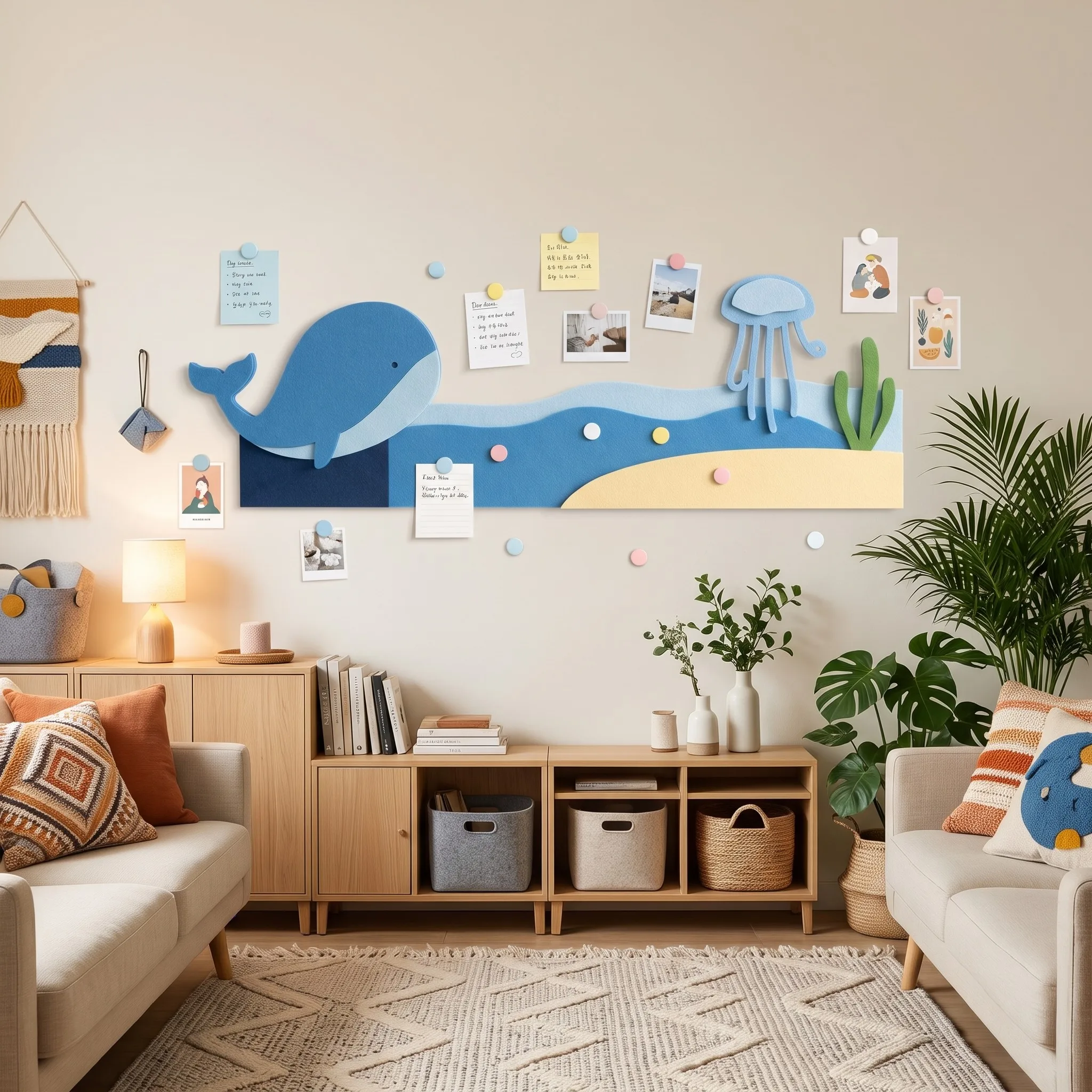
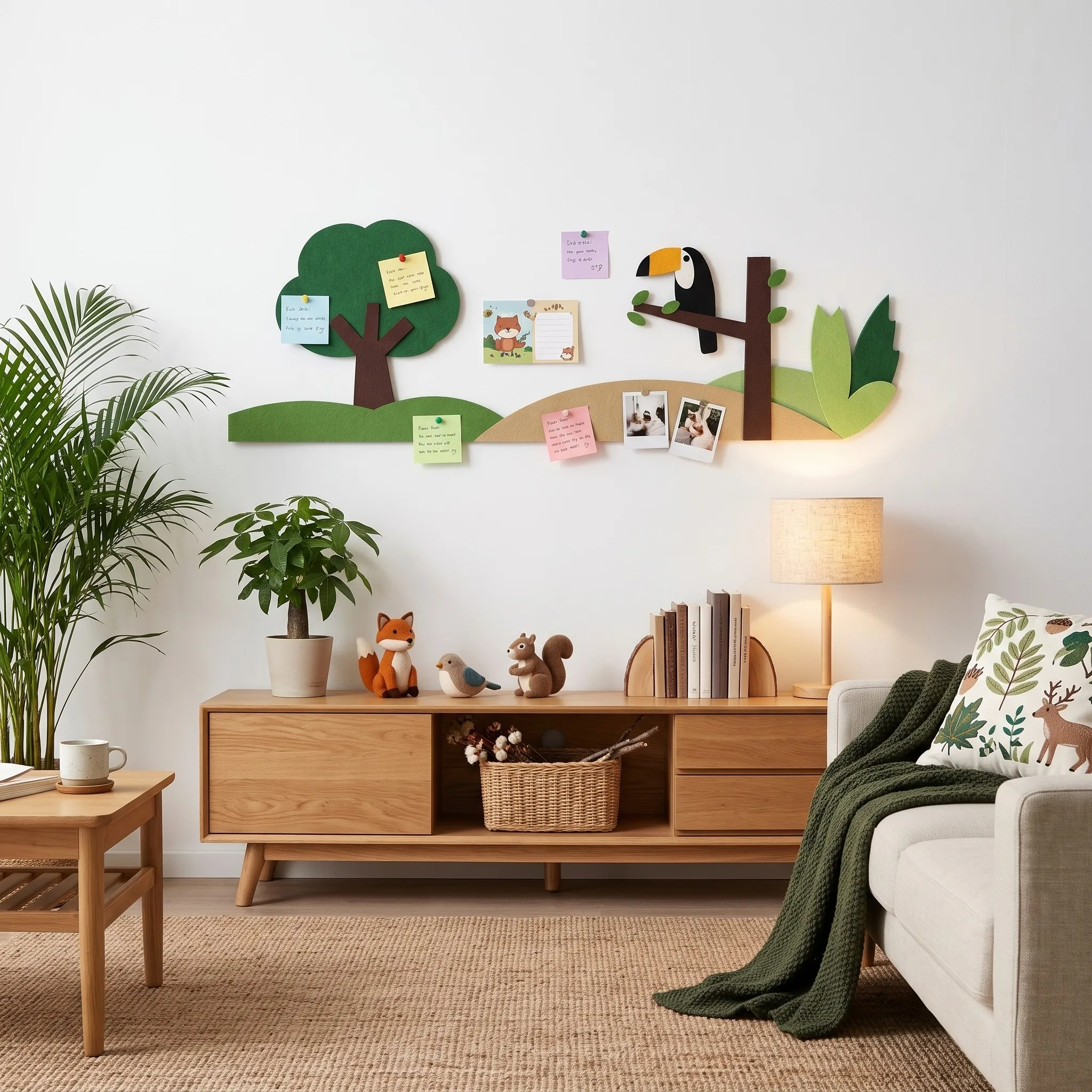
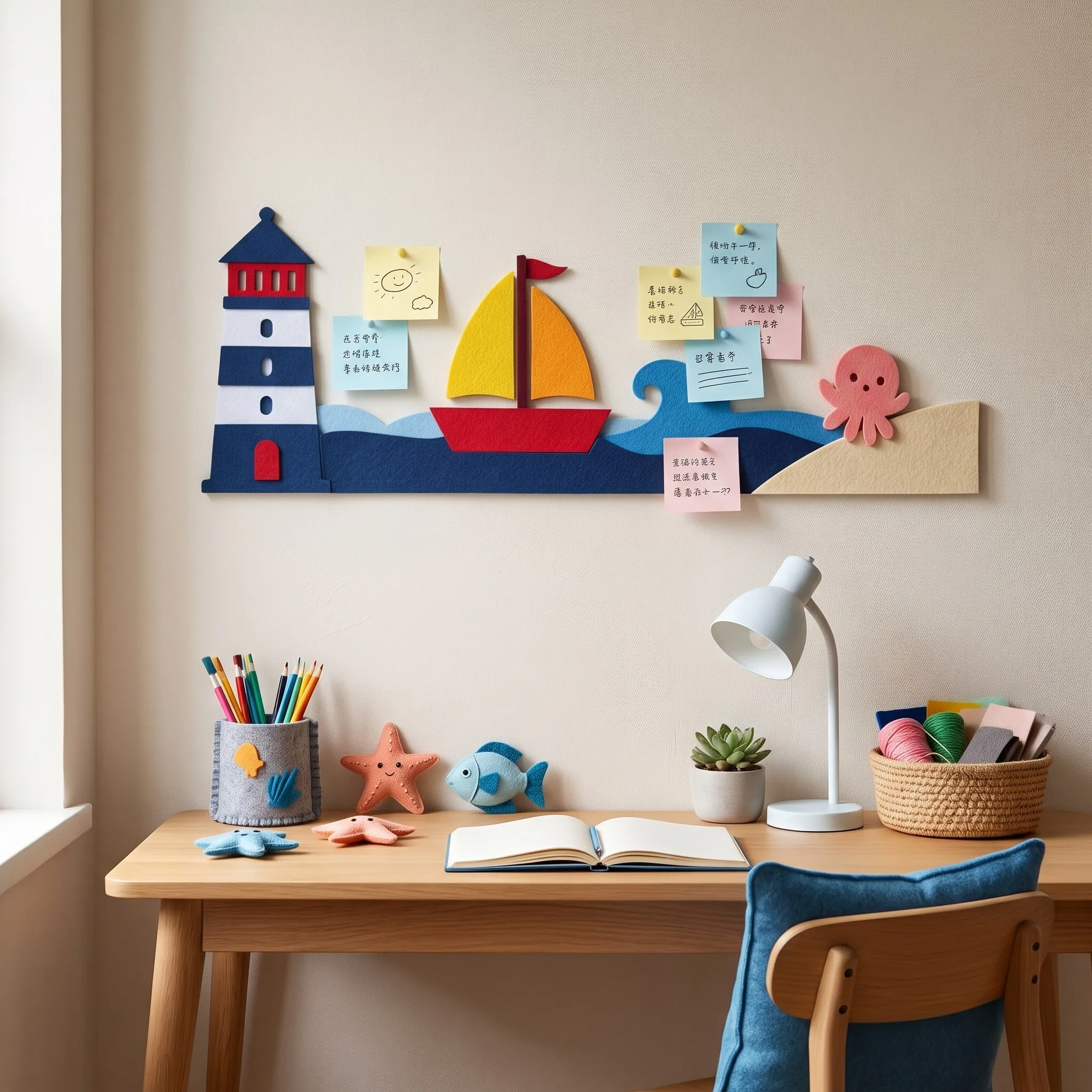
The version we produce is a 9 mm recycled PET felt panel, cut into layered shapes — a whale and a wave band, a lighthouse and a sailboat, a tree canopy with a sloth on the branch — and mounted as a single composition. The cut-outs are not printed decoration; they are the same material, at two depths, so the surface both absorbs sound and takes a pin.
In this guide — jump to a section▾
The design also solves the pin board’s oldest visual problem: what it looks like when it is empty.
What a Felt Pin Board Does That Cork and Fabric Cannot
Cork works because it is a mass of soft particles that a pin can push between. The problem is that each push breaks the bond between particles. After a few years in a busy kitchen, the board is a field of crumbling holes and nothing holds.
Fabric-covered board fails differently. The weave opens where the pin passes, and over time the covering sags away from the backing. It also shows every piercing as a permanent mark.
Dense needled felt behaves better on both counts. The fibres are interlocked rather than glued, so a pin separates them and they close again, and the 9 mm thickness means the pin has real material to grip instead of a thin skin over a hollow frame. The surface can be vacuumed, wiped, and used for years without the pattern of use becoming the pattern of the board.
There is a third difference that only matters once the board is on the wall: felt absorbs sound. A hard kitchen or a small home office with painted plaster, tile and glass is acoustically bright, and a metre or two of 9 mm felt takes the edge off it. Cork reflects. Fabric reflects until it is thick enough to matter.
Why Cut-Out Felt Beats a Plain Rectangular Board
A rectangular pin board is a utility object. It gets hung where it is convenient rather than where it is seen, and it is the first thing taken down when a room is redecorated.
Cutting the same material into shapes changes where it can go. A wave band with a whale sits above a child’s desk at the height the child actually uses, and it reads as part of the room rather than as office equipment. A lighthouse and sailboat composition works in a bathroom or a coastal rental where a cork board would look absurd. A tree with a sloth and a toucan gives a nursery a subject instead of a rectangle.
The design also solves the pin board’s oldest visual problem: what it looks like when it is empty. A layered composition is a finished wall on the day it goes up. The notes add to it rather than being the only thing making it worth having.
The Acoustic Side Effect Nobody Expects
Buyers come to this product for the look and the pinning. The acoustic behaviour is a bonus that shows up in the first week and is worth understanding, because it explains why the panel feels different from a decal.
The base material is the same PET felt used in our acoustic panels, rated NRC 0.80–0.90 across the 250–2,000 Hz band. A cut-out composition covers less area than a full wall treatment, so the effect is proportional rather than dramatic: it reduces flutter and brightness in a small hard room, and it does very little in a large one. What it will not do is stop sound passing through a wall — that requires mass, airtightness and decoupling, and no thin porous material substitutes for it.
Where this matters commercially is in rooms that are used for two things. A child’s bedroom that is also a video-call corner, a home office with a hard floor, a playroom that echoes. The panel is doing decorative and acoustic work with the same square metre.
How a Composition Is Built
Every set starts with a horizon. The base band establishes sea, ground or sky in two or three tones, and the character pieces are layered in front at one or two depths so each element casts its own edge shadow. That shadow is what makes the panel read as an object rather than a print.
Three rules separate a set that looks designed from one that looks assembled. Set the horizon at the eye level of the person who will use it most — a child’s eye level, not an adult’s. Leave roughly a third of the felt open as pinning space; a fully populated wall has nowhere to put a note. And give one shape dominance: a whale at twice the size of the jellyfish is a composition, five equally sized animals is clip art.
The cutting itself is where material quality shows. A thin fin, a tentacle or a tree canopy edge has to hold its shape without a rigid backing. Low-density craft felt droops at those points within a season; a needled panel at 9 mm stays flat because the density is uniform through the thickness rather than just at the face.
Material Safety and the Documents Behind “Eco-Friendly”
The material claim in this category is usually a sentence on a page. It should be a document.
The base felt is recycled PET, and three certificates are relevant. GRS — the Global Recycled Standard — verifies recycled content and chain of custody, and the useful part is the declared percentage together with the transaction certificate for the batch. OEKO-TEX Standard 100 tests for harmful substances, with product classes that matter: Class I is the class for articles used by babies and small children, which is the one to specify for a nursery or a school. REACH is the EU chemical framework, and the operative part is the SVHC declaration.
What those certificates do not cover is equally worth knowing: colourfastness, dimensional stability and how the cut edges age in sunlight. Those are answered by a sample on a windowsill for two weeks, and by a production sample approved in the final colour before the bulk run.
Rolking has been producing felt since 1983, across nine production lines with more than eighty workers, and holds BSCI, RWS, ISO 9001 and GRS certification with REACH compliance declared. For a buyer building a range, that means the material documentation exists as a system rather than as a favour.
Fixing, Alignment and Long-Term Wear
A single piece goes up in minutes. A multi-piece set is a layout job, and the layout is what people notice.
Lay the set out on the floor first and photograph it, then transfer the base band position to the wall with a level and a pencil line. Work outward from the centre. Spacing between characters should be measured rather than eyeballed, because the eye reads an uneven gap as a mistake even when it cannot name it.
On the fixing method: pressure-sensitive adhesive holds well on a clean, dry, fully cured painted wall, and fails on fresh paint, dusty plaster, damp walls and textured wallpaper. Where the wall must survive — a rental, a heritage interior, a hotel refurbishment — use removable adhesive strips or pins. Above a radiator or in a bathroom, adhesive is the wrong choice on both counts.
Wear shows in two places. Sun will shift a strong colour over years, which is why a windowsill sample is worth the fortnight. And cut edges at a thin point can curl if the panel was cut from low-density material; the fix is density at the specification stage, not adhesive at the installation stage.
Volume Production From a Felt Mill
Most of the enquiries that reach us are not for a single set. They are a retailer needing four themes for a season, a subscription box needing a new design each quarter, a school district ordering for a dozen classrooms, or an importer building a private-label range with their own packaging.
The route from artwork to container runs through a cutting die or a programmed cutter, a colour match against a physical swatch rather than a screen, and an approved production sample in the final material. Carton quantity, label position and pallet configuration are agreed at quotation stage, because those are cheap to fix then and expensive to fix after loading.
The practical constraint on a custom design is minimum order, and it scales with the number of separate pieces and colours rather than with the total area. A single-colour silhouette and a six-piece layered set are different production problems.
Frequently Asked Questions
Does a felt pin board hold pins as well as cork?▾
Better, over time. Dense needled felt grips a standard push pin firmly, and the fibre closes behind it, so holes do not accumulate the way they do in cork. Pinning at a slight angle gives a flatter, firmer hold.
Can it be used in a child’s bedroom?▾
Structurally yes — soft, no rigid edge, does not shatter. The material question is answered by the OEKO-TEX Standard 100 certificate for the product class, which for a nursery or school should be Class I. Keep loose pins out of reach of toddlers.
Will it reduce noise in the room?▾
Modestly. The base felt is rated NRC 0.80–0.90 and reduces flutter and brightness in a small hard room. Coverage is smaller than a full wall treatment, so treat it as a bonus rather than as acoustic design.
What sizes are available?▾
Sizes follow the design rather than a fixed grid, since a whale is larger than a jellyfish by nature. Compositions are quoted per set or per wall, and custom dimensions are produced to a drawing.
Can we produce our own design?▾
Yes — custom shapes, layered compositions, colour matching and branded packaging, with a production sample approved before the bulk run. Minimum order depends on how many pieces and colours the design needs.
How is it fixed to the wall?▾
Pressure-sensitive adhesive for permanent installations on sound painted walls, or removable adhesive strips and pins where the wall must survive. Multi-piece sets are positioned from the centre outward against a levelled base line.
Send Us the Room, We’ll Send the Numbers
Tell us the wall dimensions and what the room is used for. We’ll come back with a panel count, a layout and a sample in your colour.
Post time: Nov-25-2026