
A felt laundry hamper is sold on what it does in year three
Wall thickness, wool content, grommet pull-out and colour fastness decide whether a wool felt laundry basket still looks new after two hundred wash loads — or sags into a bag. This is the specification sheet buyers actually need.
Updated November 2026
Rolking Felt Studio
Why a felt laundry hamper is not a fabric hamper with thicker cloth
A felt laundry hamper holds its own shape. That is the entire commercial argument, and it comes from one thing: the wall is a structure, not a covering.
Woven fabric needs a frame, a wire hoop or a plastic insert to stand up. Wool felt does not. It is a non-woven material — merino fibres are entangled by mechanical action and moisture until they lock into a dense mat. At 3 mm and above, that mat is stiff enough to stand on its own base, which is why a wool felt laundry basket can be soft to the hand and still keep a vertical wall.
That single property changes the whole specification. On a fabric hamper you buy a frame and a cover. On a felt laundry hamper you buy a density and a thickness — and everything else (stiffness, weight capacity, how it behaves when wet, how long it keeps its shape) follows from those two numbers.
There is a second consequence buyers rarely price in. Wool felt breathes. A sealed plastic or coated hamper traps damp washing and starts to smell within a week of daily use; a wool felt laundry basket lets moisture migrate out through the wall, so the hamper itself stays neutral between washes. For hotel and rental properties, where the hamper is in a bathroom, that difference decides whether housekeeping has to replace it every season.
Four ways a felt laundry hamper fails — and the number that prevents each
Almost every complaint about a felt laundry hamper traces back to one of four causes. None of them are visible in a sample photo, and all of them are decided at the quotation stage.
The wall bows and the hamper becomes a bag
Thin felt at low density has no bending stiffness. Loaded with 8 kg of damp towels, the sides curve outward and the top edge folds over.
Fix: 4 mm wall at 0.30 g/cm³ for anything above 60 L.
The grommets tear out
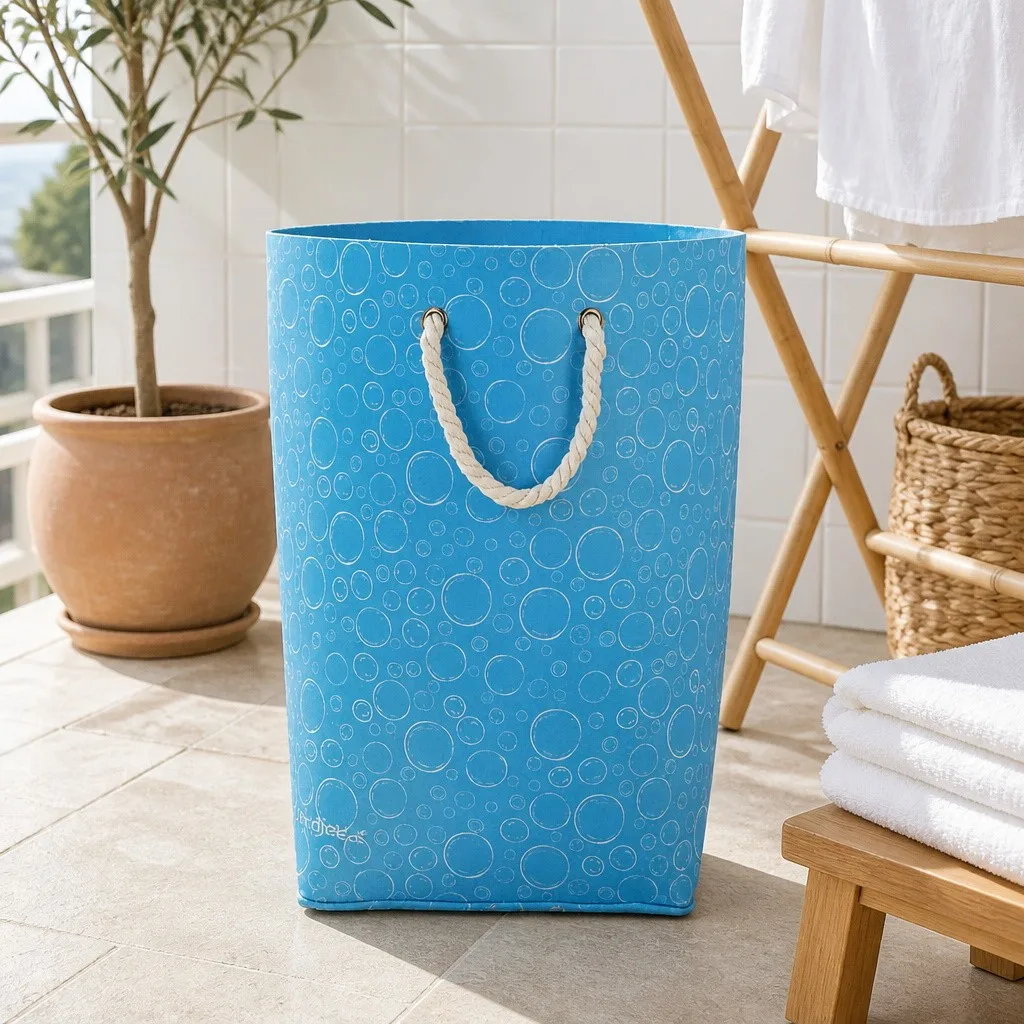
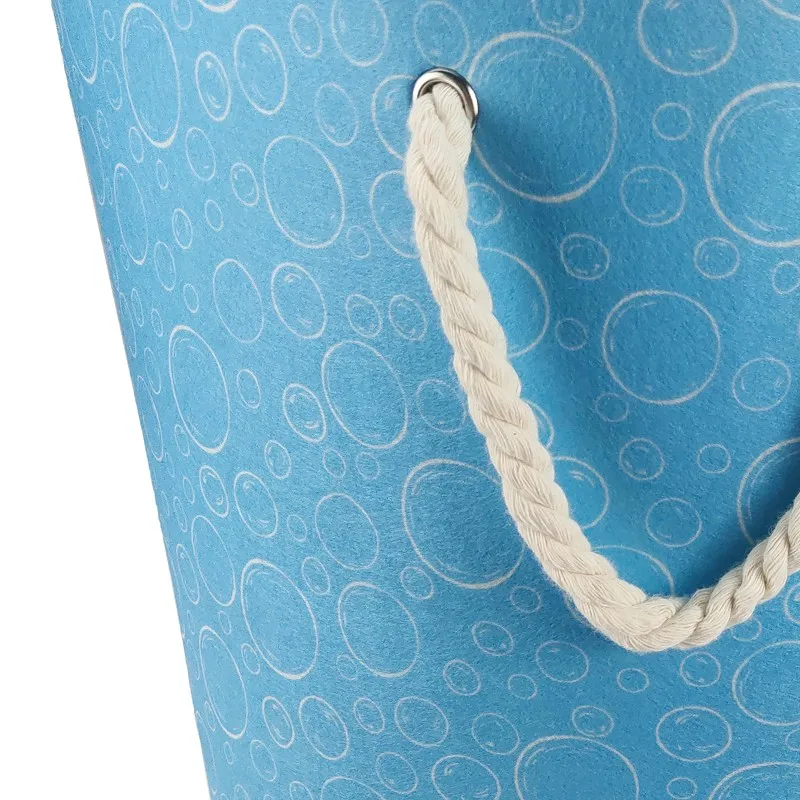
Rope handles concentrate the whole load on two holes. Without a reinforcement layer behind the eyelet, the felt elongates and the metal pulls through within months — the single most common complaint on a laundry hamper with rope handles.
Fix: internal reinforcement patch + rolled or bar-tacked eyelet.
The colour fades unevenly
Dyed wool that has not been properly fixed will crock onto light laundry and fade fastest where sunlight hits the front panel.
Fix: rub fastness grade 4+ and light fastness grade 4+ on the lab report.
Every one of those four is a procurement decision, not a manufacturing accident. When you send an enquiry for a custom felt laundry hamper, the four numbers that matter are thickness, density, wool content and the eyelet construction — and a supplier who cannot quote all four in writing is guessing.
Structure: what a felt laundry hamper is actually made of
A felt laundry hamper looks like one piece. In production it is five decisions, and each one shows up in the unit cost and in the return rate.
| Element | Options | Effect |
|---|---|---|
| Silhouette | Tapered (narrow base) / straight | Taper looks lighter and nests for shipping; straight gives more usable volume per footprint |
| Base | Felt only / felt + 2 mm PE board | The board stops the base from rounding under load; adds stiffness, adds one assembly step |
| Seam | Overlock / flat-felled / bonded | Flat-felled gives the clean inside a premium retail buyer expects; overlock is the low-cost route |
| Handles | Cotton rope through eyelets / webbing / felt loop | Rope is the recognisable look for a laundry hamper with rope handles; it needs reinforcement behind each eyelet |
| Hardware | Antique brass / nickel / matte black eyelets | Plating quality decides corrosion resistance in a bathroom — ask for a salt-spray result |
Two structural details are worth writing into the purchase order because they are where cheap versions cut corners. First, the top hem: a double-folded hem of 25–30 mm keeps the opening from wavying; a single-fold hem looks fine flat and ripples the moment the hamper is picked up. Second, the reinforcement behind the eyelets: a 40 mm felt patch, a strip of webbing or a bar-tack. Without it, the rope slowly saws through the wall.
If you intend to sell a foldable felt laundry hamper — flat-packed for e-commerce — the construction changes again: the base becomes a separate panel with a zip or press-stud, and the wall felt must be soft enough to crease without cracking. That usually means 3 mm at the lower end of the density band, plus a crease test on the sample before you approve it.
The felt specification that belongs on the purchase order
Most enquiries describe the hamper and skip the felt. That is backwards: the felt is the product, and a felt laundry hamper spec that lives only in a photo will be re-quoted at the lowest density that passes visual inspection.
| Parameter | 60 L retail | 90 L hotel / heavy use | Reason |
|---|---|---|---|
| Wall thickness | 3.5–4 mm | 4–5 mm | Bending stiffness rises roughly with the cube of thickness |
| Density | 0.28–0.32 g/cm³ | 0.30–0.34 g/cm³ | Below 0.28 the wall creases; above 0.36 it feels like board |
| Weight (single wall) | 1,000–1,250 g/m² | 1,250–1,600 g/m² | The practical way to audit density on arrival |
| Fibre | 100% wool, ≤23 µm | 100% wool, ≤23 µm | Fine fibre fulls tighter and feels softer at the same density |
| Colour fastness · rub | ≥4 (ISO 105-X12) | ≥4 | Stops dye transferring onto pale laundry |
| Colour fastness · light | ≥4 (ISO 105-B02) | ≥4–5 | Window displays fade from the front panel first |
| Load test | 10 kg / 24 h | 15 kg / 24 h | Loaded, lifted by one handle, measured for permanent set |
| pH of extract | 6.0–7.5 | 6.0–7.5 | Neutral wool does not attack metal eyelets |
Two of those rows are routinely skipped and both are cheap to check. The weight per square metre catches a supplier who substituted a lighter felt for the approved sample — you cannot see the difference, but a postal scale can. The load test catches the failure that matters commercially: fill the hamper, lift it by one handle for a day, then measure whether the mouth is still level.
For a wool felt laundry basket sold into the EU, add the declarations listed in section 06 to the same document. Buying felt and buying compliance in one conversation is what separates a repeatable product from a one-off shipment.
Colour, branding and packing: where a custom order is won or lost
Once the felt is specified, a custom felt laundry hamper is a colour and logistics problem. Three areas decide whether the delivered carton matches the approved sample.
Colour
Wool takes dye unevenly compared with cotton, and the difference between batches is visible on a large flat panel in a way it never is on a small swatch. Ask for a lab dip on the actual felt, approve it under daylight rather than office lighting, and write a tolerance into the order: ΔE ≤ 1.5 between the approved dip and the bulk. Deep saturated colours — the blues and terracottas that sell best in home storage — are the hardest to hold, so they deserve the tightest tolerance.
Branding
Three methods work on felt, and they fail in different ways. Embroidery sits on the surface and can pucker a thin wall. A woven label stitched into the seam is the most durable and reads as premium. Debossing or heat-transfer gives the low-contrast, tonal mark that suits a minimal design — but it must be tested on the actual density, because a mark that reads well at 0.30 g/cm³ disappears into 0.24 g/cm³.
Packing
A foldable felt laundry hamper ships flat: the wall folds, the base panel is separate, and the carton is a fraction of the assembled volume. A rigid hamper ships assembled and pays for air. The decision is made at design stage, not at booking — and it is often the difference between a landed cost that works and one that does not, especially for a wholesale felt storage basket programme sold through distribution.
Testing and compliance: the paperwork that clears customs
A felt laundry hamper is a textile article in most jurisdictions, which means the test list is predictable. Request it with the quotation, not after the order, because a supplier who cannot produce these documents usually cannot produce them at all.
- REACH SVHC — the candidate list declaration, dated within twelve months.
- Azo dyes — pass, with the test method stated (EN 14362).
- Formaldehyde — free and hydrolysed, reported as a number rather than “pass”.
- pH of aqueous extract — 6.0–7.5 for wool in contact with skin and with metal hardware.
- Colour fastness — rubbing (wet and dry), washing, and light.
- Metal hardware — nickel release where applicable, plus salt-spray for bathroom use.
Two more items are worth asking for even though no regulation demands them. A fibre composition statement from the mill, because “100% wool” is regularly 70/30 in practice; and a batch weight record per roll, which lets you audit density across shipments without cutting up a finished hamper.
For buyers in the United States, add California Prop 65 consideration for the dyestuffs and the eyelet plating. For pet and children’s storage lines, the same felt may need a flammability statement — wool is naturally self-extinguishing, but the claim must be tested, not assumed.
In a bathroom, the hamper is the only textile object that is judged while full. Every other soft good is judged empty.
Ten questions that separate a felt maker from a felt reseller
This is the list we expect from a professional buyer, which is why we publish it. Any supplier who can answer eight of these in writing, with numbers, is a manufacturer or a very good agent. Fewer than five, and you are buying from a trading desk that will re-quote your custom felt laundry hamper at whatever density the factory has in stock.
- What is the exact wool content, and will you state it on the invoice? “Wool blend” is not a specification. Ask for the mill’s composition statement.
- What density, in g/cm³, will you run? If the answer is “standard”, there is no answer.
- How is density verified at packing? The correct answer involves weighing a measured area, not a visual check.
- What is behind the eyelets? Reinforcement patch, webbing or bar-tack — and a photo of the inside face.
- What load did the last order test to, and did the mouth stay level? Ask for the number and the photo.
- Which eyelet plating, and what salt-spray result? A bathroom is a corrosion test that runs for years.
- Can you lab-dip against Pantone, and what ΔE do you hold? Vague tolerance means visible batch difference.
- Are the REACH and Azo reports dated within twelve months? Old reports describe an old dyelot.
- Does the hamper ship flat, and what is the carton volume? For a foldable felt laundry hamper this is the freight number, not a detail.
- Who makes the rope, and is it pre-shrunk? Untreated cotton rope tightens after the first damp load and pulls the eyelets inward.
The last question is the one almost nobody asks, and it explains a specific failure: a laundry hamper with rope handles that looked perfect in the showroom develops a puckered wall after a month of use, because the rope shrank and the felt did not. Pre-shrunk rope, or a rope with a defined shrinkage figure, removes the problem at almost no cost.
From specification to shipment
A felt laundry hamper programme runs in four stages. Timings below are typical ranges for a first order and assume the felt colour is chosen from an existing palette; a new Pantone colour adds a dyeing cycle ahead of everything else.
| Stage | Typical duration | What you approve |
|---|---|---|
| Lab dip | 7–10 days | Colour on the actual felt, viewed in daylight |
| Pre-production sample | 10–14 days | Construction, eyelet reinforcement, logo position, load test |
| Bulk production | 25–35 days | Batch weight record and in-line check photos |
| Inspection & packing | 3–5 days | Carton drop test, count, barcode and label placement |
Two habits shorten the calendar more than any negotiation. First, approve the lab dip and the sample against the same reference — a colour approved on paper will always fail against a physical sample. Second, decide the flat-pack question before sampling: retrofitting a foldable felt laundry hamper structure after the sample is approved means a second sample and a second tooling setup.
For buyers assembling a range, the efficient path is to fix one felt specification — one density, one thickness family, one palette — and then vary silhouette and hardware across the line. The wholesale felt storage basket programme that ships best is usually the one with the fewest material variables, because every new felt weight is a new minimum, a new dye lot and a new test report.
Buyer questions, answered directly
What wall thickness should a felt laundry hamper be?
For a 60 L retail hamper, 3.5–4 mm at 0.28–0.32 g/cm³ holds its shape under normal domestic loads. Above 80 L, or for hotel use where the hamper is lifted while full, go to 4–5 mm at 0.30–0.34 g/cm³. Below 3 mm the wall bows once loaded, regardless of how good the felt feels in the hand. If the hamper must ship flat, the same wall works for a foldable felt laundry hamper once the base becomes a separate panel.
Can a wool felt laundry basket be machine washed?
No — and a supplier who says otherwise is describing a bonded or needle-punched product. True felted wool will shrink and lose its wall structure in a machine cycle. Care is spot cleaning with a damp cloth and air drying flat; that is also why the density band matters, since a denser, unbonded felt resists odour and needs washing less often.
Is a laundry hamper with rope handles strong enough for wet towels?
Yes, if the eyelets are reinforced. The rope itself is rarely the weak point; the felt around the hole is. Specify a 40 mm internal reinforcement patch plus a rolled or bar-tacked eyelet, and test at 10–15 kg lifted by a single handle for 24 hours. Without the patch, the rope elongates the hole and the failure looks like a manufacturing defect even though it was a specification omission. That one detail is the difference between a laundry hamper with rope handles that lasts five years and one that puckers in five months.
What is the minimum order for a custom felt laundry hamper?
It is driven by two things: the felt colour (a new dye lot has a minimum) and the eyelet and logo tooling. Colours from an existing palette allow a much smaller first order than a new Pantone match. Ask for the current figure with your enquiry, together with the tooling cost and whether it is one-off or amortised.
Why specify a wholesale felt storage basket instead of moulded plastic?
Three reasons that show up on a shelf and in a returns report: wool felt does not scratch floors or clatter, it breathes so damp laundry does not sour, and it collapses flat for freight and for the consumer’s own storage. The trade-off is that it is not washable and it costs more per unit than injection moulding — which is why it sells as a design object rather than a utility bin. It is also why a wholesale felt storage basket programme is normally sold as a range of three to five sizes rather than as a single SKU.
Send the silhouette, the volume and the colour reference
You will get a felt recommendation with the density and thickness stated, a unit price at your quantity including tooling, and a sampling timeline — usually within one working day. One enquiry covers a single custom felt laundry hamper or a whole wholesale felt storage basket programme.
Post time: Nov-13-2026