
Damp under a mattress is not water coming up. It is air that cannot get out
A plastic sheet stops water and traps vapour. A felt mattress underlay does the opposite: it lets vapour move and buffers the peaks. This is what actually happens under a bed, and how to choose a layer that works with the physics instead of against it.
Updated November 2026
Rolking Felt Studio
The mattress is rarely the problem. The twenty millimetres of air between the mattress and the base is the problem, and almost nobody designs for it.
The damp under a mattress is condensation, not rising water
A sleeping adult releases water vapour continuously — through breath and through skin — several hundred millilitres over a night. Some of it leaves through the bedding. The rest migrates downward, because warm moist air rises only while it is warmer than its surroundings, and a mattress is a large, cool, porous slab that pulls vapour toward itself.
Under the mattress sits a base: slats, a solid platform, a box spring, or a floor. If that surface is colder than the dew point of the air arriving at it, the vapour condenses. That is the moisture people find when they lift a mattress: not groundwater, but a surface that was cold and unventilated.
Three conditions have to line up, and removing any one of them removes the problem:
- A vapour source — the sleeper, the room, a bathroom next door.
- A cold surface — a solid base, a floor slab, an exterior wall side.
- No path out — sealed plastic, a mattress laid directly on a non-breathable platform, bedding tucked under on all four sides.
This is why the fix is almost never “more waterproofing”. It is either warmth, airflow, or a buffer that holds the peak and releases it later. In bedding terms that buffer is a moisture-proof mattress pad made of wool, and it works precisely because it is not waterproof.
Moisture-proof and waterproof are opposite strategies
The single most expensive confusion in bedding is treating these two words as synonyms. A moisture-proof mattress pad manages humidity. A waterproof sheet blocks liquid. One is a buffer; the other is a wall. Put a wall in the wrong place and you create the exact condition you were trying to avoid.
| Waterproof membrane | Breathable felt underlay | |
|---|---|---|
| Blocks liquid water | Yes | No — and it does not pretend to |
| Passes water vapour | Usually not | Yes, freely |
| Traps condensation | On the cold side, which is under the sheet | Does not create a cold-side trap |
| Right for | Incontinence, spills, toddler beds | Humid rooms, solid bases, caravans, boats, rental furniture |
| Wrong for | Breathability under a mattress | Standing water, leaks, unheated wet rooms |
If a customer tells you their mattress grew mould and they had a plastic protector on it, the protector is a suspect rather than a solution. Vapour came up, met the plastic, could not leave, and condensed on the underside of the mattress — the side nobody looks at until it smells.
What wool does that foam and cotton cannot
Wool is hygroscopic in a way that synthetic foams are not. At 65 % relative humidity a wool fibre holds around 15 % of its own weight in water — not as surface wetness, but absorbed into the fibre structure. When the air around it dries, it gives that water back. This is the buffer, and it is why a felt mattress underlay changes the humidity profile of the interface rather than blocking it.
Three properties do the work together:
- Absorption and release. During the night the felt takes the peak; during the day it dries. The mattress never sees the peak.
- Vapour permeability. Felt is a non-woven with continuous voids, so vapour passes through rather than accumulating against it.
- Thermal buffering. Wool’s insulation raises the temperature of the surface where condensation would otherwise form, which moves it away from the dew point.
Open-cell polyurethane foam is breathable but not hygroscopic — it passes vapour without buffering, and it degrades in humid conditions. Cotton is hygroscopic but mats down under load and loses its loft within months. A wool felt mattress pad keeps its thickness because the fibres are entangled rather than woven, and entanglement does not collapse the way a loose batt does.
Why hysteresis matters more than capacity
Wool absorbs faster than it releases. In practice that means the felt responds quickly at night and dries slowly during the day — a slow-release buffer that is ideal for a daily cycle and poor for a permanently damp room. It is a battery, not a sponge with a drain.
Mould needs three things, and a buffer removes one of them
Household mould needs a food source (dust, skin cells, cellulose), a suitable temperature, and surface humidity above roughly 70 %. Under a bed all three are normally present — which is why the underside of a mattress in a humid climate is one of the most predictable mould habitats in a home.
An anti-mould mattress pad cannot sterilise anything, and any product claiming to is overselling. What it can do is keep the local humidity below the threshold for longer. A felt layer that absorbs the night’s vapour and releases it during the day keeps the interface in the 50–65 % band instead of the 75–90 % band, and that difference is the difference between a clean mattress and a replacement. Any anti-mould mattress pad on the market is a buffer of this kind, or it is a plastic sheet with a better name.
Two caveats belong in the same paragraph, because leaving them out is how the category loses credibility:
- If the room itself sits above 75 % relative humidity for weeks, no underlay fixes it. The building needs ventilation or dehumidification first. A moisture-proof mattress pad buys time; it does not replace a dehumidifier.
- If liquid water is arriving — a leaking roof, a wet floor, a spilled drink — felt will absorb it and hold it against the mattress. That is worse than nothing.
Choosing thickness: most buyers are one step too thin
The underlay has to do two jobs at once — buffer vapour and spread point load — and the second job sets the minimum thickness far more often than the first. A 3 mm layer buffers acceptably and does nothing for the mattress above a slatted base. A 10 mm layer does both but raises the mattress in a fitted sheet and can feel unstable on a soft base.
| Base | Thickness | Density | Why |
|---|---|---|---|
| Close slats, gaps under 60 mm | 5 mm | 0.22–0.26 g/cm³ | Load is already spread; the felt is a vapour buffer and an abrasion layer |
| Wide slats, gaps 60–100 mm | 8 mm | 0.24–0.28 g/cm³ | Bridges the gaps without sagging into them |
| Solid platform or board | 5–8 mm | 0.20–0.26 g/cm³ | A solid base is the worst case for condensation; the felt is doing humidity work, not structural work |
| Caravan, boat, camper | 8–10 mm | 0.26–0.30 g/cm³ | Cold surfaces and poor ventilation; more buffer, more insulation |
| Floor mattress, guest bed | 10 mm | 0.28–0.32 g/cm³ | Needs to survive being walked on and rolled up repeatedly |
If the customer is buying a breathable mattress topper for comfort rather than for humidity, the logic flips: thickness is set by pressure relief, and the right product is a softer, loftier grade — not the dense felt that performs best as an underlay. Both are sold as a breathable mattress topper; only one of them is doing humidity work.
One number worth insisting on for any felt mattress underlay: the thickness tolerance. Felt at “10 mm” delivered as 8.5 mm is common when nobody writes a range, and 1.5 mm is the difference between bridging a slat gap and sagging into it.
The edge is what the customer judges first
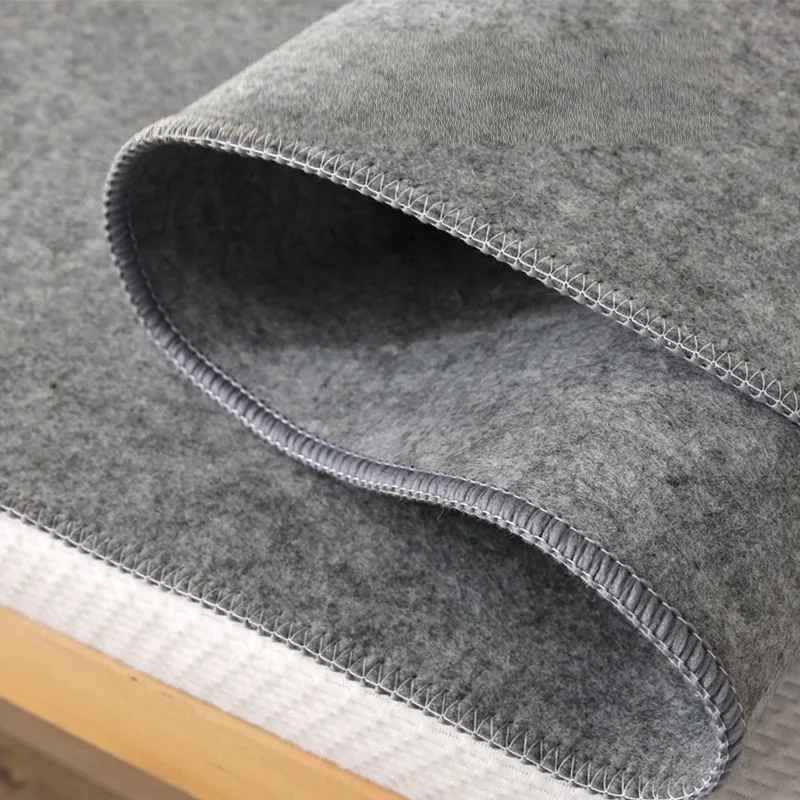
A cut felt edge sheds fibre, frays in the wash and looks unfinished on a bed. Every retail-grade wool felt mattress pad we produce is edge-finished, and the finish is chosen by how the product will be cleaned:
- Overlocked (serged) edge — the standard. Wraps the cut line in thread, survives washing, adds a visible border that reads as quality.
- Bound edge with binding tape — more expensive, better on thick grades, and the only option when the felt is laminated to a backing.
- Ultrasonic or heat-sealed edge — clean and fast, but stiffens the last few millimetres and is not suitable for 100 % wool.
Backing, and when to add one
A plain felt underlay grips a slatted base well and slides on a lacquered platform. If the product will sit on a smooth surface, a light anti-slip dot backing solves it without closing the vapour path. A full laminated film backing does close the path — which is fine for a waterproof product and fatal for a breathable mattress topper. This is the most common specification error we see from brands entering the category.
As a felt underlay manufacturer we quote the edge and the backing as separate lines, because they change the cost more than the felt does, and because a customer who specifies neither will receive whichever the factory finds easiest that week.
Five minutes of installation decides whether it works
A felt mattress underlay is a passive component. It cannot move air on its own, so it depends on the base beneath it being able to breathe. Four rules cover almost every installation:
- Never sandwich it between two non-breathable layers.Felt over a plastic-wrapped board is a humidity trap with a wool lining. If the base is solid, the felt buys you buffering — not ventilation — and the room needs airflow instead.
- Leave the slat gaps open.Do not tuck the underlay around the frame or tape it down over the gaps. It is meant to sit on top, not to seal.
- Air it seasonally.Once or twice a year, take it off, shake it out and let it hang in dry air for a day. This is the release half of the buffer cycle, and skipping it is how a working product starts to smell.
- Rotate head-to-foot.Felt takes a compression set under the heaviest point. Rotating every few months doubles the usable life and evens out the surface.
On boats and in caravans, add one more: keep a gap at the wall side. The coldest surface in a small cabin is usually the hull or the exterior wall, and felt pressed against it will hold condensation rather than release it. A moisture-proof mattress pad in that setting works best with 25 mm of air behind it.
For hotels and rental apartments, the practical test is the first turnover: lift the mattress after thirty days and look at the underside. If it is dry and odour-free, the assembly is right. If it is damp, the felt is doing its job and the room is not — which is diagnostic information you can act on, rather than a product failure.
Where felt is the wrong answer
We turn down this enquiry more often than you would expect, because selling the wrong layer creates a return, a review and a dead category.
- Liquid water. A damp patch that reappears after rain, a leaking pipe, a basement floor. Felt absorbs and holds; a waterproof membrane and a building repair are the answer.
- Rooms above 75 % RH for weeks. Tropical ground floors without air conditioning, bathrooms converted into bedrooms. The buffer saturates and stops buffering.
- Unheated rooms in cold climates. The dew point moves onto the mattress itself, above the felt. Insulation belongs under the base, not on top of it.
- Households with a confirmed wool allergy. Rare, but real. A synthetic needle-felt does the same job with a different fibre.
An anti-mould mattress pad is a humidity tool. Every honest supplier should be able to tell a buyer which of the four cases above theirs is, before taking the order. If the answer is “none of them”, felt is the right layer — and a breathable mattress topper in the same material will do the comfort job on top. A felt underlay manufacturer who never says no is selling, not specifying.
What to put on the purchase order
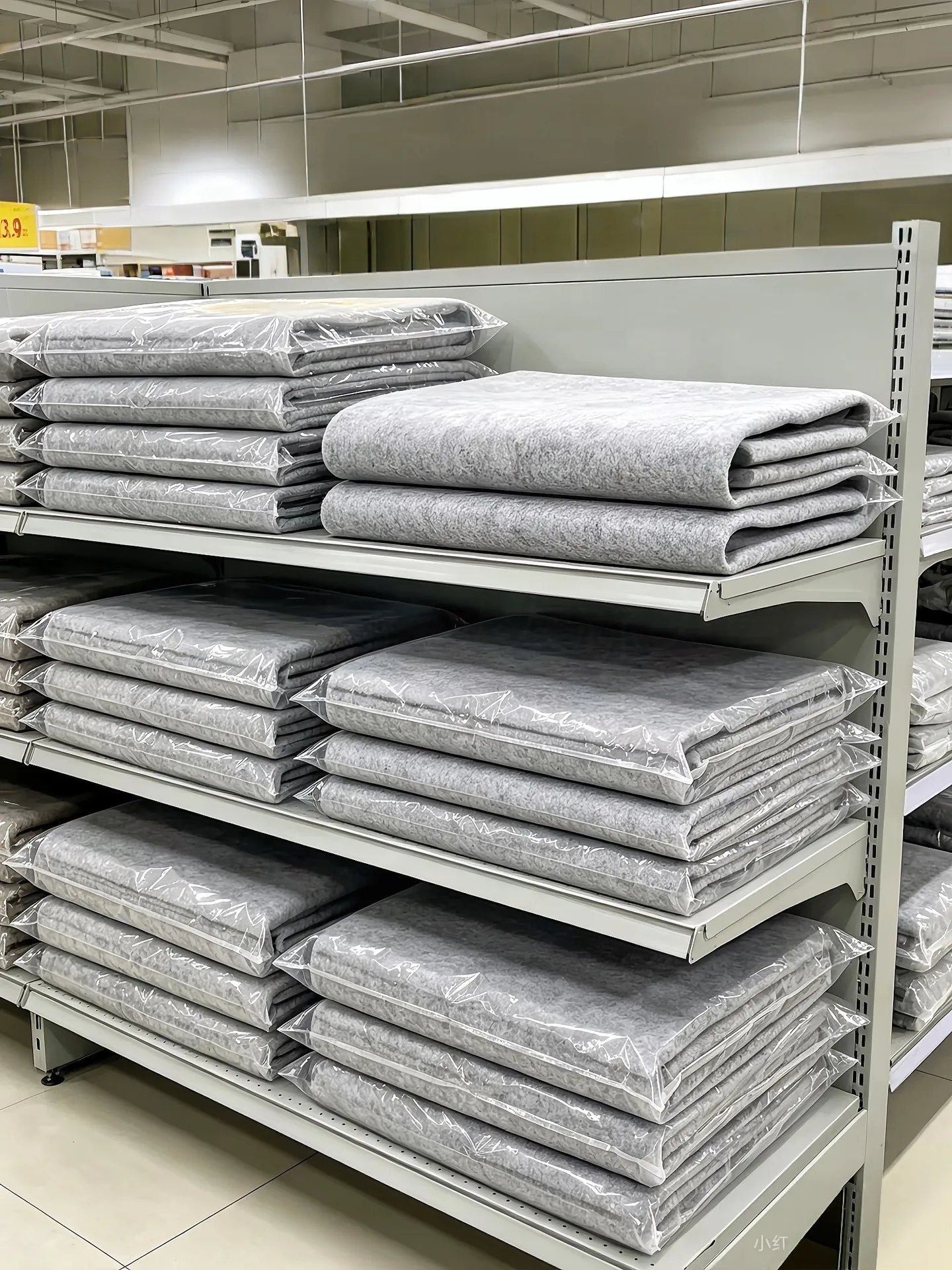
Whether you are buying one pallet or specifying a private-label range, these eight lines close almost every gap between a sample and a shipment. They apply to a single moisture-proof mattress pad as much as to a full programme.
- Fibre and blend100 % wool, wool/polyester, or recycled needle felt — each behaves differently under humidity.
- Thickness with a tolerance“8 mm ±0.5″ is a specification. “8 mm” is a hope.
- Density in g/cm³The single number that decides whether the pad bridges a slat gap or sags into it.
- Edge finishOverlocked, bound, or sealed — plus the stitch density if it will be washed.
- BackingNone, anti-slip dots, or laminated film. This line decides whether the product can still be called breathable.
- Size and shrinkage allowanceA wool felt mattress pad will relax after the first wash; state the allowance rather than discovering it.
- Odour and pHAsk for the aqueous extract pH. Wool that smells of the mill will smell of the bedroom.
- Pack formatFlat, rolled, or vacuum-compressed — and the thickness the customer will see when they open it.
A felt underlay manufacturer who can answer all eight without referring to someone else is manufacturing. One who forwards the list to a trading company is brokering — which is also fine, as long as the price reflects it.
Questions we get weekly
Is a breathable mattress topper the same as a moisture-proof one?
No, and the difference matters. A breathable topper moves vapour and is chosen for comfort. A moisture-proof layer manages humidity at the mattress interface. Some products do part of both, but no felt product is waterproof, and any listing that implies otherwise will generate returns the first time a customer spills something.
Will a felt mattress underlay stop mould completely?
It will not stop mould, and no layer can. It lowers the humidity the mattress underside sees for most of the day, which keeps it on the safe side of the threshold in a normal room. In a room that is already above 75 % relative humidity, the building is the problem and the underlay is a delay. Treat any anti-mould mattress pad as time you can use to fix the room.
Can I wash a wool felt mattress pad?
Spot clean and air dry as the default. A 100 % wool pad can be hand-washed cold with a pH-neutral wool detergent, then dried flat away from direct heat — never tumble dried, because agitation plus heat is exactly how wool felts into a smaller, harder object. An anti-mould mattress pad that has been machine washed hot will shrink and mat, and the customer will blame the product rather than the cycle.
How thick should a wool felt mattress pad be for a slatted base?
8 mm at 0.24–0.28 g/cm³ for slats with gaps up to 100 mm. Thinner works on close slats; thicker is for cold or mobile settings. The number to avoid is 5 mm over wide gaps, which sags into the gaps and creates the pressure points the pad was meant to remove.
Do you make private-label felt underlay?
Yes. As a felt underlay manufacturer we produce to a drawing and a pack spec, including the edge finish, the backing, the label position and the compression format. The two variables that decide the price are density and edge finish, not the size — which is why we ask for those first.
Send the base type, the climate and the pack format
As a felt underlay manufacturer, Rolking would rather lose the order than watch a product fail in a room it was never right for. Tell us what the bed sits on and where it ships, and we will come back with a thickness, a density and an edge finish — plus the tolerance we would actually run. If felt is the wrong layer for your case, you will hear that in the first reply.
Post time: Nov-13-2026