
PET Felt Acoustic Panels: A Specifier’s Guide to Absorption, Certification and Installation
A PET felt acoustic panel solves a specific problem: it removes the reflected energy that makes a hard room sound loud, hollow and tiring to be in. It does not block sound from leaving the room. Buyers who confuse those two outcomes spend money on the wrong product — and it is the mistake we see most often, across both private refurbishments and commercial fit-outs.
What follows is written for people who have to defend a specification: interior contractors, AV integrators, importers building a range, and facilities teams retrofitting an occupied building. It covers what a 9 mm recycled PET panel at NRC 0.80–0.90 actually delivers, how modular tiles behave over a service life, what the certificates prove and do not prove, and where adhesive installations fail.

In this guide — jump to a section▾
The adhesive is not the weak point; the substrate is.
Sound Absorption and Sound Insulation Are Not the Same Purchase
Every acoustic complaint resolves into one of two physical problems, and they are solved with different materials.
The first is reflection. Sound generated inside a room hits a hard surface, bounces, hits another surface, bounces again. Within a fraction of a second the listener is hearing dozens of overlapping arrivals, and the room acquires a tail — reverberation — plus, between parallel flat surfaces, a rapid flutter that reads as harshness. Fixing this means absorbing energy at the surface. A porous material such as PET felt forces air through a dense fibre matrix, friction converts part of the acoustic energy to heat, and less comes back. The room gets quieter without getting deader, provided you do not over-cover it.
The second problem is transmission. Sound crossing a partition is carried by the structure and by the air in the gaps, and it is resisted by mass, by airtightness and by breaking the structural path — a heavy, sealed, decoupled assembly. A 9 mm felt tile weighs a fraction of a plasterboard layer and seals nothing, so its effect on what the neighbouring room hears is essentially nil.
This matters commercially, because the two problems are usually quoted in the same conversation. If the brief says “the meeting room echoes on video calls”, the specification is absorption. If the brief says “the office next door can hear us”, absorption is a secondary refinement at best and the partition is the actual answer.
What NRC 0.80–0.90 Means at 9 mm Thickness
NRC is the arithmetic mean of a material’s absorption coefficients measured at 250, 500, 1,000 and 2,000 Hz, rounded to the nearest 0.05. A declared 0.80–0.90 therefore states that across that four-frequency band the surface returns between 80 and 90% less energy than a rigid wall would.
Two limits follow directly from that definition, and both affect how the panel is specified.
The first is frequency. The four bands behind the rating begin at 250 Hz. A porous absorber’s effectiveness falls away as wavelength grows, and at 9 mm the material is well below the thickness needed to engage a low bass note. A room with a subwoofer problem will not be fixed by covering walls with thin felt; that work belongs to corner treatment, thick absorbers or resonant devices. The panel’s territory is speech, keyboard clatter, fan noise, and the bright upper-mid hardness of tiled or glazed rooms.
The second is mounting. A porous absorber performs best with depth, and depth can come from the cavity behind it as well as from the material itself. Fixed flat against a solid wall, the panel is at its least effective. Fixed to battens with a 20–30 mm air gap, the same panel behaves like a considerably thicker absorber at very little additional cost. Where a specification is being written for a critical room, that detail is worth more than a marginal upgrade in panel thickness.
Why 300 × 300 mm Modules Suit Real Rooms Better Than Large Sheets
Large format acoustic panels look efficient on a drawing and become a problem on site. They are awkward to transport without edge damage, unforgiving of a wall that is not flat, and expensive to replace when one area is stained or knocked.
A 300 × 300 mm tile behaves differently across a building’s whole life. It arrives in a compact carton, so freight per square metre is lower and a damaged corner wastes one tile rather than a sheet. It follows a wall that is a few millimetres out of true, because the joints take up the variation instead of the panel rocking. It can be replaced in isolation after a water stain, a repair or a change of layout. And critically for design-led interiors, the small module allows a pattern to be composed across the wall: the embossed geometric face repeats across tiles, so a designer can run a field, a border or a feature panel without a cutting charge.
The trade-off is honest. A modular wall has more joints, and joints are where a careless installer shows. Alignment needs a marked grid and a dry-fit before the first tile is committed, and the pattern repeat has to be reconciled at the edges of the treated area. Done properly, the result reads as a designed surface; done quickly, it reads as tiles.
Coverage arithmetic follows from the module: one tile is 0.09 m², so a square metre needs 11.1 tiles and should be ordered as 12.
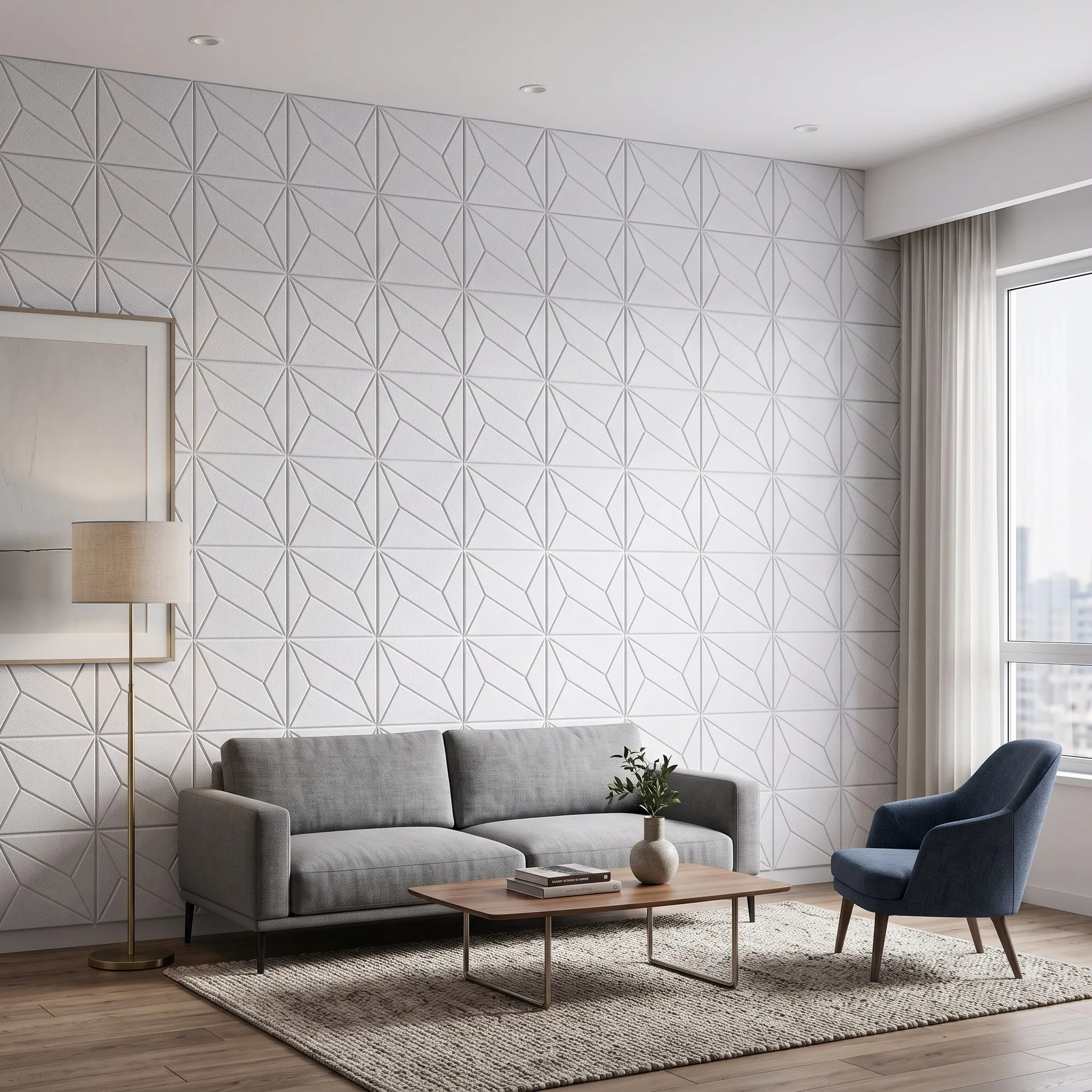
The Material: Recycled PET Felt and What GRS Actually Certifies
The fibre in these panels is polyester felt, commonly produced from recycled PET. The case for it over polyurethane foam is not marketing: needled PET is dense and dimensionally stable, it does not crumble or shed the way ageing foam does, it can be vacuumed, it holds an embossed relief without a rigid backing, and it does not carry the same concerns about airborne particulates in an occupied room.
The recycled claim should be evidenced rather than assumed. GRS — the Global Recycled Standard — certifies recycled content and the chain of custody behind it, and the meaningful part of the claim is the declared percentage plus the transaction certificate issued for the shipment. A supplier displaying a logo without a percentage is not telling a buyer enough to put in a tender document.
Two further certificates recur in European and North American procurement. OEKO-TEX Standard 100 covers harmful substances, and its product classes matter — Class I is the class for articles used by babies and small children, which is the one to specify for a nursery, a school or a play area. REACH is the EU chemical framework, and the operative part is the SVHC candidate list and a declaration that the material falls below the threshold.
What none of these three covers is performance: not acoustic values, not fire behaviour, not durability. Those come from test reports. Ask for fire classification to the standard of the destination market — EN 13501-1 in the EU, ASTM E84 and the Class A designation in the US — and for the acoustic report to ASTM C423 or ISO 354 if the NRC figure is to be cited in a specification.
Four Applications and What Each One Needs
The same tile, four different briefs, four different installation logics.
Streaming and Podcast Rooms
A creator’s room is typically small, hard and full of reflective surfaces at head height. The microphone captures the room as much as the voice, and the result sounds boxy no matter how good the microphone is. Treat the wall the speaker faces, both side walls at mouth height, and the wall behind the microphone, at roughly 20–30% of wall area. The camera imposes a second requirement that foam cannot meet: the wall is the backdrop, so the surface has to look intentional. An embossed felt field reads as interior design rather than as a studio.
Children’s Rooms and Play Areas
The brief here is rarely acoustic precision. It is a room that sounds shrill, noise that carries down a corridor at bedtime, and a parent asking what the wall is made of. Felt answers all three: it absorbs the mid-range that makes a small hard room loud, it has no rigid frame or sharp edge at the height a toddler reaches, and the material certificates allow a straight answer about content. It also performs as wall protection behind a bed or a play bench.
Home Cinema and Media Rooms
A cinema room wants a controlled reverb, typically around 0.3–0.4 seconds domestically, without being deadened into a foam box. The 9 mm tile handles first reflection points, the rear wall and the front wall around the screen. Low-frequency control is a separate line item: corner traps and thicker absorbers, planned deliberately. Over-covering a cinema is a common and expensive error, because an over-absorbed room flattens dialogue and feels airless.
Meeting Rooms and Small Offices
Video calls expose a room’s acoustics immediately: hard walls, a glass partition and a table produce a hollow, fatiguing sound that participants on the far end hear as distance. Here the treatment is selective and often modest — the wall behind the seated row, one side wall, sometimes just the rear wall. Discrete dark or neutral tiles also solve the visual problem of a bare wall behind a camera without turning the room into a studio.
Adhesive Performance, Surface Preparation and Service Life
A pressure-sensitive backing is the difference between a two-hour installation and a two-day one, and it is also the most common source of callbacks. The adhesive is not the weak point; the substrate is.
Freshly painted surfaces fail most often, because paint continues to cure and release solvent for days after it is touch-dry. Chalky filler, dusty plaster and skim coat give nothing to bond to. Cold or damp walls trap condensation behind the tile and the bond releases from the back. Textured wallpaper, vinyl wall covering and glossy tile are unreliable, and bare drywall paper can tear away under load.
The preparation is straightforward: the wall must be dry, clean, dust-free and sound, with a primer on porous plaster; application should happen at normal room temperature; each tile should be pressed across its full face rather than at the corners; and one tile should be tested for 24 hours before the wall is committed.
Two details decide long-term behaviour. On ceilings, adhesive alone is not adequate — use mechanical fixings or adhesive plus physical support, and avoid the method altogether in damp rooms. And at end of life, assume some paint will lift with the tile; gentle heat and a slow peel reduce the damage but do not eliminate it.

What Four Decades of Felt Production Changes for a Buyer
Felt is a simple material to describe and a difficult one to make consistently. Fibre blend, needling density, heat setting and the embossing tool all shift the finished product, and the variation shows up not in a sample but in the third container.
Rolking has been producing felt since 1983. The operation runs nine production lines with more than eighty workers, most of whom have spent over a decade in the felt trade, and it is certified to BSCI, RWS, ISO 9001 and GRS, with REACH compliance declared. In practice that combination affects a buyer in three ways: process control that keeps a repeat order close to the sample, a documented quality system behind a claim, and — for programmes that require social compliance auditing — a BSCI audit already on file rather than a new one to commission.
Sample first, then commit. A production sample in the final colour, pattern and thickness is the only reliable check that the material on the drawing is the material in the carton, and confirming the carton quantity, label position and pallet pattern in writing prevents the disputes that surface at goods-in.
Sample, Specification and Order Checklist
Before a purchase order is raised, these are the fields that should be pinned down.
- Acoustic test report for the declared NRC, with the standard named.
- Fire classification to the destination market’s standard.
- GRS transaction certificate and declared recycled percentage.
- OEKO-TEX product class, if the end use involves children.
- Panel weight per square metre and dimensional tolerance.
- Backing type: adhesive, plain, or both across the range.
- Colour reference and confirmation that the sample matches production.
- Minimum order for a custom colour, sampling lead time, and production lead time.
- Carton quantity, label specification and pallet configuration.
- Inspection routine and the agreed remedy on a quality claim.
A specification that answers all ten is one that can be quoted, produced and received without surprises. The two that cause the most rework are the last two: carton and pallet configuration, which are cheap to agree at quotation stage and expensive to correct after the container is loaded, and the inspection routine, which decides who pays when a batch arrives with a colour drift. Both belong in writing before the order, not in a conversation after delivery.
Frequently Asked Questions
Do PET felt acoustic panels block noise from the next room?▾
No. They absorb sound within the room, reducing echo and reverb. Blocking transmission requires mass, airtightness and structural decoupling. If the complaint is what the neighbour hears, the partition is the specification and the panels are a refinement on top of it.
Is 9 mm thick enough to be worth installing?▾
For speech, echo and upper-mid harshness, yes, and it is the most cost-effective thickness to ship. For low-frequency problems it is not enough on its own; mounting the panel on a battens with an air gap behind it extends performance downward at low cost.
How is NRC 0.80–0.90 achieved with a felt tile?▾
The needled fibre matrix provides the absorption and the embossed face adds surface area and scattering. The declared figure is an average across 250–2,000 Hz, so performance at 125 Hz or below is not represented by that number.
Can the tiles be installed on a ceiling?▾
With mechanical fixings or adhesive plus physical support, yes. Adhesive alone is not appropriate overhead, and damp rooms should be avoided for this method entirely.
What documentation should I expect with a shipment?▾
A GRS transaction certificate for the batch, the applicable OEKO-TEX and REACH declarations, and on request the fire and acoustic test reports. Certificates should reference the material actually supplied, not a generic product family.
Can the panels be produced in a custom colour and size?▾
Yes — colour, pattern depth, tile size, backing and packaging are all configurable. The practical constraint is the minimum order for a custom colour rather than the capability, and a production sample should be approved before the bulk run.
Send Us the Room, We’ll Send the Numbers
Tell us the wall dimensions and what the room is used for. We’ll come back with a panel count, a layout and a sample in your colour.
Post time: Nov-25-2026