
The lining nobody specifies — and every customer notices
A working guide to merino wool felt for jewelry display: what actually scratches polished gold, why lint ends up on a diamond, how tarnish starts inside a closed box, and the specifications that prevent all three.
Updated November 2026
Rolking Materials Studio
The lining is the cheapest component and the most expensive mistake
A jewelry box is opened thousands of times. Every one of those openings is a small quality test — and the material the piece rests on is the part that fails first.
Ask a brand where the money goes and you will hear about the clasp, the setting, the plating thickness. Ask a customer what felt wrong and the answer is usually vaguer: the piece looked dull, there was fluff on the stone, the ring had a mark on the shank, the white lining had gone slightly yellow at the fold. None of that is a jewelry defect. All of it is a lining defect, and none of it is covered by the specification sheet that came with the box.
This is because a jewelry box lining is normally chosen late, by appearance, from a swatch book. Colour gets approved under showroom lighting. Thickness gets chosen by feel. Nobody measures fibre diameter, pH, dye fastness or shedding — and those are precisely the four variables that decide whether the piece still looks new after a season in the case.
The economics are lopsided in a way that is easy to demonstrate. Lining material is typically a few percent of a box’s landed cost. A single return, re-polish or re-pack of a high-value piece costs more than the lining for a hundred boxes. Yet the lining is the only component in direct, continuous contact with a mirror-polished surface.
Six ways a lining fails — and how to recognise each one
Before choosing a material, it helps to know what you are choosing against. These are the six failure modes we see most often in jewelry packaging, roughly in order of how much damage they do. Each has a visible signature, which means each can be diagnosed from a returned box.
Fibre shedding
Short fibres migrate out of a cut edge and land on stones, in settings and across polished surfaces. On a diamond it reads as dust; on black lacquer it reads as a defect. Needle-punched synthetics shed at cut edges; a properly fulled wool felt sheds almost nothing because the fibres are entangled, not punched through a batt.
Micro-scratching
Polished gold, platinum and lacquer are soft at the surface. Any lining that traps dust, or has a coarse or resinous hand, becomes an abrasive pad under the weight of the piece. The signature is a cluster of fine parallel marks where the item rested.
Dye transfer
Deep colours — emerald, burgundy, navy — are the ones buyers want and the ones most likely to migrate. Humidity plus pressure plus an unfixed dye equals staining on the underside of a piece, or a pale ghost on the lining itself. Test with a wet white cloth before you approve a colour.
Compression set
A ring sits in the same place for two years. A good lining recovers; a poor one keeps the dent, and the next piece sits in someone else’s hole. This is a density and resilience question, not a thickness question.
Tarnish and discolouration
Silver and copper alloys darken inside closed boxes. The cause is sulfur-bearing gases and humidity trapped in the cavity — and the lining is the largest surface in that cavity. Section 05 deals with this properly, because it is the one issue where wool needs a deliberate answer.
Batch colour drift
Order 500 trays in March and 500 in September and the two greens may not match. On a display wall under retail lighting, a half-shade difference across a shelf is visible from three metres. Colour needs a measured tolerance, not an eyeball approval.
Notice what these have in common: none of them are visible in a swatch, and all of them are measurable in a lab. That gap — between how lining is sold and how it fails — is the whole argument for specifying a material rather than picking a colour.
Why merino wool felt behaves differently under a diamond
Merino wool felt is not simply “nicer wool”. Three properties change at once when you move from a coarse wool or a needle-punched synthetic to a fine merino, and each one maps directly onto a failure mode above.
Fibre diameter sets the hand — and the scratch risk
Merino typically runs from about 11.5 to 24 microns, with the fine grades used in contact applications sitting around 17–19.5 microns. Conventional wool for industrial felt often sits above 25 microns. The number matters because fibre stiffness rises with the fourth power of diameter: a 30-micron fibre is not 50% stiffer than a 19-micron fibre, it is several times stiffer. That is why coarse felt feels prickly and fine merino feels like suede — and why the fine fibre, laid against lacquer or polished gold, behaves as a soft cushion rather than a mild abrasive.
Felting is mechanical, so there is no binder to migrate
True wool felt is made by wet felting: heat, water and agitation open the microscopic scales on each fibre and let them lock into one another. The structure holds itself together. Needle-punched synthetics, by contrast, are held by mechanical punching plus, very often, a proportion of low-melt bicomponent fibre or a resin binder that fuses under heat.
Those binders are the reason a cheap felt can feel boardy at the fold, stiffen with age, and release volatile residues inside a closed box. A lint-free wool felt made without binder has nothing to migrate, nothing to outgas and nothing to go brittle. It also cuts cleanly, which is what makes felt practical for high-volume felt inserts rather than only for flat lining.
Density is tuneable in a way foam is not
Wool felt can be fuller-ed to a wide range of densities while keeping the same thickness, so a tray base can be firm enough to hold a hinge and a ring slot soft enough to close around a band. Foam gives you one hardness per grade and takes a permanent set. Velvet gives you drape but no body at all — it is a surface, not a structure.
“The piece is judged by the surface it rests on. If that surface is stable, the piece looks cared for. If it moves, sheds or discolours, the piece looks old.”
Rolking Materials Studio
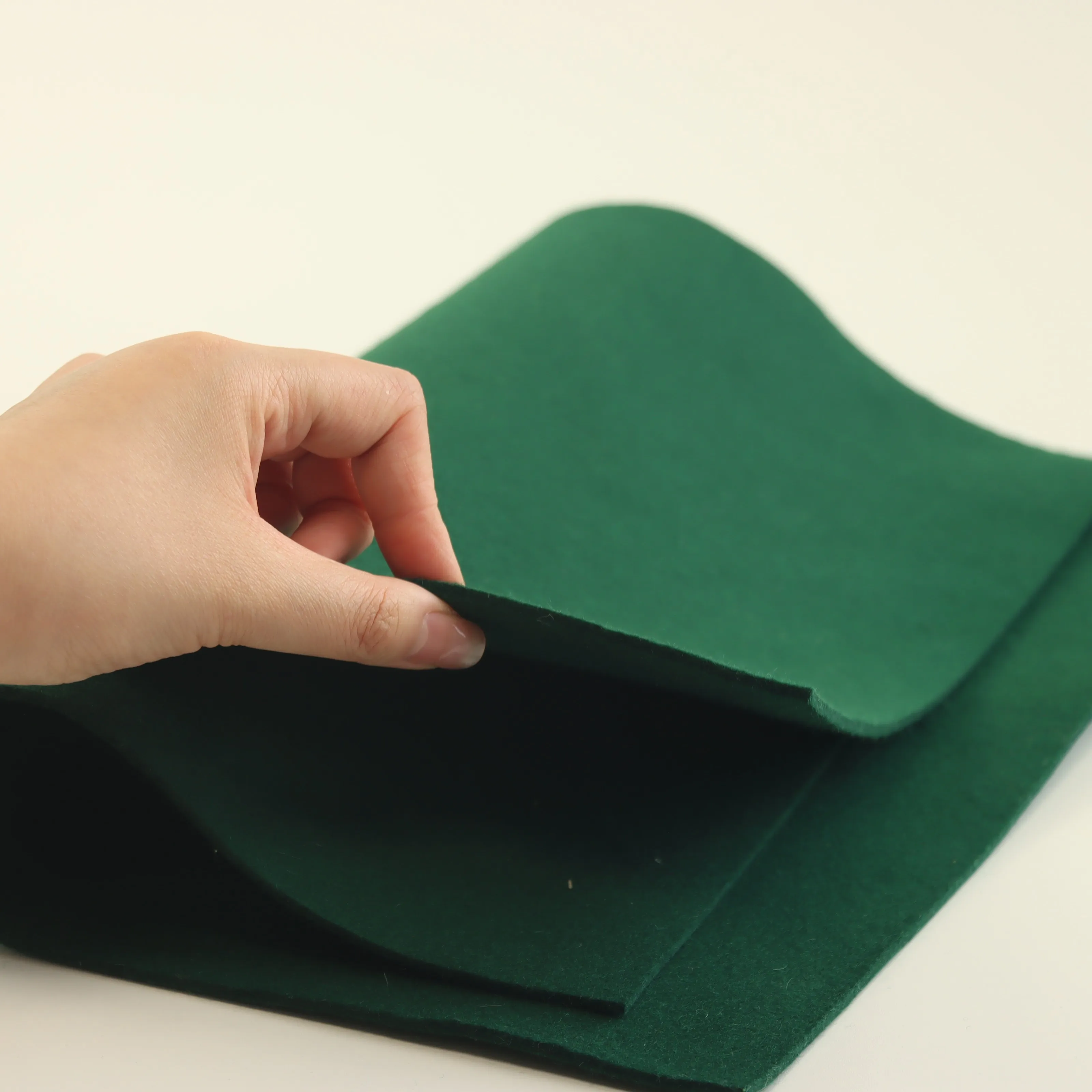
Felt for jewelry display, measured against the usual alternatives
Most jewellery display decisions come down to four materials: felt, velvet, suede and foam. Each is right for something, and the honest comparison is not about which is “best” but about which failure mode you can live with. The table below is the one we use in customer reviews.
| Material | Body & hold | Surface protection | Shedding | Colour control | Lifespan in a case | Best used for |
|---|---|---|---|---|---|---|
| Merino wool felt | High — tuneable density, holds a fold | High — no abrasive hand at fine micron | Very low when fulled | Good — dye to Pantone, tight batch control | 5–10 years | Trays, ring slots, box lining, watch cushions |
| Needle-punched polyester felt | Medium — springs back unevenly | Medium — coarser fibre, can haze a polish | High at cut edges | Good, but colour can shift under heat | 2–4 years | Structural padding behind a visible layer |
| Velvet | None — a surface, needs a substrate | High when new | Low until the pile flattens | Good | 2–3 years before pile crush | Lids, back panels, visual depth |
| Suede / microsuede | Low — stretches and creases | High initially, becomes polished and slick | Low | Moderate — hard to match across lots | 3–5 years | Drawer lining in premium cases |
| PU / EVA foam | High but takes a set | Low — open cells trap dust | None, but crumbles with age | Limited palette | 1–3 years | Structural core under a felt or velvet skin |
| Flocked plastic insert | Rigid, precise | Medium — flock fibres flatten | Medium | Limited | 3–5 years | High-volume, low-cost trays |
The practical conclusion most brands reach is a hybrid: a structural core for geometry, and a jewelry box lining of fine felt where the piece actually touches. That is why merino wool felt shows up in the expensive half of the display even when the box itself is modest — the contact surface is where the perceived quality lives. It is also why felt for jewelry display is almost always specified as an insert or a lining panel rather than as the whole structure.
Will a wool lining tarnish silver? The answer is more specific than yes or no
This is the question a serious buyer asks, and it deserves a straight answer rather than a reassurance.
Silver tarnish is a chemical film, mainly silver sulfide, formed when silver meets sulfur-bearing gases in the presence of humidity and, often, chlorides. Any enclosed cavity accumulates those gases. The lining is the largest surface in that cavity, so its chemistry matters. Wool is a protein fibre and contains sulfur-bearing amino acids in its keratin — which is exactly why conservation literature treats wool with some caution around polished silver and copper alloys. The fibre is not “safe by default”; the assembly has to be designed.
Three controls do the work in practice, and together they are what an anti-tarnish felt system actually means:
- Neutral chemistry. Specify pH 6.5–7.5 and no residual acid from dyeing or carbonising. An acidic felt accelerates attack on silver and on plated finishes. Ask for the pH of the finished lot, not of the raw fibre.
- No sulfur-bearing auxiliaries. Some dyestuffs and finishing agents carry sulfur. A simple declaration of “no sulfur-containing auxiliaries” plus a test report closes this off far more reliably than a verbal assurance.
- A barrier or an inhibitor. For silver-heavy lines, the practical answer is a tarnish-inhibiting interlayer or a sealed pouch, with the felt providing the physical cushion rather than the atmosphere. An anti-tarnish felt system — felt plus inhibitor — outperforms either element alone.
For gold, platinum, diamonds and coloured stones, the tarnish pathway is largely irrelevant and the felt’s job is purely mechanical: protect the polish, hold the form, stay clean. For silver, design the cavity, not just the material. If a supplier cannot tell you the pH and whether sulfur auxiliaries are present, that is the answer to a different question — whether they have tested it at all. Background on the chemistry is documented in the tarnish literature.
The specification sheet that prevents all six failures
Below are the ranges we work to for felt for jewelry display — the sheet, and the jewelry tray built from it. They are starting points based on contact applications, not a standard — validate them against your own drop test, your own lighting and your own climate before locking a purchase order.
| Parameter | Tray insert | Box / drawer lining | Why it matters |
|---|---|---|---|
| Thickness | 1.5–2.0 mm | 1.0–1.5 mm | Too thin reads cheap at the fold; too thick lifts the lid |
| Density | 0.22–0.30 g/cm³ | 0.18–0.25 g/cm³ | Governs compression set and how the slot closes on a band |
| Weight | 330–600 g/m² | 180–380 g/m² | The number most suppliers quote; convert, do not assume |
| Fibre | 100% merino, ≤23 µm mean diameter | Below the prick threshold; lower scratch risk | |
| pH of finished felt | 6.5–7.5 | Acidic residue attacks silver and plating | |
| Colourfastness to rubbing | Grade ≥4 (ISO 105-X12) | Predicts dye transfer onto a piece | |
| Lightfastness | Grade ≥4 (ISO 105-B02) | Case lighting is on 12 hours a day | |
| Shedding | No visible fibre on black glass after 50 rubs | The test that predicts complaints | |
| Compression recovery | ≥90% after 24 h at 10% compression | Prevents permanent dents under a ring | |
| Flammability | Self-extinguishing | Wool’s natural advantage in commercial interiors | |
Two of these are worth insisting on. Shedding is the only spec that predicts the most common customer complaint, and almost no supplier measures it — the test is simply a felt sample rubbed fifty times on black glass under weight, then inspected. pH is the only spec that predicts tarnish, and it costs a supplier about a minute to test. A felt that passes the shedding test is, in practice, a lint-free felt — the two specifications describe the same behaviour from opposite directions.
When you move from flat lining to shaped parts — ring slots, watch cushions, necklace grooves — the specification has to travel with the die-cut felt inserts as well: same lot, same density, same colour, cut from the same direction of the roll so the grain and shade match across a tray. For silver lines the anti-tarnish answer has to live in the part as well as in the sheet: same lot, same pH, same declaration.
Cutting, wrapping and assembly: where good felt goes wrong
A correct material can still produce a poor tray. These are the assembly variables that decide the finished result, and they are worth confirming with any converter before tooling is committed.
Cut method changes the edge — and the edge is visible
Steel-rule die cutting is the default for volume: fast, repeatable, and it produces a clean compressed edge on felt at roughly ±0.5 mm. Laser cutting holds tighter geometry but carbonises the wool at the cut line, leaving a dark, slightly odorous edge that is unacceptable on a light-coloured lining. Waterjet avoids the char but needs a drying step and can leave a stiffer edge. For visible felt inserts, die cutting is usually the right answer; for prototypes, CNC knife cutting gives you the geometry without tooling cost. The edge is also where a lint-free felt stops being lint-free — a dull die crushes the fibre instead of severing it, and the crushed line releases short fibre for the life of the part. Ask how often the die is sharpened.
Corners and radii
Felt will not wrap a sharp inside corner without lifting. A minimum inside radius of about 1.5× the material thickness keeps the wrap tight and prevents the tell-tale pale line where the fibre has been stretched. Where two panels meet, a 45° mitre hides the seam; a butt joint on 2 mm felt is visible from arm’s length.
Adhesive choice
Double-sided tape is the default for trays because it allows rework. Spray adhesive is faster but migrates through thin felt and can stain light colours over time. Hot-melt gives the strongest bond and the worst disassembly. For a box lid that will be closed thousands of times, tape plus a mechanical return at the edge outlasts adhesive alone.
Pocket depth and tolerance stack
The most common assembly failure is arithmetic: lid thickness plus felt plus adhesive plus clearance exceeds the box depth, and the lid sits proud. Build the tolerance stack before the box is tooled, not after. As a rule, allow 0.3–0.5 mm of compression in the felt at the closing face — enough to give a soft close, not enough to strain the hinge.
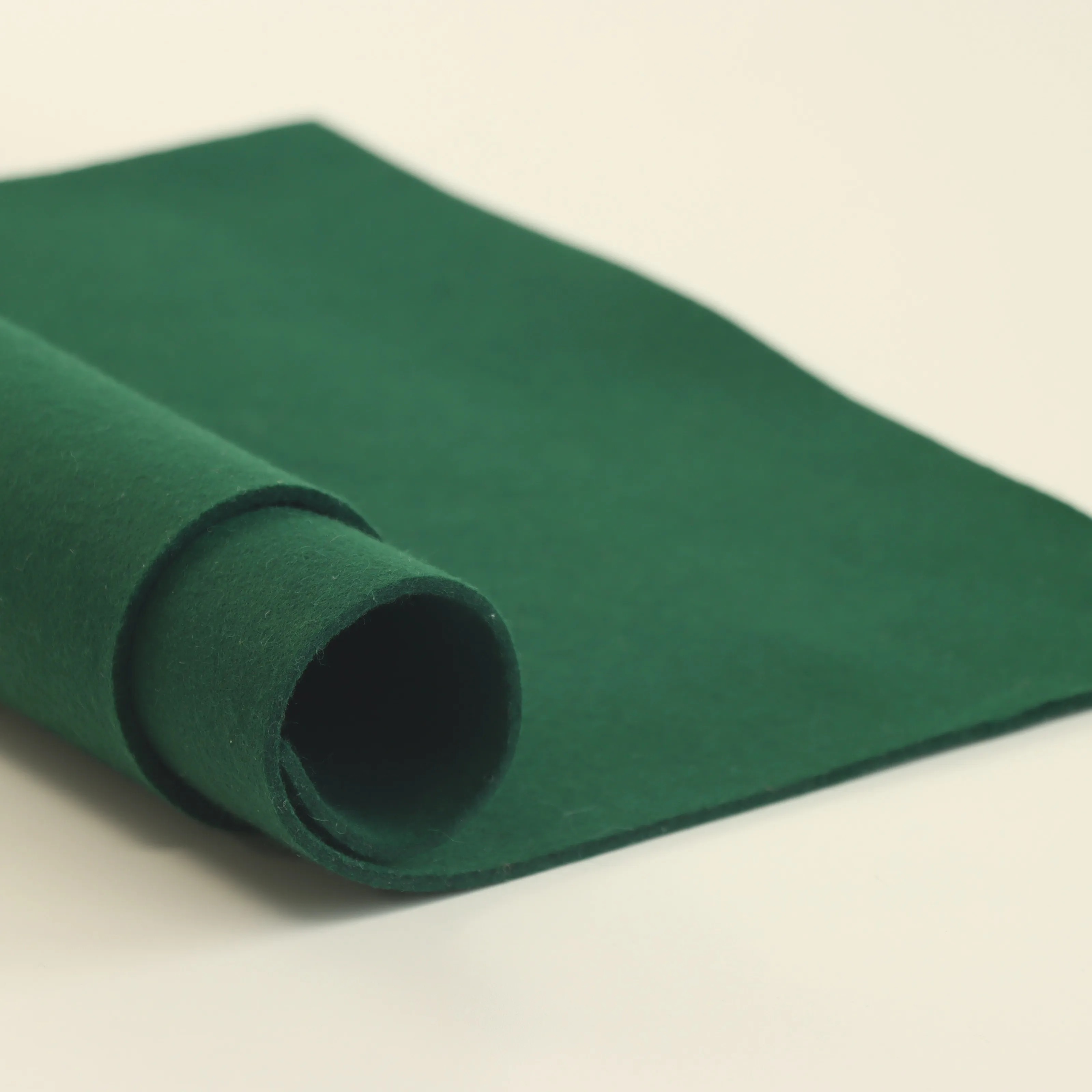
Colour is a specification, not a preference
In jewellery retail, colour is the first thing judged and the last thing controlled. A jewelry box lining is approved from a swatch under office lighting, then produced months later under factory lighting, then displayed under 3000K retail spots. Three different light sources, one supposed colour.
The fix is procedural. Approve colour against a physical standard — a Pantone TCX chip or a signed retained sample — and set a measured tolerance, typically ΔE ≤ 1.5 against that standard, with the measurement method named. Ask for a lab dip before bulk, and keep the approved dip as the reference for every subsequent lot. This is ordinary practice in textile supply; it is unusual in packaging supply, which is why so many brands discover drift only when two production runs sit on the same shelf.
Two further points separate a stable colour from a fragile one. Lightfastness matters more than most buyers expect, because display pieces sit under continuous illumination and a deep emerald is the first to fade. Wet and dry rub fastness predicts transfer onto a piece — and transfer onto a white gold shank is invisible until the customer opens the box at home.
Where the fibre is sourced responsibly, that too can be documented rather than asserted. Fine merino is a traceable fibre; standards such as the Responsible Wool Standard exist precisely so that an animal-welfare and land-management claim can be verified through the chain rather than taken on trust. For brands with an ESG statement in their packaging brief, that documentation is worth requesting at the sampling stage, not after the purchase order.
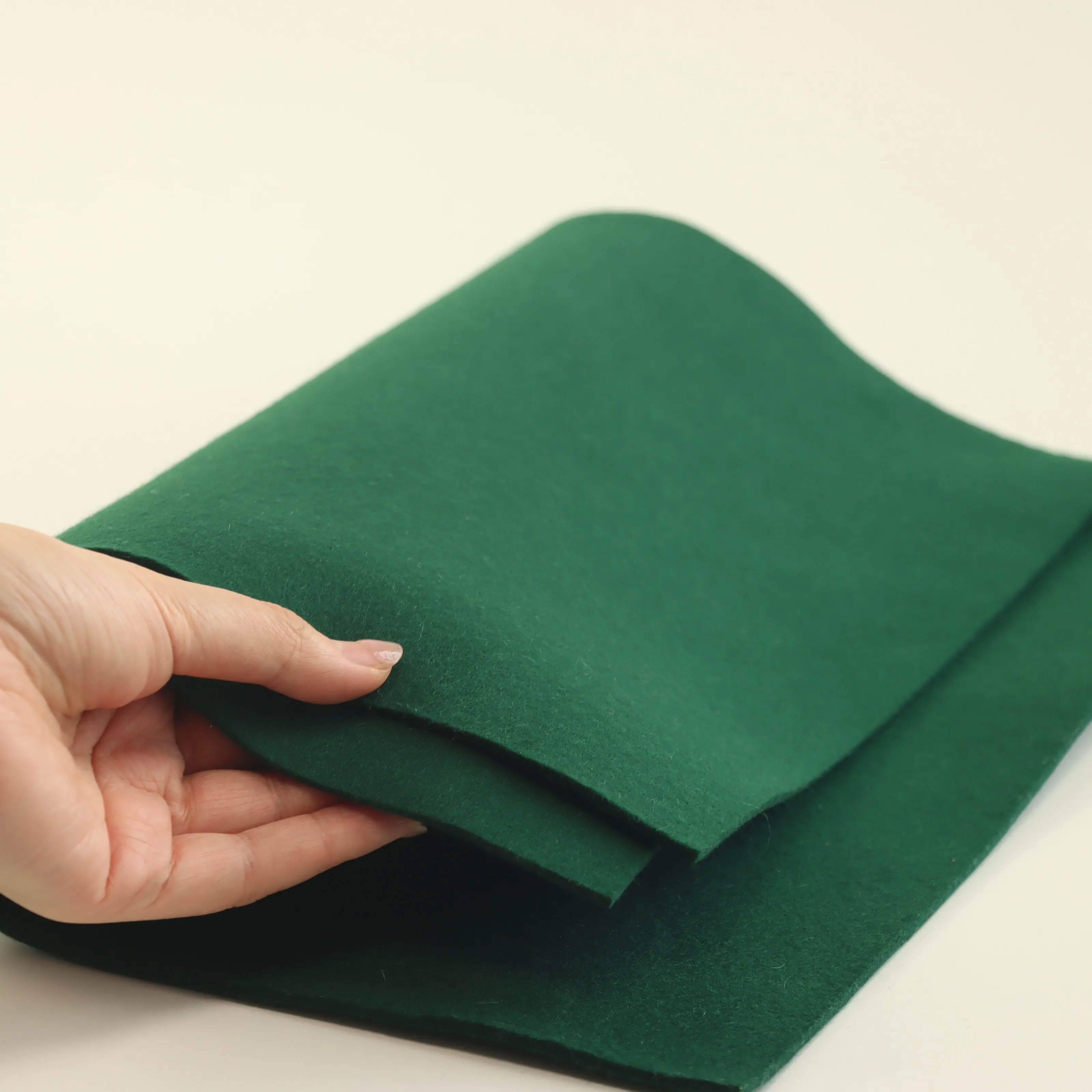
Ten questions to ask any felt supplier before you tool a tray
This list works on us as well as on anyone else. It is the same list we hand to buyers who are choosing felt for jewelry display for the first time. If a supplier cannot answer six of these ten in writing, the sample you are holding is not evidence of what the production run will be.
- 01 — Fibre. Is it 100% wool, and what is the mean fibre diameter? “Merino” without a micron figure is a marketing word.
- 02 — Construction. Wet-felted or needle-punched? If needled, is there a bicomponent or resin binder, and at what percentage?
- 03 — Density and weight. Both numbers, in g/cm³ and g/m², with the tolerance band.
- 04 — Thickness tolerance. Measured under what load? Felt thickness without a stated load is not a number.
- 05 — pH of the finished lot. Not the fibre — the finished, dyed felt.
- 06 — Colourfastness. Rub fastness and lightfastness grades, with the test method named.
- 07 — Shedding. Has anyone rubbed it on black glass? What did they see?
- 08 — Sulfur and auxiliaries. Any sulfur-bearing dye or finishing agent that could affect silver?
- 09 — Batch consistency. Can you hold a retained sample and match future lots to it, at what ΔE?
- 10 — Cut capability. Die cutting, CNC knife, or laser? For lint-free wool felt parts, what is the achievable tolerance and the minimum radius?
Question nine is the one that separates a mill from a trader. Anyone can ship a beautiful sample; only a controlled process can ship the same sample again in eight months.
What we make, and why jewellery brands buy it in volume
Rolking produces merino wool felt from fine merino fibre, supplied as rolls and as finished cut parts for display and packaging. A significant share of our output goes into jewellery presentation — tray inserts, ring slots, drawer lining and box interiors — where the material has to protect a polished surface for years and hold a colour across production runs.
Three things follow from making the felt rather than reselling it. Density is set at fulling, so a 1.5 mm tray base and a 3 mm lid pad can be produced at the densities each one needs instead of compromising on a single grade. Cutting is in-house, so felt inserts arrive to your drawing with the grain direction and shade matched across a set. And colour is matched against a retained standard rather than to a photograph, which is what makes repeat orders possible without a re-approval cycle.
We work with brands at two points: at the sampling stage, where the specification is still open and a material change is cheap; and at the reorder stage, where the incumbent lining has started to shed, yellow at the fold or show dents. Both conversations start the same way — with the application, the piece weight, the climate and the target colour.
Frequently asked
What is merino wool felt, and how is it different from craft felt?
Is wool felt actually suitable for a jewelry box lining?
Will felt scratch polished gold, platinum or a diamond?
Can you supply die-cut felt inserts to my drawing?
How do I tell whether a felt is genuinely lint-free?
Does anti-tarnish felt work, or is it marketing?
Send us the piece, the box, or just the colour
Tell us what the piece weighs, what it is made of, and how the tray closes. We will come back with a felt specification — fibre, density, thickness, colour reference — and a sample cut to your shape. If a different material is the right answer for your application, we will say so.
Post time: Nov-13-2026