
Sauna Water Bottle · Material and Design Guide
Sauna Water Bottle: Is Stainless Steel Actually Worth It?
A hot room is unkind to what you carry into it: plastic goes soft, glass waits for a wet floor, and any cold drink ends up warm. Here is what a steel bottle really changes, what it cannot, and the four parts that decide whether it lasts.
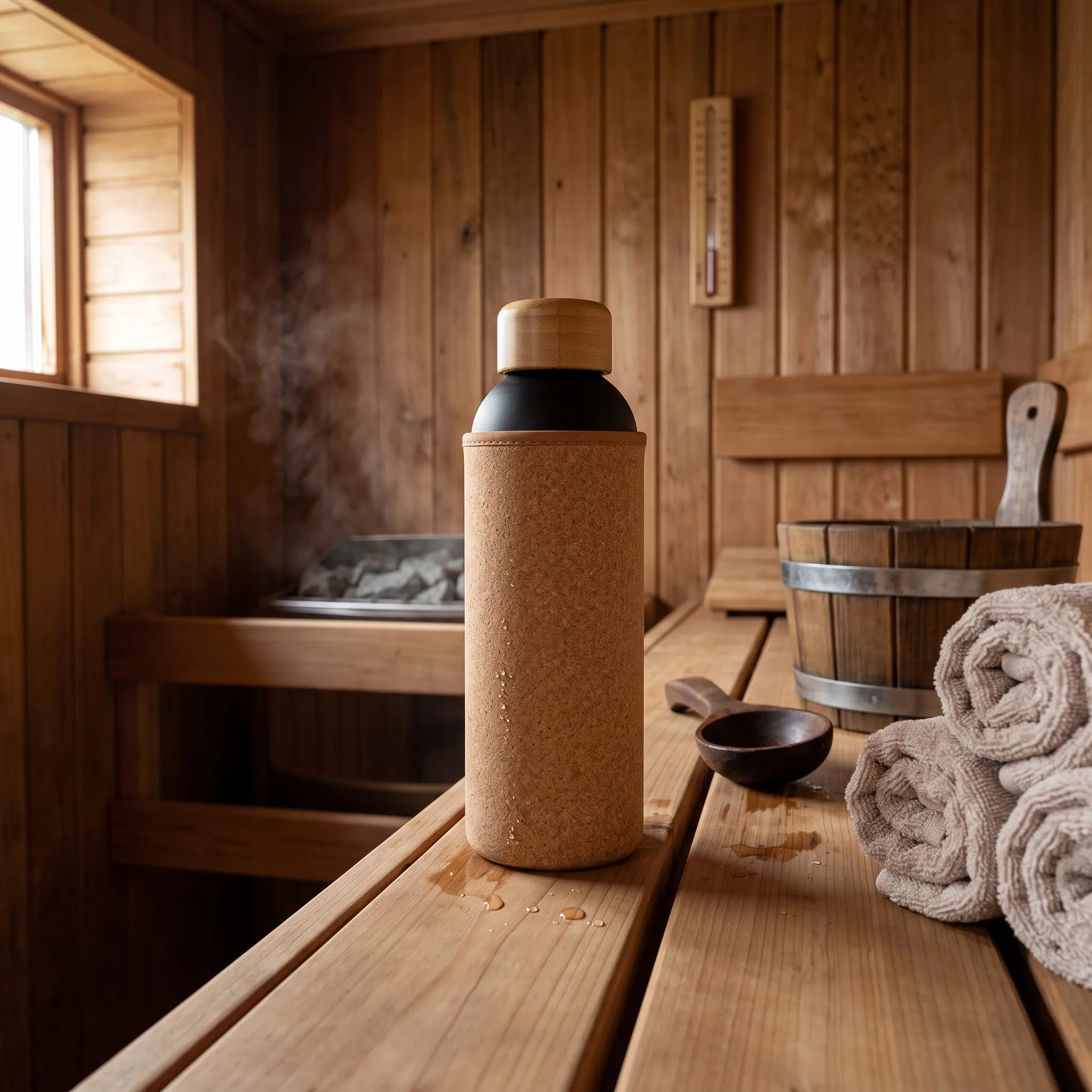
What a hot room does to a bottle
Four things happen at once, and only one of them is about temperature.
The obvious one is heat transfer: the room warms the outside of the bottle, and the bottle warms what is inside. How fast that happens is a property of the wall, not of the drink.
The second is condensation. A bottle that is colder than the room collects moisture on its shell within minutes — you can see it in the photograph above, beads running down the cork. That water goes two ways: onto your hands, and onto the bench you set the bottle down on. A wet steel cylinder on a wet wooden bench is a dropped bottle waiting to happen, which is the quiet argument for a sleeve.
The third is pressure. A sealed bottle holding anything warm, or anything carbonated, builds pressure as the contents heat. The cap holds it, the thread takes the load, and whoever opens it next finds out how much.
The fourth is the least discussed: a sauna is a hard environment for objects. Benches are wet, floors are tiled, and things get set down in a hurry. Whatever you bring in has to survive being knocked over.
Plastic, glass, ceramic, steel
People carry all four into a sauna. Three of them are the wrong tool, and the reasons are different.
| Material | In a hot room | If it is knocked onto wet tile | Verdict |
|---|---|---|---|
| Disposable PET | Softens as it warms; the cap thread is the first part to give trouble | Splits or skids; the cap comes off and the rest empties | Fine on a walk, wrong in a hot room |
| Reusable plastic | Holds its shape, insulates nothing | Cracks at the base after enough knocks | Cheap, but it is not an insulator |
| Glass | No insulation at all: the outside mirrors the room | Shatters, and the shards are invisible on a wet floor | The one material to keep out |
| Ceramic | Holds heat well, which means it becomes too hot to hold | Chips, then cracks along the chip | A water scoop, not a bottle |
| Stainless steel | The wall slows heat transfer; the shell stays close to room temperature | Dents and keeps holding water | The only one designed for this |
The glass row is the one worth reading twice. A sauna floor is wet, tiled and often stepped on in the dark; a dropped glass bottle does not fail gracefully. If a venue supplies bottles to guests, this is a liability question before it is a design question.
What double-wall steel changes
Steel on its own is not insulation — a single-wall bottle behaves like glass, with the outside matching whatever is inside. The insulation comes from the gap between two walls.
A vacuum between the walls removes the air that would carry heat across, so heat has to arrive by radiation and through the neck. The practical result in a sauna is threefold: the shell stays near room temperature, so you can pick it up with a bare hand; the drink warms slowly rather than immediately; and condensation forms on the outside instead of the inside, where a cork or felt sleeve can deal with it.
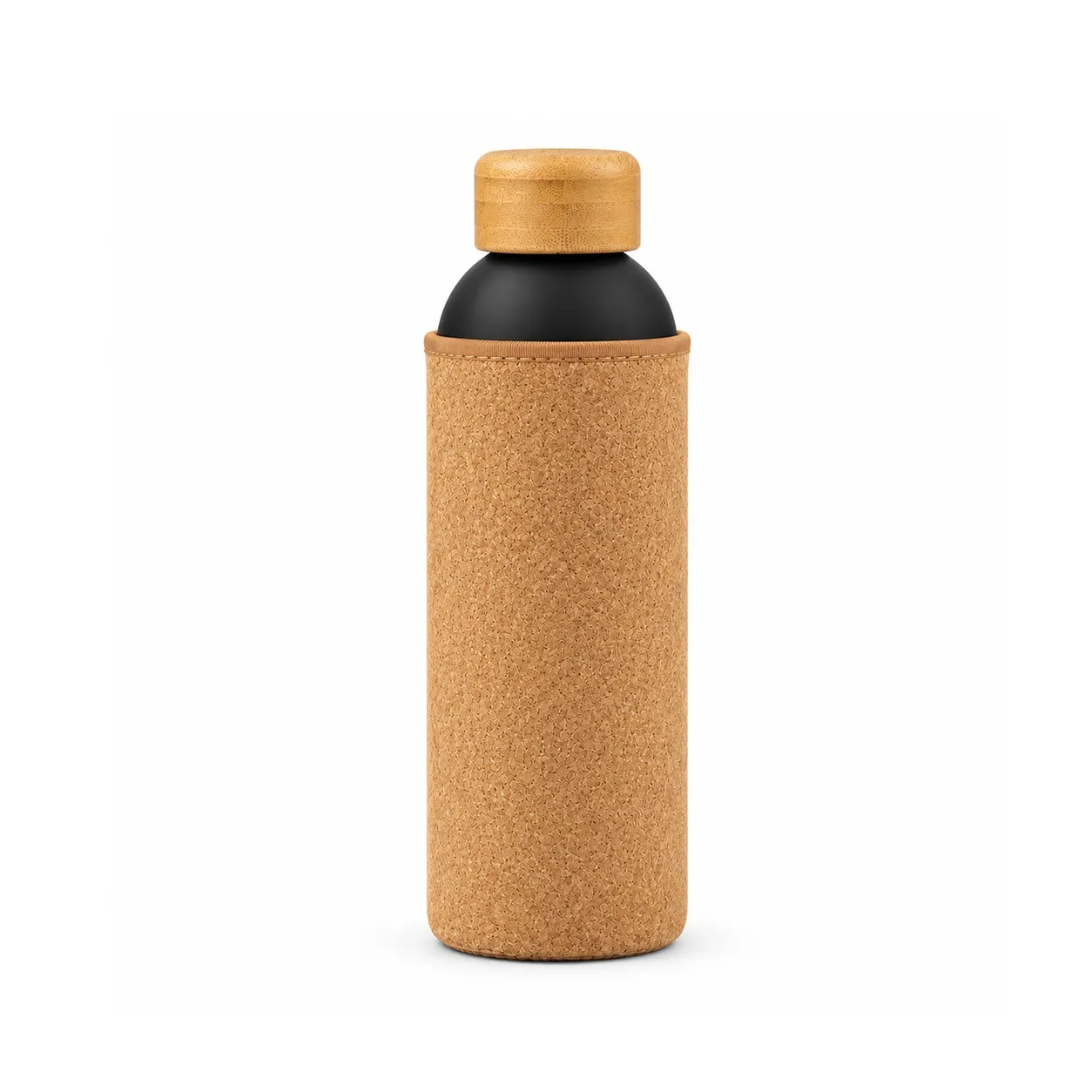
What it does not change: the room wins in the end. A vacuum slows heat transfer, it does not stop it, and a bottle left on a bench for a whole session will end up warm like everything else. Sell it as a bottle that is still pleasant after the first round, not as a thermos that ignores the room.
Confirm before you quote. Single-wall or vacuum-sealed? A photograph cannot tell you, and the difference in cost and performance is large. Ask the factory for the construction and, if it is vacuum, for the wall thicknesses.
The four parts that decide the outcome
On a steel bottle the body is rarely the part that disappoints a buyer. These are.
| Part | Why it decides the outcome | What to put in the spec |
|---|---|---|
| Cap and gasket | The only place where heat, pressure and handling meet. Every “it leaks” complaint starts here. | Cap material, gasket material, vented or sealed, thread engagement |
| Sleeve | Grip when the shell is wet, protection for the coating, and the part guests touch first. | Cork, felt or silicone; coverage height; bonded or replaceable |
| Mouth | A narrow mouth is slow to drink from and hard to clean; a wide mouth takes ice and a brush. | Inner diameter, thread type, whether it accepts standard ice cubes |
| Base and coating | The base takes every knock, and the coating ring is where a matte finish first looks tired. | Coating type, base ring, whether a silicone boot is offered |
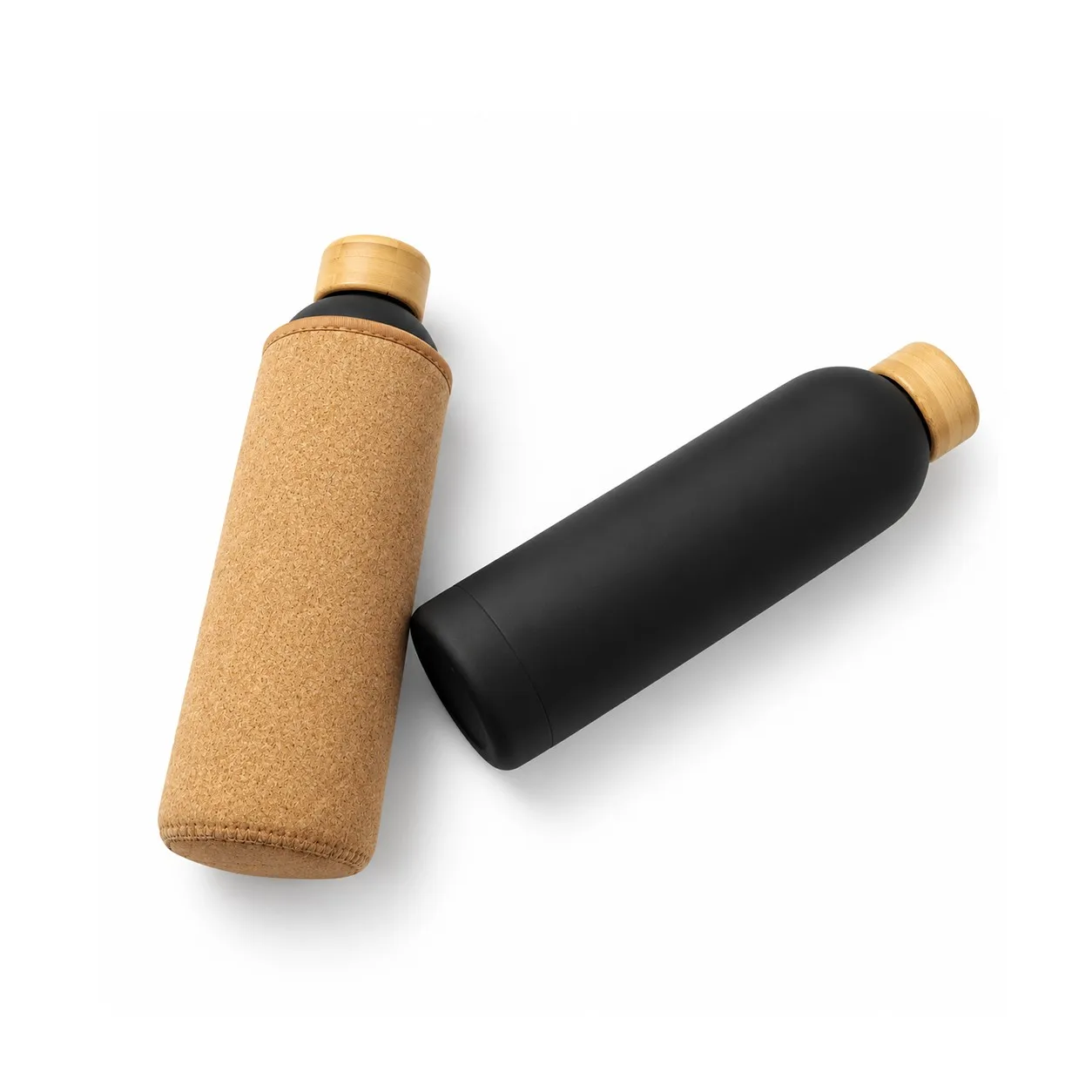
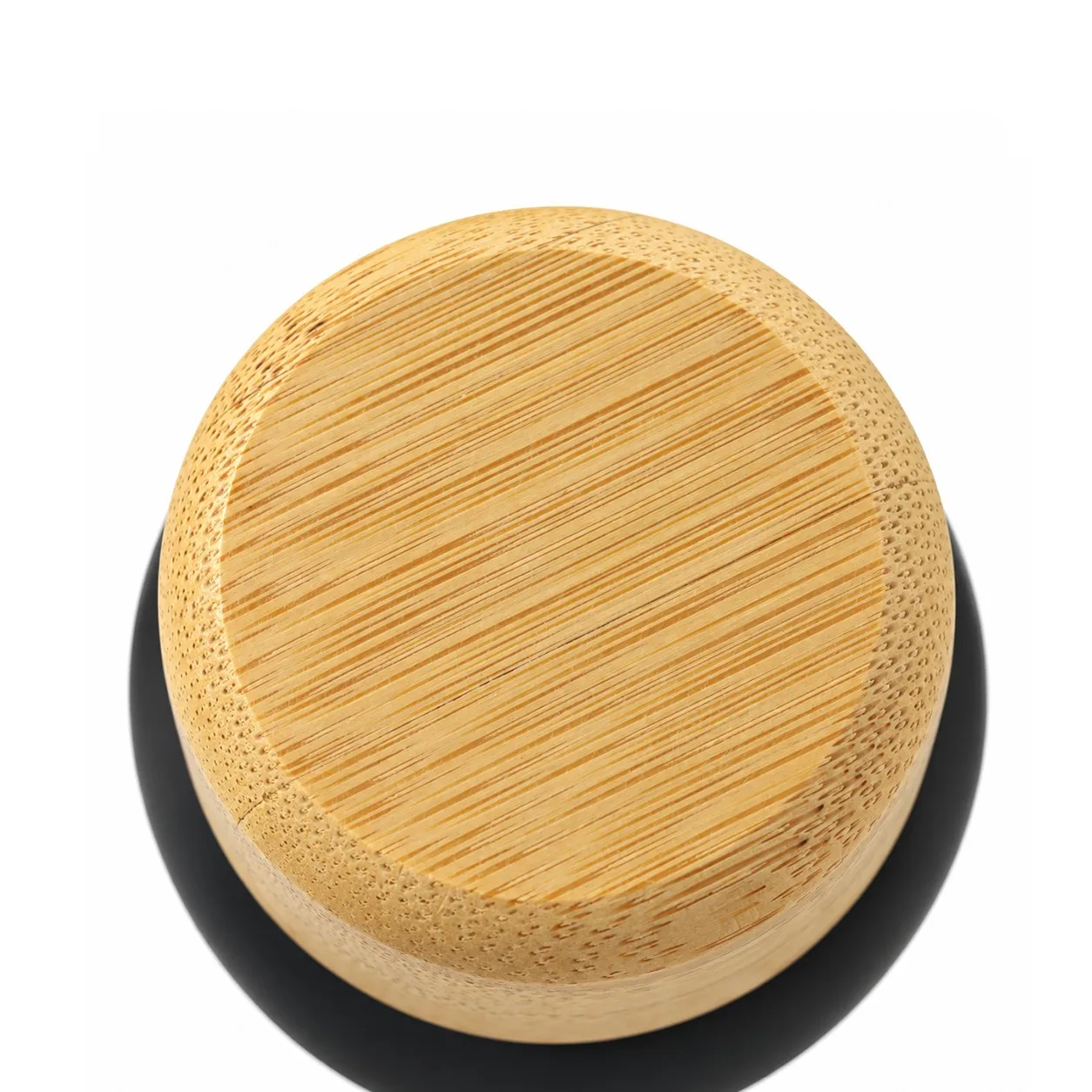
The bamboo cap deserves its own line because it is the most attractive part and the least stable one. Wood and bamboo take on moisture and swell; a cap that fits perfectly in a dry showroom can become stiff in a steam room, and a gasket that was snug in winter can weep in summer. That is not a reason to avoid it — it is a reason to specify the gasket material and to test the cap after a week in a humid room, not on the day it arrives.
Where a steel bottle stops being the answer
Four honest limits, all of which a buyer will discover in the first month if the sales sheet does not mention them.
- It is heavy. Steel plus a sleeve weighs more than any plastic bottle of the same volume. For a hotel shipping hundreds of units, that is freight; for a guest carrying it to the sauna, it is a decision about whether they take it at all.
- It does not cheat the room. A vacuum slows warming; it does not stop it. Anyone promising an ice-cold drink at the end of a long session is describing a different product.
- Hot fill and a sealed cap are a bad pair. Warm contents, a tight seal and a hot room build pressure. Either the cap vents, or the drink goes in cold, or the cap stays loose until it cools.
- It does not make anyone drink. Hydration in a sauna is a habit. A good bottle makes the habit easier because the water is still pleasant; it cannot replace the habit.
Care: what actually ruins one
Not the heat. The three things that end a bottle’s life are a dent that breaks the vacuum, a dishwasher cycle on a printed finish, and a cap left sealed with something sweet inside.
| Do | Do not |
|---|---|
| Hand wash warm with mild soap and a bottle brush | Run a printed or powder-coated body through a hot dishwasher cycle |
| Dry with the cap off, and store it open | Seal it away wet, or leave coffee or juice in it overnight |
| Treat a dent as the end of the insulation | Assume a dented bottle still holds temperature: the vacuum is gone |
| Rinse the gasket and let it air dry separately | Boil the cap, or soak a bamboo cap in water |
A dent is worth explaining to end users, because it is counter-intuitive: the bottle still holds water perfectly, so it looks fine, and it has quietly stopped insulating. Once the vacuum gap is breached, what is left is a steel tube with a nice finish.
How it gets used, in four settings
The same bottle behaves differently depending on who is holding it, and the spec should follow the setting rather than the catalogue.
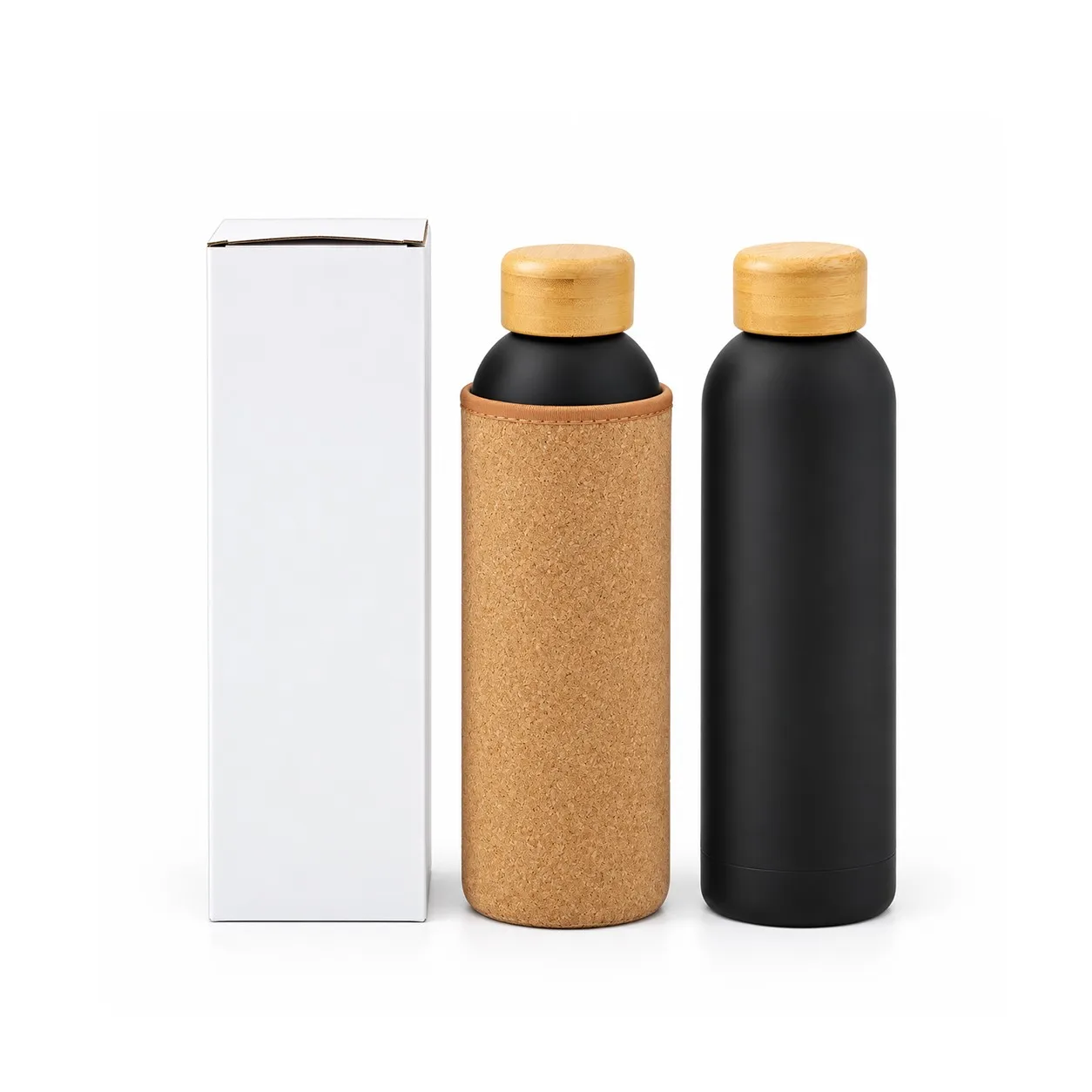
| Setting | What the bottle is doing there | What to watch |
|---|---|---|
| Home sauna | Keeps a cold drink within reach so people actually drink between rounds | A wide base tips less on a bench; a narrow mouth is slower to drink from when hot |
| Spa and wellness centre | A branded object on the bench that a guest takes home | Print durability, replacement cost, and whether the sleeve can be swapped per season |
| Hotel sauna | An amenity that sits with the robe and the towel | Loss rate, packaging that survives courier handling, consistent logo across reorders |
| Gym with sauna | Carries electrolyte or juice drinks as well as water | Steel grade and interior finish, cap hygiene, and how the gasket is cleaned |
Questions buyers ask
Will the drink stay cold inside a hot sauna?
It stays cooler than the room for a while, and longer than it would in a plastic bottle, because the vacuum layer slows heat coming in from the outside. It will not stay cold through a long session: the room is the heat source and it wins eventually. Plan on a bottle that is still pleasant after the first round, not after the third.
Can I put hot water in a steel sauna bottle?
Only if the body is rated for hot filling, and never sealed tight while hot. Warm contents plus a sealed cap plus a hot room is how people end up unable to open a bottle, or wearing what was inside it. Leave the cap loose until it cools, or specify a vented cap.
Why does the outside of the bottle get wet?
Condensation. The outer wall sits close to room temperature, so moisture in the sauna air condenses on it. That is also why a sleeve matters: a wet steel body is slippery, and a sauna bench is not a stable surface.
Is stainless steel safe for coffee, juice or electrolyte drinks?
It depends on the grade and the liner, so ask for both plus a food-contact declaration. Acidic and salty drinks are the ones that punish a cheap interior, and they are also the drinks people carry into a gym sauna. Do not assume every bottle on the market uses the same steel.
Can it go in the dishwasher?
Check the coating before you promise that to a customer. A powder-coated or printed body survives hand washing for years and a dishwasher for months; the finish goes first, then the print, then the base ring.
Can we put our logo on a steel bottle?
Four methods work and they age differently: laser engraving on powder coat is permanent and monochrome; screen print is crisp but can chip at the edges; a printed or branded cork sleeve is replaceable; a small metal plate reads as premium and costs the most.
Next step
Send the setting, not just the picture
The same bottle is a different product for a home sauna, a spa amenity and a gym. Tell us where it will be used and what it has to survive, and we will come back with a construction — or say plainly when steel is not the right answer.
Worth including
- Setting home, spa, hotel amenity, gym
- Capacity in ml, and whether one size or a range
- Construction single-wall or vacuum, and the steel grade
- Finish coating colour, cap material, sleeve option
- Branding laser, screen print, sleeve print or plate
- Volume first run quantity, packaging, target landed cost
Post time: Oct-30-2026