
Felt Table Mats: How Thick a Mat Needs to Be to Protect the Table
A table mat is bought for one reason and kept for another. It is bought to stop a hot dish marking the table, and it is kept because it also stops the plate scratching the finish, stops the cutlery making that hard click, and looks better than the plastic it replaced. Felt does three of those four jobs unusually well and the fourth only up to a point, and the difference between a mat that works and a mat that gets returned is almost always a number in millimetres rather than a choice of colour.
This is written from the mill side, for the buyer or product developer who has to specify the mat rather than admire it. It sets out what felt genuinely does under heat, what the alternatives do better, and which specifications decide whether the mat survives its first year on a table.
01 HeatHeat: what felt slows and what it does not stop
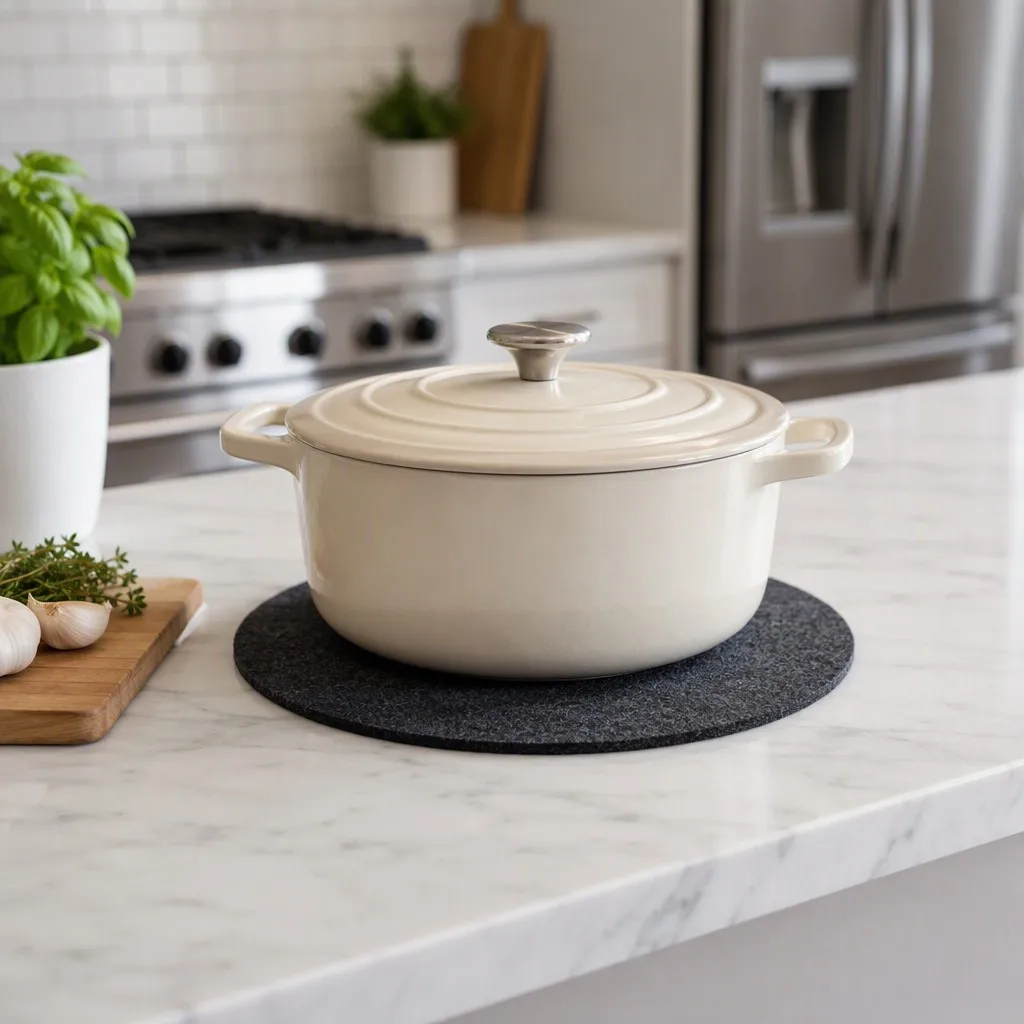
Felt is a fibrous insulator. Wool and polyester fibres both trap air between them, and still air is a poor conductor, so a felt mat of any reasonable caliper will slow the transfer of heat from a dish to the table. That is why a felt coaster under a mug works, and why a felt mat under a warm serving dish is genuinely useful.
What felt does not do is block heat. It is a resistance, not a barrier. A pan taken straight off a hob and set on a 3 mm mat is still feeding heat into the surface beneath it, and the temperature under the mat will keep climbing for as long as the pan stays there. Whether that matters depends on the finish: an oiled or waxed wood can blush and take a permanent pale ring at a temperature a lacquered surface would shrug off, and a veneered top can lift at the joint. The failure is not the mat melting; it is the table changing colour under it.
The variables that actually govern this are caliper and density, and they are not interchangeable. Heat has to travel through the mat’s thickness, so doubling the caliper roughly halves the rate of transfer, all else equal. Density matters differently: a dense felt has less trapped air per millimetre, so a heavy 5 mm mat can conduct more than a lighter 6 mm one. This is why “5 mm felt” on its own is not a specification — two mats at 5 mm from two mills can perform quite differently under the same pan.
The honest way to settle it is to measure rather than argue. Put a pan at service temperature on the mat, put an infrared thermometer on the table surface beside it, and read the underside temperature at one, three and five minutes. Do it at two calipers and pick the one that keeps the surface below the temperature at which your finish marks. That number, not a claim on a spec sheet, is what belongs in the product brief. Where a mat is sold specifically as a trivet for cookware, a cork layer or a two-layer felt-and-cork construction is the conventional answer, because cork adds a second, different resistance and a physical barrier at the hot face.
02 Grip and noiseThe other three jobs: scratch, noise and grip
Scratch protection is felt’s easiest win. The fibre is softer than lacquer, varnish or stone, so a plate resting on felt cannot abrade the finish the way ceramic on wood can. The caveat is the one that catches everyone: grit. A crumb or a grain of salt trapped between mat and table turns the mat into a lap. Felt also holds dust in its surface, so a mat that is never brushed gradually becomes an abrasive sheet. Mats that are shaken out daily and washed on a cycle last far longer as protection than mats that are only wiped.
Noise is the benefit buyers underestimate and the one hospitality operators notice first. A plate set down on felt lands with a dull sound; the same plate on stone, glass or a hard laminate produces a sharp report that carries across a room. In a restaurant with hard surfaces, forty of those per service is a material contribution to the noise floor, and it is the reason felt mats appear in rooms that could afford anything. If the product is being sold to hospitality, this is worth testing rather than describing: set a plate down on each candidate and listen.
Grip is felt’s weakest job, and it is the one that varies most with the table. Against a matte finish the coefficient of friction is adequate. Against high-gloss lacquer, glass or polished stone it is not, and the mat will migrate as plates are lifted. The fixes are geometric or chemical: a larger diameter, a heavier caliper, a cork backing, or a printed grip layer. Each is defensible, and each should be chosen on purpose because they change washability and the material story.

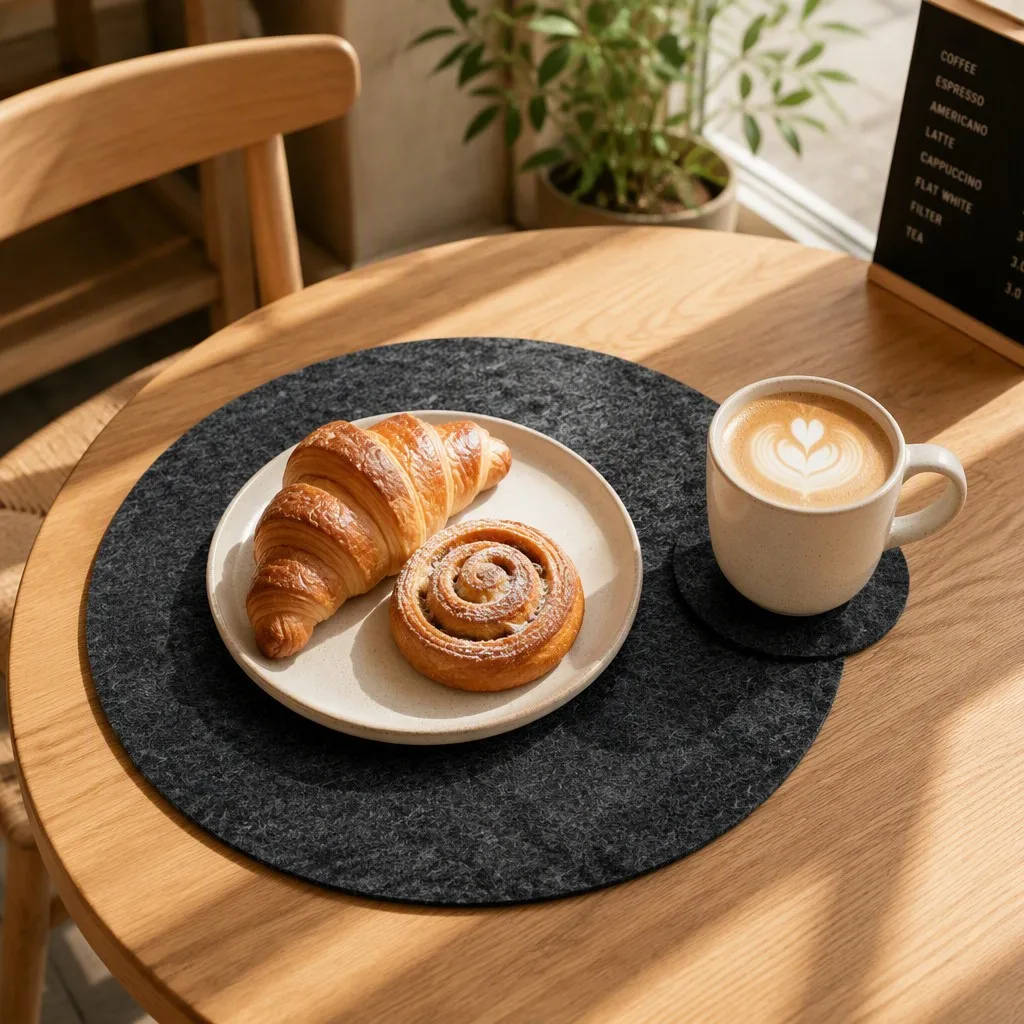
Two rooms, one question: does the mat stay where it is put? The desk mat and the cafe table are the same felt in different company.
03 FibreWool or polyester: two felts, two different products
The word “felt” covers two materials that behave differently enough to be separate products, and a range that mixes them under one care label will generate returns.
Wool felt is dense, warm in the hand, and has a surface that improves with use rather than flattening. It is also dimensionally unstable in hot water: heat, water and agitation make the fibres lock tighter, so a wool mat washed repeatedly at temperature will shrink, thicken and distort. Spot cleaning is fine. Machine washing is not, unless it is cold and gentle, and even then the mat is not the same object after twenty cycles. Against that, wool is a protein fibre, biodegradable, and contains no plastic — which is precisely why some buyers want it.
Polyester felt is dimensionally stable in a warm wash, dries fast, takes colour consistently and tolerates the kind of cleaning a commercial kitchen imposes. Recycled PET versions carry the same practical advantages with a better material story. What it does not have is wool’s hand-feel or its biodegradability, and a buyer who needs a plastic-free claim cannot use it.
The third option is a blend, and blends are where care labels go wrong. A wool-rich blend behaves like wool in a wash; a polyester-rich blend behaves like polyester. The composition has to be stated per colour, because the same range can contain both.
It is a resistance, not a barrier.
Felt table mats · 01 / Heat
04 ComparedThe alternatives compared
Buyers rarely choose between two felts; they choose between felt and four other materials. The table is deliberately blunt about what each one gives up.
| Wool felt | HeatSlows heat well at 4–5 mm; marginal at 3 mm under cookware | GripAdequate on matte, poor on gloss | CleaningSpot clean; shrinks in hot wash | The catchCannot be sold as machine washable; attracts pests in storage |
| PET / recycled felt | HeatSimilar to wool, slightly better under sustained heat at equal density | GripAdequate on matte, poor on gloss | CleaningWarm machine wash, fast dry | The catchSynthetic, even when recycled |
| PVC / vinyl | HeatBlocks heat well, wipes clean | GripGood | CleaningWipe only | The catchPlasticiser migration, restrictions on some phthalates in the EU, and it reads as cheap once the print wears |
| Silicone | HeatHighest continuous heat resistance of the group | GripVery good | CleaningDishwasher safe | The catchNo texture, grabs lint, looks industrial, plastic |
| Cork | HeatGood, and naturally low conductivity | GripGood | CleaningWipe only | The catchCrumbles at the edge, stains permanently, uneven surface |
| Cotton or linen | HeatThin, so almost no heat protection | GripPoor on gloss | CleaningMachine wash, hot | The catchWrinkles, stains, and it is a cloth rather than a mat |
| PU leather | HeatModerate | GripGood | CleaningWipe only | The catchCracks along folds, plastic, and the surface ages visibly |
Read across the rows and the pattern is that the plastic options win on cleaning and lose on material story, cork wins on heat and loses on durability, and felt is the only one that combines heat resistance, silence, softness and a natural fibre story — while losing on grip and on washability. That is the trade. It is not a quality ranking.
05 Hidden specsThe parts of a mat you cannot see in a photograph
Four specifications decide how a mat performs, and none of them is visible in a product image.
Density, expressed as grams per square metre or as thickness under a defined load. It governs both heat transfer and how the mat behaves after a year of plates. A low-density mat at 5 mm compresses to 3 mm under a stack of plates and never fully recovers.
Caliper tolerance, not just nominal caliper. A mat quoted at 5 mm with a wide tolerance will produce a stack that rocks, and a set sold as four will not sit flush.
Edge treatment. Die-cutting gives a clean, slightly fibrous edge and is the cheapest. Laser cutting seals and darkens the rim, which looks precise on light colours and can look burnt on pale ones. A stitched or bound edge is the most durable and the most expensive, and it is the only option that survives commercial use without the rim breaking down.
Flatness after packing. Felt has memory. A mat rolled for freight arrives with a curl and needs a day under weight to relax. Flat packing costs more in volumetric weight and delivers a mat that is usable immediately.
06 The benchHow to judge a sample in an afternoon
Most of this can be settled on a bench with no laboratory.
- ▪ Put a pan at service temperature on the mat and read the surface temperature underneath at one, three and five minutes with an infrared thermometer.
- ▪ Set a plate down on the mat, then on the table, and listen to the difference. If you cannot hear it, the room is not the room you are selling into.
- ▪ Put a plate on the mat and slide it sideways on the actual table finish. If it walks, the mat needs grip, a larger diameter or more weight.
- ▪ Wash one sample the way the customer will wash it, five times, and compare the dimensions and the edge.
- ▪ Rub a dark mat on a white cloth, dry and wet, before approving the shade.
- ▪ Leave a mat in a closed bag for a day and smell it when you open the bag.
- ▪ Stack ten mats and check whether the pile rocks.
If the sample passes those seven, the remaining questions are price and packing. If it fails one, the fix is usually a specification change rather than a different supplier — a heavier caliper, a cork layer, a stitched edge, or a lighter shade.
07 QuestionsFAQ
What thickness should a felt table mat be?+
Around 3 mm works for a mug, a bowl or a decorative placemat. For a dish taken from the oven, or a mat sold as a trivet, 5 mm or a felt-and-cork construction is the sensible starting point — and confirm it by measuring the surface temperature underneath rather than by trusting the nominal caliper.
Does felt protect a table from a hot pan?+
It slows the heat, it does not stop it. A heavy pan left on a thin mat will still warm the surface below. The mat buys time; the table finish decides how much time you need.
Why does a felt mat slide on some tables?+
Because grip depends on the table. Felt holds on matte finishes and moves on gloss, glass and polished stone. Add a grip backing, increase the diameter, or increase the caliper.
Can felt mats be machine washed?+
PET felt can. Wool felt should be spot-cleaned — hot water and agitation make wool felt shrink and thicken permanently.
Is felt quiet enough for a restaurant?+
Yes, and that is often the real reason operators specify it. Felt removes the sharp click of a plate being set down, which is a large part of the noise a hard-surfaced dining room generates.
Do felt mats attract insects in storage?+
Wool is a protein fibre and can be attacked by moths and carpet beetles if goods sit for long periods. Sealed packaging and a pest routine in the warehouse deal with it. PET felt does not have this exposure.
Measure underneath it, then decide
Send the pan temperature, the table finish and the caliper you are considering. We will tell you what to read under the mat at one, three and five minutes, and which of the two felts your cleaning routine actually allows.
Post time: Nov-25-2026